Acoura savona
Half-banded Loach
Formerly Cobitis savona Hamilton, 1822 · Nemacheilus savona Hamilton, 1822 · Noemacheilus savona Hamilton, 1822 · Cobites obscura Swainson, 1839 · Schistura savona
On this page13 sections
Quick facts
Difficulty6 of 8 measures
More bars, more demanding. Hardiness is not averaged with the rest.
- Space
- modest tank
- Water
- tap water
- Temp
- unfussy
- Diet
- unknown
- Temperament
- unknown
- Social
- shoal
- Compatibility
- not a community fish
Hardiness on its own can raise the rating, whatever the measures above say.
- Hardiness
- wants a mature tank
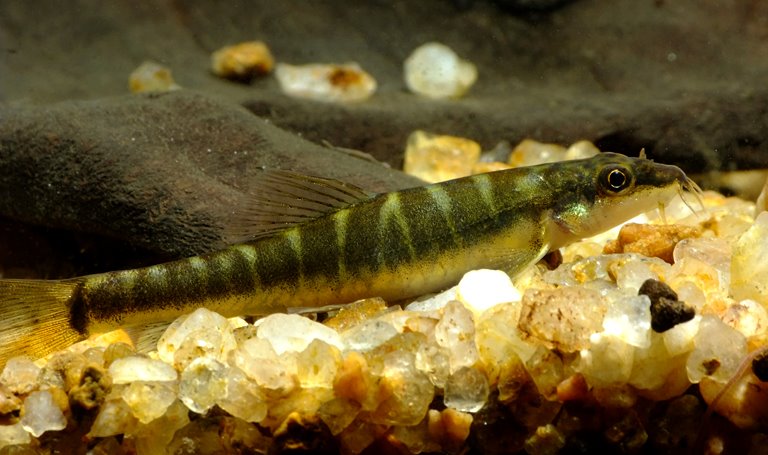
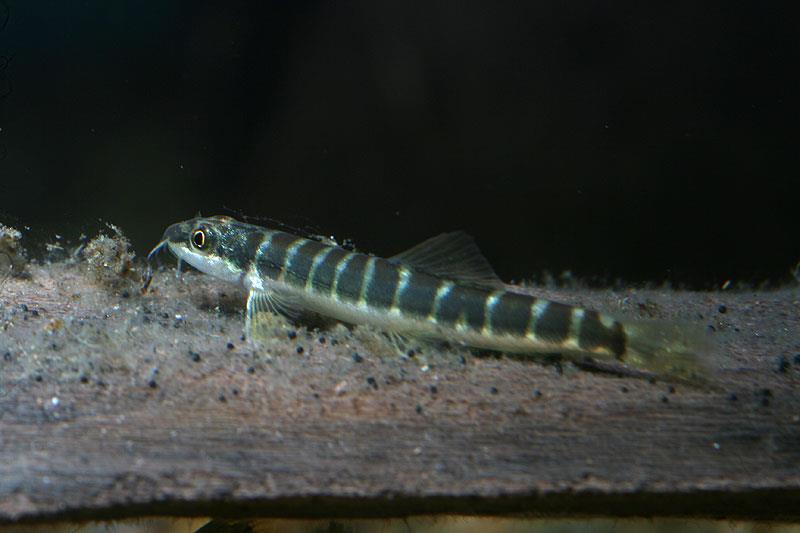
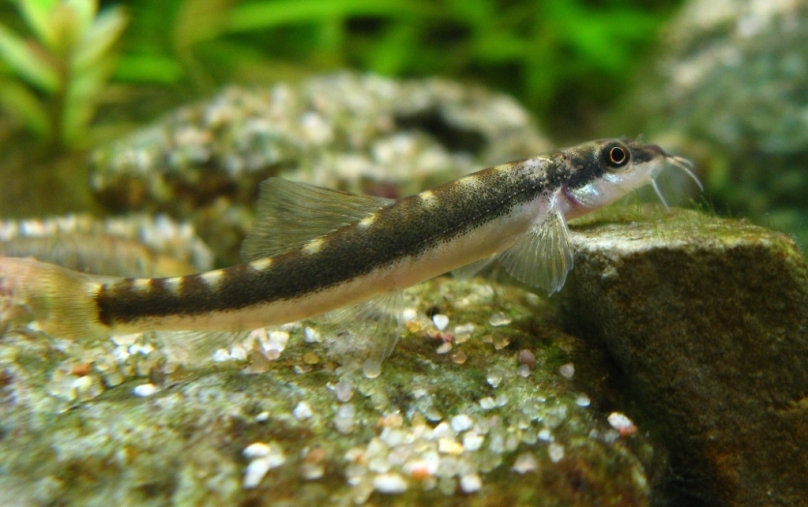
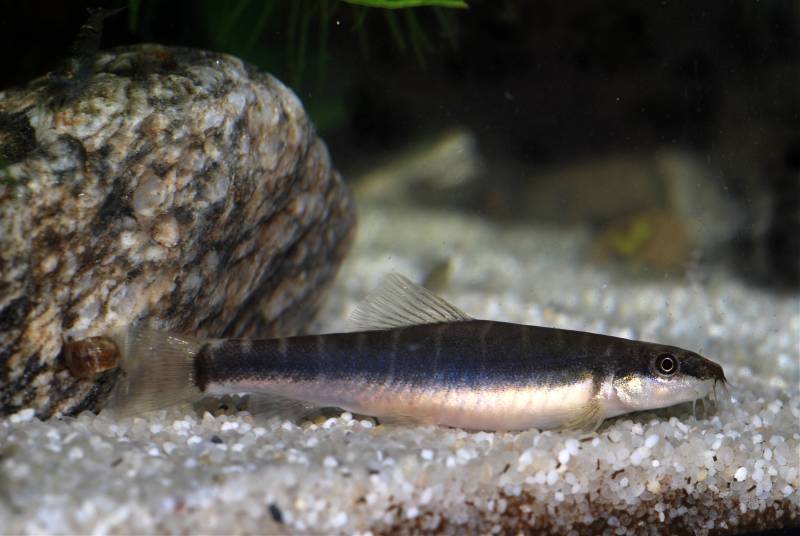
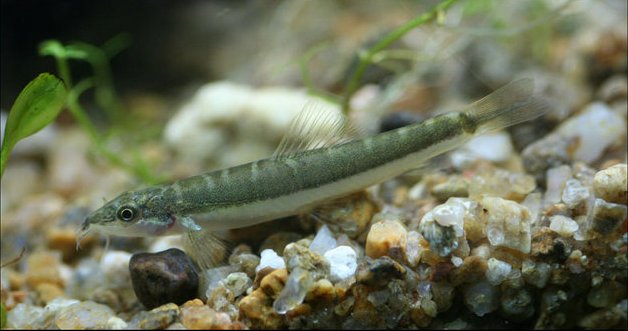
The half-banded loach, Acoura savona, is a nemacheilid loach from Ganges tributaries draining the eastern Himalayas in India, Nepal and Bangladesh. The species is seen in the trade fairly often and is sometimes sold as 'bicolor loach' in the United States. Its colour pattern of 9-10 thin, yellowish bars on a dark upper body, with plain whitish lower parts, separates it from similar loaches, and it is among the less aggressive of them.
Etymology
Acoura: Swainson did not explain the name. It perhaps comes from the Greek akros, meaning 'tip' or 'at the end', and oura, meaning 'tail'. He proposed it for loaches with a lobed rather than truncate or rounded caudal fin.
savona: appears to have been named in reference to a local vernacular name 'Savon khorka'.
Distribution
The type series was collected from the Kosi River at Nathpur, Uttar Pradesh state, northern India. The Kosi (aka 'Koshi') is a trans-boundary river flowing through Nepal and India, and one of the major tributaries of the Ganges system.
A. savona occurs throughout a number of Ganges affluents draining the eastern Himalayas, from the Karnali and Kali watersheds in Uttar Pradesh to the Teesta in West Bengal and Assam states. Outside India it's been recorded in Nepal and Bangladesh.
Habitat
The majority of the area over which this species occurs mostly experiences a temperate climate with heavy rainfall, high humidity and a pronounced monsoon period between June and September.
Average air temperatures tend to fall within the range 15 – 32 °C59 – 90 °F depending on locality and time of year, though in the northern extreme of its range it can be significantly cooler during winter. Many of its habitats are therefore subject to severe seasonal alteration in terms of water depth, volume and flow.
At the type locality of the catfish Pseudolaguvia muricata in northern Bangladesh the habitat comprised a slow-moving, shallow stream containing clear water with a substrate of sand and organic detritus.
A. savona was recorded alongside numerous other species including Barilius barna, B. bendelisis, B. tileo, Devario devario, Oreichthys cosuatis, Psilorhynchus sucatio, Lepidocephalichthys guntea, Acanthocobitis botia, 'Nemacheilus' corica, Amblyceps mangois, Mystus bleekeri, Olyra longicaudata, Conta conta, Hara jerdoni, Pseudolaguvia ribeiroi, P. shawi, Aplocheilus panchax, Xenentodon cancila, Microphis deocata, Chanda nama, Pseudambassis baculis, P. ranga, Channa gachua, Badis badis, Nandus nandus, Ctenops nobilis, Glossogobius giuris, Mastacembelus pancalus and Tetraodon cutcutia.
Aquarium size
Base dimensions of 60 ∗ 30 cm24 ∗ 12 in or equivalent should be the smallest considered.
Maintenance
Not difficult to maintain under the correct conditions. We strongly recommend keeping it in a tank designed to resemble a flowing stream or river with a substrate of variably-sized rocks, sand, fine gravel, and some water-worn boulders.
This can be further furnished with driftwood branches arranged to form a network of nooks, crannies, and shaded spots, thus providing broken lines of sight. While the majority of aquatic plants will fail to thrive in such surroundings hardy types such as Microsorum, Bolbitis, or Anubias spp. can be grown attached to the décor.
Though torrent-like conditions are unnecessary it does best if there is a high proportion of dissolved oxygen and some water movement in the tank meaning power filter(s), additional powerhead(s), or airstone(s) should be employed as necessary.
Like many fishes that naturally inhabit running water it's intolerant to accumulation of organic pollutants and requires spotless water in order to thrive, meaning weekly water changes of 30-50% tank volume should be considered routine.
Water conditions
These recommendations come from this profile’s own figures. They contain affiliate links, so we may earn a commission.
Diet
This species is omnivorous although the bulk of its diet consists of small insects, worms, crustaceans, and other zooplankton with only relatively small amounts of plant matter and other organic detritus consumed.
In the aquarium they will accept dried foods of a suitable size but should not be fed these exclusively. Daily meals of small live and frozen fare such as Daphnia, Artemia, bloodworm, etc., will result in the best colouration and condition.
Behaviour and compatibility
Not among the more aggressive nemacheilid loaches and can be maintained in a community aquarium provided tankmates are selected with care and proper research.
Fishes which inhabit similar biotopes in nature, especially those which swim in open water such as Danio, Devario, Pethia, Puntius, and Rasbora spp. perhaps constitute the best options, and one or two schools can make a visible difference to the confidence of benthic species.
Other possibilities include rheophilic loaches from genera such as Pseudogastromyzon, Beaufortia, or Sewellia plus benthic cyprinids such as Crossocheilus and Garra spp. Similarly-shaped relatives aren't recommended under most circumstances although a combination may work in larger aquaria.
Though not gregarious in the sense of schooling or shoaling fishes it does seem to do best in the presence of conspecifics and provided plenty of cover is available any aggression should be minimal.
Sexual dimorphism
Adult females are typically a little larger and heavier-bodied than males.
Reproduction
Unrecorded.
Notes
This species is seen in the aquarium trade on a relatively frequent basis and is sometimes sold as 'bicolor loach' in the United States.
It can be distinguished from similar loaches by its unique colour pattern comprising 9-10 thin, yellowish bars on a dark background in the upper part of the body, and plain whitish colouration in the lower portion.
Until 2026 this species was Schistura savona. Bohlen, Dvořák and Šlechtová (2026) found that species then placed in Schistura fall into three separate lineages of the family, and that this one stands on its own. They moved it to Acoura, a genus Swainson named in 1839 that had been treated as a synonym of Schistura. It is the only species in the genus.
The family Nemacheilidae is widely-distributed across most of Eurasia with the Indian subcontinent, Southeast Asia and China representing particular centres of species diversity.
References
- Šlechtová, V., J. Bohlen and H. H. Tan (2007). Families of Cobitoidea (Teleostei; Cypriniformes) as revealed from nuclear genetic data and the position of the mysterious genera Barbucca, Psilorhynchus, Serpenticobitis and Vaillantella. Molecular Phylogenetics and Evolution 44(3), 1358-1365
- Kottelat, M. (1990). Indochinese nemacheilines. A revision of nemacheiline loaches (Pisces: Cypriniformes) of Thailand, Burma, Laos, Cambodia and southern Viet Nam. Verlag Dr. Friedrich Pfeil, München, Germany, 1-262
- Tang, Q., H. Liu, R. Mayden and B. Xiong (2006). Comparison of evolutionary rates in the mitochondrial DNA cytochrome b gene and control region and their implications for phylogeny of the Cobitoidea (Teleostei: Cypriniformes). Molecular Phylogenetics and Evolution 39(2), 347-357
- Kottelat, M. (2012). Conspectus cobitidum: an inventory of the loaches of the world (Teleostei: Cypriniformes: Cobitoidei). Raffles Bulletin of Zoology Supplement 26, 1-199
- Hamilton, F. (1822). An account of the fishes found in the river Ganges and its branches. An account of the fishes found in the river Ganges and its branches., i-vii + 1-405
- Bănărescu, P. M. and T. T. Nalbant (1995). A generical classification of Nemacheilinae with description of two new genera (Teleostei: Cypriniformes: Cobitidae). Travaux du Museum d'Histoire Naturelle 'Grigore Antipa' 35, 429-495
- Conway, K. W., D. R. Edds, J. Shrestha and R. L. Mayden (2011). A new species of gravel-dwelling loach (Ostariophysi: Nemacheilidae) from the Nepalese Himalayan foothills. Journal of Fish Biology 79(7), 1746-1759
Species images · 5
Used with the photographer’s permission. Not licensed for reuse.
How the name has changed
Moved to Acoura, resurrected for this species alone by Bohlen, Dvořák and Šlechtová (2026).
Distribution
Profile completeness22 of 24
Community
Questions about Acoura savona?
Ask on Discord