River
Muar
Only species with a profile on Seriously Fish are counted.
- Species
- 11
- Families
- 5
- Photographed
- 11 of 11
- Difficulty rated
- 11 of 11
Shares fishes withspecies recorded from both
Runs through
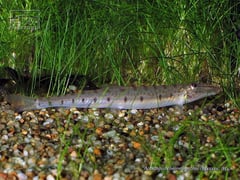
Acantopsis dialuzonaHorseface Loach
Cobitidae · van Hasselt, 1823
The horseface loach, Acantopsis dialuzona, is a cobitid loach from Sumatra, Borneo, Java and Peninsular Malaysia, and possibly Thailand. Most literature lists it as A. choirorhynchos, which Kottelat treats as a junior synonym, and few if any fish in the trade come from near the type locality, so they may represent an unidentified species. Juveniles are exported in large numbers but adults are uncommon in the hobby, and it needs soft sand to bury in.

Barbonymus schwanefeldiiTinfoil barb
Cyprinidae · Bleeker, 1854
The tinfoil barb, Barbonymus schwanefeldii, is a large cyprinid found across much of Southeast Asia, from the Mekong to Borneo and Sumatra. Usually sold at 50 to 75 mm, it grows to 355 mm SL, and tinfoil barbs are among the species most often returned to shops having outgrown their aquarium. Selectively-bred 'golden' and 'blushing' strains exist, and the species has also been subjected to artificial dyeing.

Betta imbellisCrescent Betta
Osphronemidae · Ladiges, 1975
The crescent betta, Betta imbellis, is a labyrinth fish thought to be native to southern Thailand, Peninsular Malaysia and northern Sumatra. It has been line-bred for aggression in southern Thailand and hybridised with B. splendens and other congeners for the ornamental trade, producing colour forms that do not occur naturally. Introduced ornamental forms and other Betta spp. are having an adverse effect on the genetic integrity of some wild populations.

Betta pugnax
Osphronemidae · Cantor, 1849
Betta pugnax is a paternal mouthbrooding labyrinth fish from much of Peninsular Malaysia and Singapore, described from Penang. It lends its name to the B. pugnax complex. Populations inhabit shallow, flowing clear-water hill streams as well as stiller forest swamps. It is not among the more aggressive members of the genus and can be maintained in a pair or group.
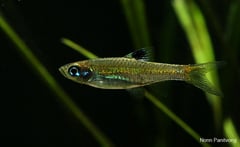
Brevibora dorsiocellataEyespot Rasbora
Cyprinidae · Duncker, 1904
The eyespot rasbora, Brevibora dorsiocellata, is a small cyprinid from southern Thailand, Peninsular Malaysia, Borneo and Sumatra. It is also traded as the 'green-eyed', 'emerald-eyed' or 'hi-spot' rasbora. The common, commercially produced form is plain-coloured with a greenish-blue reflective patch in the eye, while a probably wild-caught form seen from time to time has russet red at the base of the tail. Some Bornean records may refer to B. cheeya.
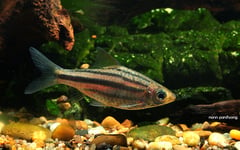
Desmopuntius johorensisStriped Barb
Cyprinidae · Duncker, 1904
The striped barb, Desmopuntius johorensis, is a cyprinid from southern Thailand, Peninsular Malaysia, Singapore, Sumatra and Borneo. Juveniles have 4 dark vertical bars and develop 5 or 6 broad lateral stripes as they grow, a pattern change shared with D. gemellus and D. trifasciatus. Before Kottelat (1992) it was referred to as Puntius eugrammus, while the name 'Puntius johorensis' was misapplied to D. hexazona. It lives mainly in peat swamps and black water streams.

Gymnothorax tile'Freshwater' Moray Eel
Muraenidae · Hamilton, 1822
The 'freshwater' moray eel, Gymnothorax tile, is a moray from coastal regions of the Indo-West Pacific, from eastern India to the Philippines. Although typically sold as a freshwater fish, this is not strictly the case, and the profile treats a marine salt mix as mandatory. It has small pale spots on a darker head and body, where the congener G. polyuranodon has much larger dark spots on a paler background. Highly piscivorous, it is best kept alone in all but the very largest aquaria.
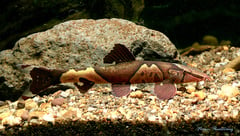
Homaloptera parclitella
Balitoridae · Tan & Ng, 2005
Homaloptera parclitella is a 'lizard' loach from Peninsular Malaysia and the Sai Buri, Bang Nara and Kolok river systems of southern Thailand. It was previously considered a form of H. orthogoniata and may be seen identified as such online and in print. It always has two large, saddle-shaped markings on the back, where H. orthogoniata has three, and it lives in swift, clear, oxygen-saturated streams.

Puntigrus partipentazona
Cyprinidae · Fowler, 1934
Puntigrus partipentazona is a small cyprinid recorded from numerous river basins in Vietnam, Cambodia, Laos, Thailand and Peninsular Malaysia. It is easily told from congeners because the dark blotch on its dorsal fin extends onto the body. Typically found in heavily vegetated parts of rivers and sluggish streams, it is generally peaceful, though rival males continually battle for position within the group.

'Puntius' lineatusLined Barb
Cyprinidae · Duncker, 1904
The lined barb, 'Puntius' lineatus, is a laterally-striped cyprinid from Peninsular Malaysia, Sumatra and Borneo, found mostly in peat swamps. It is most often confused with 'P.' johorensis, the two being the most common of the striped species in the trade, but it has no more than one pair of barbels, lacks vertical bars as a juvenile and grows smaller. Its habitats include black water streams stained brown with humic acids, with pH as low as 3.0 or 4.0.
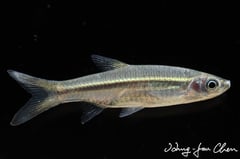
Rasbora argyrotaeniaSilver Rasbora
Cyprinidae · (Bleeker, 1849)
The silver rasbora, Rasbora argyrotaenia, is a cyprinid from Peninsular Malaysia, Singapore, Sumatra, Java, Borneo and the Palawan islands. One of the larger rasboras at up to 140 mm TL, it is a plain, silvery fish with a faint dark stripe, and fish pictured under this name with a bold black stripe are probably a regional variant of R. daniconius. A DNA barcode study found two mitochondrial lineages under the name, and the species as currently recognised is likely to be split.