River
Sekong
Only species with a profile on Seriously Fish are counted.
- Species
- 14
- Families
- 6
- Photographed
- 14 of 14
- Difficulty rated
- 14 of 14
Basin
Also in the Mekong basinspecies recorded from both
Shares fishes with rivers elsewherespecies recorded from both
Runs through
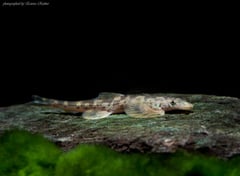
Annamia normaniVietnamese Giraffe Loach
Gastromyzontidae · Hora, 1931
The Vietnamese giraffe loach, Annamia normani, is a hillstream loach from Mekong tributaries in Vietnam, Laos and Cambodia and from coastal Vietnam. An obligate resident of riffles and rapids, it has been traded as the 'Vietnamese lizard loach' and 'Vietnamese Homaloptera'. Adults studied in the Duc My River were specialised grazers of cyanobacteria. Many of its known habitats are threatened by planned hydroelectric projects.

Barbodes aurotaeniatus
Cyprinidae · Tirant, 1885
Barbodes aurotaeniatus is a small cyprinid from the middle and lower Mekong basin in Laos, Vietnam, Cambodia and Thailand. Uncommon in the aquarium trade, it has a single pair of maxillary barbels, lacking the rostral barbels of other Barbodes, and usually four small vertical black markings on the flanks. It inhabits streams, irrigation canals and ditches, and is apparently very peaceful, best kept in a mixed-sex group of 6 to 10.

Channa gachuaDwarf Snakehead
Channidae · Hamilton, 1822
The dwarf snakehead, Channa gachua, is a snakehead recorded across an enormous range from Iran to Taiwan and Bali. There is significant evidence that C. gachua as currently understood is a complex of similar-looking species in need of taxonomic review. A mouthbrooder bred regularly in captivity, it can share a well-chosen community with peaceful fishes too large to be prey, but populations should not be mixed as some may hybridise.

Datnioides undecimradiatusMekong Tiger Perch
Datnioididae · Roberts & Kottelat, 1994
The Mekong tiger perch, Datnioides undecimradiatus, is known only from the middle and lower Mekong basin in Thailand, Laos, Cambodia and Vietnam. An efficient, largely piscivorous predator of large, deep lowland rivers, it is marked with 4 relatively thin dark bars. The names 'Siamese tiger fish' and 'gold datnoid' are sometimes applied to it, but more typically belong to D. pulcher.

Hampala disparSpotted Hampala Barb
Cyprinidae · Smith, 1934
The spotted hampala barb, Hampala dispar, is a cyprinid endemic to the Mekong basin in northern Laos, Thailand and Cambodia. It needs plenty of space but, at up to 350 mm SL, makes a more suitable aquarium fish than the larger and more commonly traded H. macrolepidota. It has a single dark blotch on the body and less well-defined marginal stripes on the caudal lobes, although juveniles of the two can appear very similar.

Hypsibarbus lagleri
Cyprinidae · Rainboth, 1996
Hypsibarbus lagleri is a large cyprinid endemic to the middle Mekong basin in Laos, eastern Thailand and Cambodia. It migrates seasonally, living in larger river channels in the dry season and moving into smaller tributaries and flooded forests in the wetter months. Growing to 350 mm, it is a valued food fish, and like most of its congeners is thought to be in decline because of the damming of rivers and agriculture.

Lobocheilos melanotaenia
Cyprinidae · Fowler, 1935
Lobocheilos melanotaenia is a grazing cyprinid from the Mekong in Laos, Thailand, Cambodia and Vietnam, plus the Dong Nai, Chao Phraya and Mae Klong. One of the most abundant species in the seasonal cyprinid migrations of the mainstream Mekong, it is available on a sporadic basis. It is told from L. rhabdoura by its deeper body, narrower mouth and a dark area in the dorsal-fin. It can be aggressive at feeding times and is not particularly tolerant of conspecifics.

Macropodus opercularisParadise Fish
Osphronemidae · Linnaeus, 1758
The paradise fish, Macropodus opercularis, is a labyrinth fish from China south of the Yangtze, including Taiwan and Hainan, plus Vietnam and Laos. Imported to France in 1869, it was among the very first ornamental fish brought to Europe. Wild examples are uncommon in the hobby since it is farmed extensively, and xanthic, albino, red, blue and stripeless strains exist. Males are territorially aggressive, especially when breeding, and should not be housed together unless the aquarium is very large.

Opsarius koratensis
Cyprinidae · Smith, 1931
Opsarius koratensis is a cyprinid of the middle and lower Mekong in Thailand, Laos and Cambodia, and the Chao Phraya, Mae Klong and Dong Nai systems. It apparently inhabits larger, deeper and more turbid rivers than many congeners. Genetic evidence from Tang et al. (2010) suggests it may represent a distinct genus, and it occasionally appears in the ornamental trade.
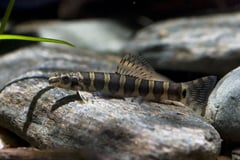
Serpenticobitis octozona
Serpenticobitidae · Roberts, 1997
Serpenticobitis octozona is a small loach apparently endemic to the Sekong River basin in southern Laos, part of the lower Mekong system. Sometimes sold as 'serpent loach', it shows a degree of social interaction and can cling to vertical or overhanging surfaces. The type species of its genus, it has 7-8 dark bars on each flank, much wider than the pale interspaces. It lives in shallow, fast-flowing, highly-oxygenated headwaters and minor tributaries.
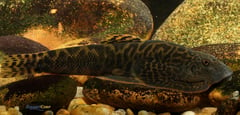
Sewellia elongata
Gastromyzontidae · Roberts, 1998
Sewellia elongata is a hillstream loach from the Bolovens plateau in southern Laos, also recorded in the upper Se Kong drainage in central Vietnam. The largest described Sewellia, growing to at least 73 mm SL, it is most similar to S. diardi but has a relatively slender, elongate body. It appeared in the aquarium trade during 2010 and inhabits shallow, fast-flowing, highly-oxygenated headwaters with riffles and runs.

Incisilabeo behri
Cyprinidae · Fowler, 1937
Incisilabeo behri is a large cyprinid native to the Mekong river system in southern China, Laos, Thailand, Vietnam and Cambodia. Growing to 450 to 550 mm, it is patently unsuitable for the home aquarium, though juveniles are available on a relatively regular basis. The only member of its genus, it is separated from Bangana by a conspicuous transverse notch across the top of the head, and migrates seasonally up the Sekong, Sesan and Srepok rivers.

Mekongina erythrospila
Cyprinidae · Fowler, 1937
Mekongina erythrospila is a large cyprinid endemic to the middle and lower Mekong River system in Laos, Thailand, Cambodia and Vietnam. It tends to inhabit medium to large river channels with fast-flowing water and rocky beds. Occasionally in the ornamental trade, it grows to 400 to 450 mm and is unsuitable for most private aquaria. It can be aggressively territorial towards conspecifics and similarly-shaped fishes.

Labeo pierrei
Cyprinidae · Sauvage, 1880
Labeo pierrei is a large cyprinid from the Mekong river system in southern China, Laos, Thailand, Cambodia and Vietnam, and the Dong Nai in Vietnam. It grows to 800 mm and inhabits main river channels and large, deep tributaries. It migrates seasonally, moving upstream into the Sekong, Sesan and Srepok rivers at the onset of the wet season and returning downstream in the dry months.