River
Pastaza
Only species with a profile on Seriously Fish are counted.
- Species
- 16
- Families
- 11
- Photographed
- 16 of 16
- Difficulty rated
- 16 of 16
Basin
Also in the Amazon basinspecies recorded from both
Shares fishes with rivers elsewherespecies recorded from both
Runs through

Apistogramma cacatuoidesCockatoo Cichlid
Cichlidae · Hoedeman, 1951
The cockatoo cichlid, Apistogramma cacatuoides, is a small cichlid from the upper Amazon basin, from the Ucayali in Peru to the Solimões in Brazil. It lives in slow tributaries, backwaters and creeks where leaf litter collects. Numerous line-bred forms such as 'double red' and 'orange flash' are traded, and captive-raised fish suit a community aquarium, while wild fish are best kept alone or with small dither fishes.

Astyanax bimaculatusTwo Spot Astyanax
Characidae · (Linnaeus, 1758)
The two spot astyanax, Astyanax bimaculatus, is a characid ranging from Panama through most of the Amazon and Orinoco basins. It lives in a wide variety of biotopes, from swiftly-flowing rivers and streams to ponds, ditches and reservoirs. The name is currently applied to what is considered a species complex of at least four taxa, and aquarium fish most often arrive as contaminants among shipments of other species.
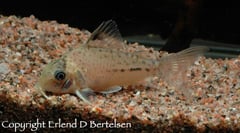
Brochis lambertiC009
Callichthyidae · (Nijssen & Isbrücker, 1986)
Brochis lamberti (C009), long known as Corydoras lamberti, is an armoured catfish known only from the lower Río Pastaza, a tributary of the Río Marañón in Loreto, northern Peru. Similar-looking fish are known from tributaries close to Iquitos, and it is unclear whether these, 'C009' and B. lamberti are the same species. It is rare in the hobby and difficult to identify without collection details, so it may have been traded under other names.
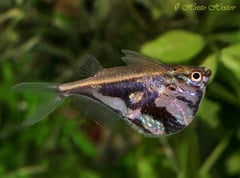
Carnegiella strigataMarbled Hatchetfish
Gasteropelecidae · (Günther, 1864)
The marbled hatchetfish, Carnegiella strigata, is a hatchetfish from the Amazon and Orinoco basins and coastal rivers of Guyana and Suriname. Popular in the hobby, it is collected for the trade mostly in the rio Negro basin in Brazil. Its larger size and dark, marbled pattern set it apart from congeners, though the pattern varies and the wide range may be open to question. It appears to live only in blackwater.

Colomesus asellusAmazon Puffer
Tetraodontidae · (Müller & Troschel, 1849)
The Amazon puffer, Colomesus asellus, is a freshwater puffer found throughout much of the Amazon basin, with records north to Guyana and Venezuela. Also traded as the South American puffer or 'SAP', it is told from congeners by a transverse row of dermal flaps across the chin. It lives mostly in well-oxygenated river habitats, is intolerant of organic waste, and forms loose aggregations, so a group of 6 or more is best, away from the general community.
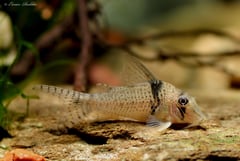
Corydoras pastazensisPastaza Cory
Callichthyidae · Weitzman, 1963
The Pastaza cory, Corydoras pastazensis, is an armoured catfish from the upper Río Pastaza basin in Ecuador and the ríos Ucayali and Puinahua in Peru. The Río Tigre form was raised to species status as C. orcesi, a decision not followed by all authorities. The two are relatively easy to tell apart: in C. pastazensis the dark vertical bar breaks up or tapers off low on the body, and the body is peppered with numerous small dark spots.
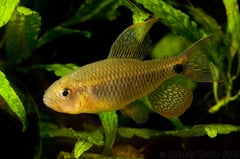
Crenuchus spilurusSailfin Characin
Crenuchidae · Günther, 1863
The sailfin characin, Crenuchus spilurus, is a crenuchid from much of the Amazon and Orinoco drainages and coastal rivers of the Guianas. The only described member of its genus, it varies considerably in colour pattern and morphology across that range. It lives in tea-stained forest streams, and its timid, predominantly benthic nature means it does not always make an ideal community fish. Males guard eggs laid on the roof of a small cave, often formed from leaf litter.
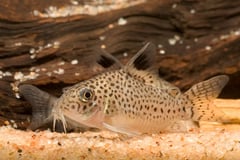
Hoplisoma copei
Callichthyidae · (Nijssen & Isbrücker, 1986)
Hoplisoma copei, long known as Corydoras copei, is an armoured catfish from Peru, apparently endemic to the Río Pastaza basin and possibly the lower Río Marañón. It is not well known and rarely traded. It looks very similar to several congeners, particularly H. acrense and H. cruziense, and little has been written about it since its description.
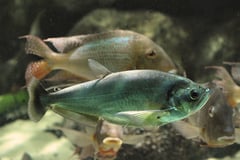
Hydrolycus scomberoidesVampire Tetra
Cynodontidae · (Cuvier, 1819)
The vampire tetra, Hydrolycus scomberoides, is a predatory dogtooth characin from the central and upper Amazon in Brazil, Bolivia, Peru and Ecuador. Also sold as 'scomb' and 'sabre tooth tetra', it is regularly confused with the much larger payara, H. armatus. At up to 300 mm it still needs a huge tank and specialist care, and newly-imported specimens often refuse anything but live food.

Iguanodectes spilurusGreen Line Lizard Tetra
Iguanodectidae · (Günther, 1864)
The green line lizard tetra, Iguanodectes spilurus, is a characin found throughout the Amazon, Orinoco, Essequibo and Tocantins river systems. The most widespread Iguanodectes species, it has also been called the 'slender', 'spindle' or 'iguana' tetra, and differs from its congeners in its translucent dorsal and anal fins, lack of a red lateral stripe and prominent dark caudal-fin marking. It is sensitive to poor water conditions.
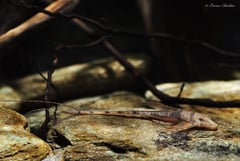
Lamontichthys filamentosusSturgeon Catfish
Loricariidae · (La Monte, 1935)
The sturgeon catfish, Lamontichthys filamentosus, is a loricariid from the central and western Amazon in Brazil, Peru, Ecuador and Bolivia. Above 60 mm SL the pectoral-fin spine extends into a filament that can be over four times the length of the first branched ray, and the dorsal-fin spine carries a similar extension. Relatively common in the hobby but not easy to maintain, it needs clean, well-oxygenated water and a mature aquarium with plenty of algae-covered surfaces.
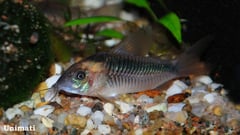
Osteogaster zygataBlack Band Cory
Callichthyidae · (Eigenmann & Allen, 1942)
The black band cory, Osteogaster zygata, long known as Corydoras zygatus, is an armoured catfish from the middle Río Marañón watershed in eastern Ecuador and northern Peru. Also known in the trade as the 'zygus cory', it looks very similar to O. rabauti. In O. zygata the broad dark stripe on the upper body stops short of the lower caudal peduncle, and in O. rabauti it extends onto it.
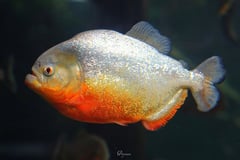
Pygocentrus nattereriRed Bellied Piranha
Serrasalmidae · Kner, 1858
The red bellied piranha, Pygocentrus nattereri, occurs through much of the Amazon basin and south into the Paraná and Uruguay river systems. Famed as a rapacious predator, it is among the most notorious freshwater fishes in the world. According to Herbert Axelrod (1976), the myth began with a feeding frenzy staged for Theodore Roosevelt in Brazil in 1913. Usually only juveniles form aggregations, and the species is relatively easy to breed in the aquarium.
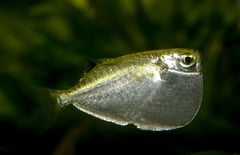
Thoracocharax stellatusSpotfin Hatchetfish
Gasteropelecidae · (Kner, 1858)
The spotfin hatchetfish, Thoracocharax stellatus, is the most widespread neotropical hatchetfish, recorded from much of South America. It is told from its only congener, T. securis, by a prominent dark spot in the dorsal fin, and is sometimes traded as 'platinum hatchetfish'. It feeds almost entirely on insects, and a tightly fitting cover is needed because it can clear several metres in one jump.

Aequidens tetramerusSaddle Cichlid
Cichlidae · (Heckel, 1840)
The saddle cichlid, Aequidens tetramerus, is a cichlid found across much of northern South America, from the Amazon and Orinoco basins to the Guianas. The type species of its genus, it occurs in several colour forms, and fish from Ecuador and Peru are sought after for the red or orange colouration on the lower head and belly. As currently recognised it is likely to represent a group of related fishes, some of which may be described as distinct species.
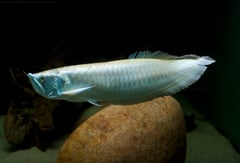
Osteoglossum bicirrhosumSilver Arowana
Osteoglossidae · (Cuvier, 1829)
The silver arowana, Osteoglossum bicirrhosum, is a large predator from the Amazon basin, plus river systems in Guyana and French Guiana. Reaching 80 cm, it is largely unsuitable for the home aquarium, and although juveniles are readily available, few private aquarists can house an adult long-term. Juveniles have a single dark lateral stripe, while in those of its only congener, O. ferreirai, most of the body and fins are dark.