River
Branco
Only species with a profile on Seriously Fish are counted.
- Species
- 21
- Families
- 10
- Photographed
- 21 of 21
- Difficulty rated
- 21 of 21
Basin
Also in the Amazon basinspecies recorded from both
Shares fishes with rivers elsewherespecies recorded from both
Runs through
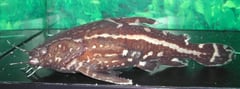
Acanthodoras spinosissimusChocolate Talking Catfish
Doradidae · Eigenmann & Eigenmann, 1888
The chocolate talking catfish, Acanthodoras spinosissimus, is a doradid catfish from the northern Amazon basin and the Essequibo in Guyana. Usually exported as bycatch among Platydoras armatulus, it is sold under the same trade names as A. cataphractus, and the most useful difference is the pale blotches on its back between the dorsal and caudal fins. Largely nocturnal and gregarious, it is best kept in a group of at least four.
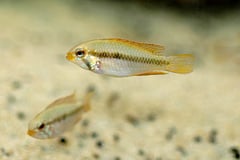
Apistogramma gibbicepsBlackline Apisto
Cichlidae · Meinken, 1969
The blackline apisto, Apistogramma gibbiceps, is a dwarf cichlid from the Rio Branco and middle Rio Negro basins in Brazil. It is identified by a row of short dark marks low on the flank below the lateral band, which show most clearly on a settled fish. Meinken's type series held three species, and A. roraimae from the Rio Branco has been treated as a synonym since 2003.

Astyanax bimaculatusTwo Spot Astyanax
Characidae · Linnaeus, 1758
The two spot astyanax, Astyanax bimaculatus, is a characid ranging from Panama through most of the Amazon and Orinoco basins. It lives in a wide variety of biotopes, from swiftly-flowing rivers and streams to ponds, ditches and reservoirs. The name is currently applied to what is considered a species complex of at least four taxa, and aquarium fish most often arrive as contaminants among shipments of other species.

Biotoecus opercularis
Cichlidae · Steindachner, 1875
Biotoecus opercularis is a small geophagine cichlid from the middle Amazon basin in Brazil, including the lower Madeira, Tapajós and Negro. It favours shallow, slow-flowing water over sand with leaf litter and submerged wood, often stained with tannins. Several populations are traded, among them B. sp. 'rio Negro' from the rio Jauaperi and B. sp. 'Santarém' or 'Tapajós', though no scientific evidence shows them to be more than one species. It should not be mixed with other Biotoecus species or populations.
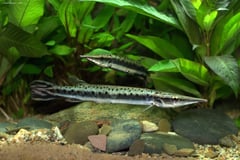
Boulengerella maculata
Ctenoluciidae · Valenciennes, 1850
Boulengerella maculata is a pelagic ctenoluciid found throughout much of the Amazon, Orinoco and Tocantins river systems. Colour pattern varies considerably, with some specimens much paler than others, and this may be correlated with water type. Random dark spots on the upper body, and a dark stripe only behind the eye when one is present, separate it from the similar B. lateristriga. It reaches 329 mm SL and needs an aquarium with base dimensions of 240 by 90 cm or more.

Colomesus asellusAmazon Puffer
Tetraodontidae · Müller & Troschel, 1849
The Amazon puffer, Colomesus asellus, is a freshwater puffer found throughout much of the Amazon basin, with records north to Guyana and Venezuela. Also traded as the South American puffer or 'SAP', it is told from congeners by a transverse row of dermal flaps across the chin. It lives mostly in well-oxygenated river habitats, is intolerant of organic waste, and forms loose aggregations, so a group of 6 or more is best, away from the general community.
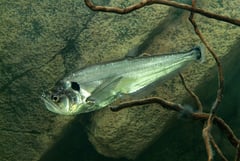
Cynodon gibbus
Cynodontidae · Agassiz, 1829
Cynodon gibbus is a cynodontid from much of the Amazon basin, the middle and lower Orinoco, and the Rupununi River in Guyana. A pelagic fish of main river channels and larger tributaries, it grows to around 280 mm SL. It is rare in the trade but arguably more suitable for the home aquarium than some of its better-known relatives, given its size and relatively docile behaviour. Being easily dominated, it is best kept alone or with similarly sized, non-aggressive fishes.
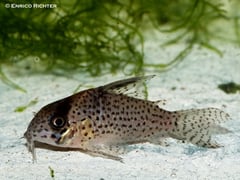
Hoplisoma kaneiC026
Callichthyidae · (Grant, 1998)
Hoplisoma kanei, long known as Corydoras kanei, is an armoured catfish that appears to be native to the rio Negro basin in Brazil, possibly only the rio Branco drainage. Before description it was assigned the 'C' numbers C026 and C046. It is most easily confused with H. atropersonatum and sometimes traded as that species, but has dark markings in the anal and caudal fins, more numerous and smaller dark spots on the body, and a darker base colouration.

Megalamphodus megalopterusBlack Phantom Tetra
Characidae · (Eigenmann, 1915)
The black phantom tetra, Megalamphodus megalopterus, is a characid from the upper rio Madeira and upper rio Paraguai in Bolivia and Brazil. Most records are from the rio Guaporé (Río Iténez in Bolivia). Popular in the hobby and bred commercially in several countries, it is also available as a 'long-finned' strain. Adult males have black fins with the pelvic, dorsal and anal enlarged, while females are deeper-bodied with reddish pelvic, anal and adipose fins.

Megalamphodus socolofiLesser Bleeding Heart Tetra
Characidae · (Weitzman, 1977)
The lesser bleeding heart tetra, Megalamphodus socolofi, is a characid known only from the rio Negro basin and the rio Nhamundá in Brazil. One of three similar species in the 'bleeding heart' subgroup, it shares their reddish humeral spot, found in no other characid. Generally peaceful, although adult males are territorial to an extent, it mostly inhabits sluggish tributaries, side arms and forest lakes.
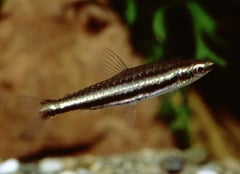
Nannostomus digrammusTwostripe Pencilfish
Lebiasinidae · Fowler, 1913
The twostripe pencilfish, Nannostomus digrammus, is a lebiasinid from the central Amazon basin in Brazil and the Rupununi basin in Guyana. Rare in the hobby, it usually arrives as bycatch among shipments of other fishes. It is most similar to N. bifasciatus but has an adipose-fin, and its small size and timid nature make it a poor community fish.
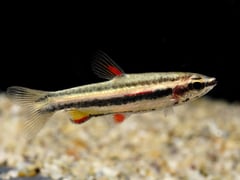
Nannostomus marginatusDwarf Pencilfish
Lebiasinidae · Eigenmann, 1909
The dwarf pencilfish, Nannostomus marginatus, is a lebiasinid of Guyana, Suriname and the middle-to-lower Amazon in Peru, Colombia and Brazil. Enduringly popular, it lacks the red body colour of males of the related N. mortenthaleri and N. rubrocaudatus, showing three dark lateral stripes with no red or purple between them. Colour varies between populations, and its small size and timid nature make it a poor community fish.
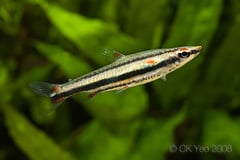
Nannostomus trifasciatusThree-lined Pencilfish
Lebiasinidae · Steindachner, 1876
The three-lined pencilfish, Nannostomus trifasciatus, is a lebiasinid widespread in the western Amazon basin in Brazil, Peru, Colombia and Bolivia. Fairly ubiquitous in the trade, it is less demanding than many congeners and a good choice for a newcomer to pencilfishes. Many fish on sale are farmed, and wild populations vary in colour pattern, one being marketed as 'super red' for its unusually long red stripe.

Satanoperca acuticepsSharphead Eartheater
Cichlidae · Heckel, 1840
The sharphead eartheater, Satanoperca acuticeps, is a cichlid from the central Amazon basin in Brazil, including the lower rio Negro and rio Branco. Relatively rare in the trade, it is sometimes confused with S. daemon and S. lilith but has three dark flank blotches (vs. two in S. daemon, one in S. lilith). Unless breeding it is surprisingly peaceful, and it is very rarely bred in aquaria.

Satanoperca lilith
Cichlidae · Kullander & Ferreira, 1988
Satanoperca lilith is an eartheater cichlid known only from Brazil, where it is widely distributed along the Solimões/Amazon main channel. Despite that extensive range it is uncommon in the ornamental trade, where it is sometimes called 'one-spotted demon fish' or 'one spot eartheater'. A single dark blotch on the flank separates it from the closely similar S. daemon, which has two.

Satanoperca pappaterraPantanal Eartheater
Cichlidae · Heckel, 1840
The Pantanal eartheater, Satanoperca pappaterra, is a cichlid from the rio Guaporé and upper rio Paraguai basins in Brazil, Bolivia and Paraguay. Relatively rare in the ornamental trade and much sought after, it is easily told from all known congeners by a series of prominent black blotches beneath the dorsal-fin and a well-defined dark band along the side of the body. It has been introduced to the upper rio Paraná in southeastern Brazil.
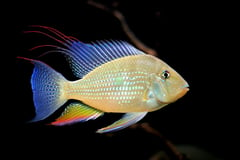
Acarichthys heckeliiThreadfin Acara
Cichlidae · Müller & Troschel, 1849
The threadfin acara, Acarichthys heckelii, is a cichlid from the northern Amazon basin in Colombia, Peru and Brazil and the Essequibo in Guyana. The only member of its genus, it grows to around 200 mm and digs incessantly, and it is susceptible to deteriorating water quality. Some adults show sudden, extreme aggression towards conspecifics that can kill weaker fish, and the problem decreases as tank and group size increase.

Aequidens tetramerusSaddle Cichlid
Cichlidae · Heckel, 1840
The saddle cichlid, Aequidens tetramerus, is a cichlid found across much of northern South America, from the Amazon and Orinoco basins to the Guianas. The type species of its genus, it occurs in several colour forms, and fish from Ecuador and Peru are sought after for the red or orange colouration on the lower head and belly. As currently recognised it is likely to represent a group of related fishes, some of which may be described as distinct species.
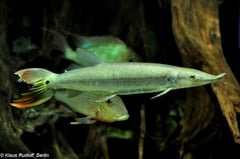
Boulengerella cuvieri
Ctenoluciidae · Spix & Agassiz, 1829
Boulengerella cuvieri is a pelagic ctenoluciid characin from much of the Amazon basin, the Río Orinoco and coastal drainages of the Guianas. The largest officially recorded specimen measured 675 mm, but it appears to grow larger, possibly beyond 800 mm. Given that size and its natural behaviour it is largely unsuitable for the home aquarium. Its entire dorsal-fin base lies ahead of the anal-fin origin, a character shared only with B. lucius and B. xyrekes among ctenoluciids.
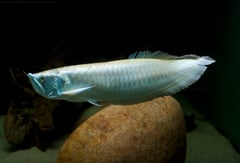
Osteoglossum bicirrhosumSilver Arowana
Osteoglossidae · Cuvier, 1829
The silver arowana, Osteoglossum bicirrhosum, is a large predator from the Amazon basin, plus river systems in Guyana and French Guiana. Reaching 80 cm, it is largely unsuitable for the home aquarium, and although juveniles are readily available, few private aquarists can house an adult long-term. Juveniles have a single dark lateral stripe, while in those of its only congener, O. ferreirai, most of the body and fins are dark.

Iguanodectes variatus
Iguanodectidae · Géry, 1993
Iguanodectes variatus is a characin from Brazil, recorded from the Guaporé, Madeira, Branco, Trombetas and Urubu river systems in the Amazon basin. It belongs to a small genus of elongate fishes in the family Iguanodectidae and grows to around 103 mm SL.