River
Tietê
Only species with a profile on Seriously Fish are counted.
- Species
- 5
- Families
- 3
- Photographed
- 5 of 5
- Difficulty rated
- 5 of 5
Basin
Also in the Parana basinspecies recorded from both
Shares fishes with rivers elsewherespecies recorded from both
Runs through

Hyphessobrycon flammeusFlame Tetra
Characidae · Myers, 1924
The flame tetra, Hyphessobrycon flammeus, is a small characid from Rio de Janeiro and São Paulo states in Brazil. Popular in the hobby, it is bred commercially in several countries and also sold as 'red', 'fire', 'rio' and 'Von Rio' tetra. In nature it is now uncommon or even extinct across much of its range, and the São Paulo populations may have been introduced by aquarists or breeders.
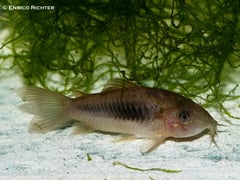
Osteogaster aeneaBronze Cory
Callichthyidae · (Gill, 1858)
The bronze cory, Osteogaster aenea, long known as Corydoras aeneus, is an armoured catfish described from Trinidad and accepted to occur across much of South America. That range looks more like a complex of similar, distinct species than a single one, and fish from outside Trinidad are of uncertain identity. Aquarium fish are almost all commercially farmed, and the names C. schultzei and C. venezuelanus are routinely misapplied to them.

Psalidodon anisitsiBuenos Aires Tetra
Characidae · (Eigenmann, 1907)
The Buenos Aires tetra, Psalidodon anisitsi, is a characid from the Paraná and Uruguay river systems in Brazil, Paraguay, Argentina and Uruguay. A popular and hardy aquarium fish, it is also available as a line-bred albino strain, sometimes traded as 'golden'. It has a reputation for fin-nipping, though mostly when too few are kept or space is limited, and a group of at least 8-10 is the minimum. It is still often sold as Hyphessobrycon anisitsi.

Satanoperca pappaterraPantanal Eartheater
Cichlidae · (Heckel, 1840)
The Pantanal eartheater, Satanoperca pappaterra, is a cichlid from the rio Guaporé and upper rio Paraguai basins in Brazil, Bolivia and Paraguay. Relatively rare in the ornamental trade and much sought after, it is easily told from all known congeners by a series of prominent black blotches beneath the dorsal-fin and a well-defined dark band along the side of the body. It has been introduced to the upper rio Paraná in southeastern Brazil.

Hyphessobrycon bifasciatusYellow Tetra
Characidae · Ellis, 1911
The yellow tetra, Hyphessobrycon bifasciatus, is a characid from coastal rivers of southeastern Brazil between Espírito Santo and Rio Grande do Sul. It also occurs in parts of the upper Paraná basin, in floodplain tributaries, lakes and streams, usually under forest cover. Two vertically elongate humeral spots, the front one more prominent, help separate it from similar congeners. Generally peaceful, it is best kept as a group of 8-10 or more.