River
de la Plata
Only species with a profile on Seriously Fish are counted.
- Species
- 10
- Families
- 9
- Photographed
- 10 of 10
- Difficulty rated
- 10 of 10
Basin
Also in the Parana basinspecies recorded from both
Shares fishes with rivers elsewherespecies recorded from both
Runs through
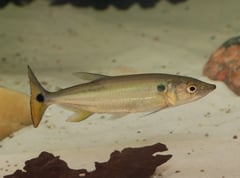
Acestrorhynchus pantaneiroPantanal Barracuda Tetra
Acestrorhynchidae · Menezes, 1992
The Pantanal barracuda tetra, Acestrorhynchus pantaneiro, is a predatory acestrorhynchid from the Paraná, Uruguay and de la Plata basins. It also occurs in the rio Mamoré in Bolivia. A member of the A. lacustris group with a round humeral spot, it is virtually impossible to tell from its relatives in the trade unless collection data is known. It lives in open water, and a group must be of comparable size because acestrorhynchids are cannibalistic.
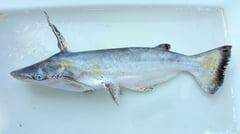
Ageneiosus inermisManduba
Auchenipteridae · (Linnaeus, 1766)
The manduba, Ageneiosus inermis, is a large auchenipterid catfish found throughout much of South America east of the Andes. At around 470 mm SL it would need an aquarium in excess of 400 x 120 cm as an adult and is largely unsuitable for private aquaria. An obligate carnivore, it can take surprisingly large prey, and the larger Ageneiosus species are often used as food fishes in their native countries.
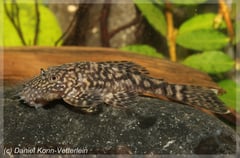
Ancistrus claroLDA 008
Loricariidae · Knaack, 1999
Ancistrus claro, the gold marble bristlenose catfish (LDA 008), is a suckermouth catfish from the rios Claro and Coxipó in Mato Grosso, Brazil. It inhabits flowing streams over boulders and bedrock. Sometimes confused with unidentified fishes such as A. sp. 'L352', it has long maxillary barbels and small spots on the head, with vermiform lines on the body in males and spots all over in females. A peaceful cave-spawner, it has been bred in aquaria on numerous occasions.

'Geophagus' brasiliensisPearl Cichlid
Cichlidae · (Quoy & Gaimard, 1824)
The pearl cichlid, Geophagus brasiliensis, comes from Atlantic-draining river systems of eastern and southern Brazil and Uruguay. It belongs to the 'G.' brasiliensis group, which still needs definitive classification. Colour and body shape vary with locality, and some coastal lagoon populations have evolved a degree of salt tolerance. Fish sold as Gymnogeophagus australis in Europe are more often this species, and non-native populations exist in several countries.
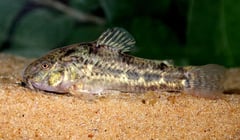
Hoplisoma gladysae
Callichthyidae · (Calviño & Alonso, 2010)
Hoplisoma gladysae, long known as Corydoras gladysae, is an armoured catfish known only from two localities in the Río Calchaquí watershed in Salta province, northwestern Argentina. The Calchaquí is a swift, snow-fed mountain river with hard water, and the species shows adaptations to life among rocks in flowing water, including a cryptic colour pattern, short fin spines and reduced body depth. It is unlikely to be collected for commercial purposes.

Hyphessobrycon anisitsiBuenos Aires Tetra
Characidae · (Eigenmann, 1907)
The Buenos Aires tetra, Hyphessobrycon anisitsi, is a characid from the Paraná and Uruguay river systems in Brazil, Paraguay, Argentina and Uruguay. A popular and hardy aquarium fish, it is also available as a line-bred albino strain, sometimes traded as 'golden'. It has a reputation for fin-nipping, though mostly when too few are kept or space is limited, and a group of at least 8-10 is the minimum.
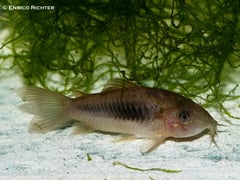
Osteogaster aeneaBronze Cory
Callichthyidae · (Gill, 1858)
The bronze cory, Osteogaster aenea, long known as Corydoras aeneus, is an armoured catfish described from Trinidad and accepted to occur across much of South America. That range looks more like a complex of similar, distinct species than a single one, and fish from outside Trinidad are of uncertain identity. Aquarium fish are almost all commercially farmed, and the names C. schultzei and C. venezuelanus are routinely misapplied to them.
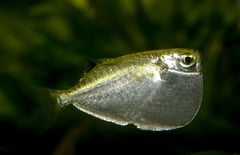
Thoracocharax stellatusSpotfin Hatchetfish
Gasteropelecidae · (Kner, 1858)
The spotfin hatchetfish, Thoracocharax stellatus, is the most widespread neotropical hatchetfish, recorded from much of South America. It is told from its only congener, T. securis, by a prominent dark spot in the dorsal fin, and is sometimes traded as 'platinum hatchetfish'. It feeds almost entirely on insects, and a tightly fitting cover is needed because it can clear several metres in one jump.
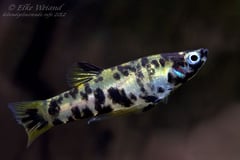
Phalloceros caudimaculatusDusky Millions Fish
Poeciliidae · (Hensel, 1868)
The dusky millions fish, Phalloceros caudimaculatus, is a small livebearer native to Brazil, Paraguay, Uruguay and Argentina. Feral populations in Australia, New Zealand, Ethiopia and Malawi were purportedly introduced for mosquito control and are now considered invasive. Highly variable in colour pattern, it is known in the hobby in spotted and golden ornamental forms. P. caudimaculatus is the type species of a genus that was monotypic until 21 new species were described in 2008.
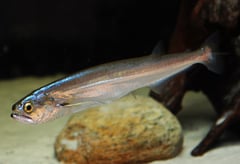
Rhaphiodon vulpinusBiara
Cynodontidae · Spix & Agassiz, 1829
The biara, Rhaphiodon vulpinus, is a dogtooth characin found from the Orinoco and Amazon basins south to the Río de la Plata in Argentina. The only member of its genus, it grows to 600 to 800 mm and is an obligate piscivore, and it is suitable only for public installations or the very largest private aquaria. Juveniles are seen for sale quite regularly, most often without adequate information on their long-term care.