River
Xe Kong
Only species with a profile on Seriously Fish are counted.
- Species
- 6
- Families
- 4
- Photographed
- 6 of 6
- Difficulty rated
- 6 of 6
Shares fishes withspecies recorded from both
Runs through

Channa gachuaDwarf Snakehead
Channidae · Hamilton, 1822
The dwarf snakehead, Channa gachua, is a snakehead recorded across an enormous range from Iran to Taiwan and Bali. There is significant evidence that C. gachua as currently understood is a complex of similar-looking species in need of taxonomic review. A mouthbrooder bred regularly in captivity, it can share a well-chosen community with peaceful fishes too large to be prey, but populations should not be mixed as some may hybridise.

Esomus metallicusStriped Flying Barb
Cyprinidae · Ahl, 1923
The striped flying barb, Esomus metallicus, is a cyprinid found from the Salween basin in Myanmar east across Thailand to Laos and Cambodia. It is abundant over most of this range and moves into rice paddies and other flooded ground at the onset of the wet season, returning to permanent water when the flooding recedes. Its lateral stripe grows more intense towards the tail and ends at the caudal-fin base.

Luciosoma bleekeri
Cyprinidae · Steindachner, 1878
Luciosoma bleekeri is a slender, pike-like cyprinid from the Mekong in Laos, Thailand, Cambodia and Vietnam, and from central and western Thailand. Subadults are traded regularly as 'apollo shark' or 'shark minnow' and it is frequently confused with L. setigerum, which has a series of black spots on the lateral line scales that this species lacks. It needs the largest private aquaria, and feeds mainly on terrestrial insects taken at the surface.

Opsarius koratensis
Cyprinidae · Smith, 1931
Opsarius koratensis is a cyprinid of the middle and lower Mekong in Thailand, Laos and Cambodia, and the Chao Phraya, Mae Klong and Dong Nai systems. It apparently inhabits larger, deeper and more turbid rivers than many congeners. Genetic evidence from Tang et al. (2010) suggests it may represent a distinct genus, and it occasionally appears in the ornamental trade.
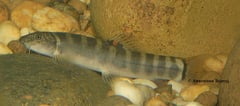
Schistura nicholsi
Nemacheilidae · Smith, 1933
Schistura nicholsi is a nemacheilid loach widespread in the Mekong basin in Laos and Thailand, and it may also occur in Cambodia. It is sometimes traded for aquaria, but its name also appears to have been widely misapplied to other fishes. It has 8-10 quite regular dark bars wider than the light interspaces. It has been bred in an aquarium, although the adults seem to consume both eggs and fry.
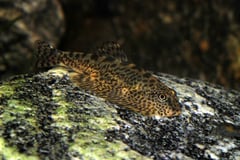
Sewellia speciosa
Gastromyzontidae · Roberts, 1998
Sewellia speciosa is a hillstream loach that appears endemic to the Xe Kong river drainage in central Vietnam and southern Laos. It first became available in early 2010 and sometimes appears on trade lists as 'Laos sucker' or 'Laos Sakura sucker'. The spotted body without stripes separates it from the morphologically similar S. lineolata, which is striped, and it inhabits shallow, fast-flowing, highly-oxygenated headwaters.