Aphyosemion elberti
Red-Barred Lyretail · Rotstreifen Prachtkärpfling
Formerly Panchax elberti Ahl, 1924 · Panchax tessmanni Ahl, 1924 · Aphyosemion rubrifascium Clausen, 1963 · Aphyosemion bualanum kekemense Radda & Scheel, 1975
Last revised 2026Edit this page
On this page4 sections
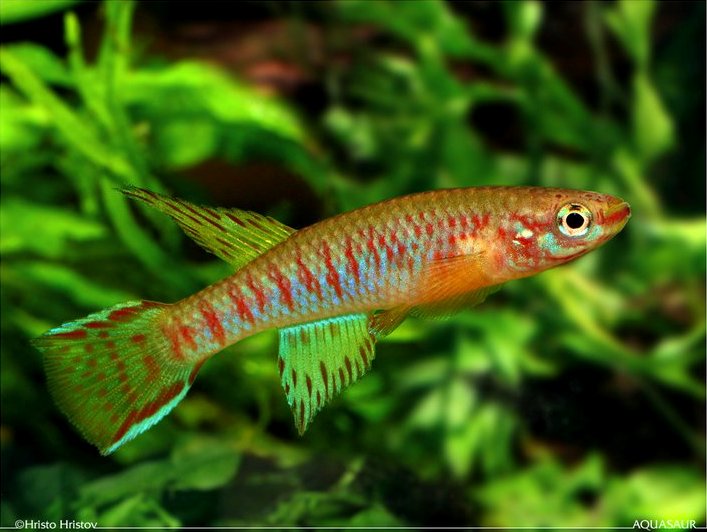
Quick factsEdit
Difficulty3 of 8 measures
- Space
- small tank
- Water
- needs soft water, kept steady
- Temp
- needs cool water, held steady
- Diet
- unknown
- Temperament
- unknown
- Social
- unknown
- Compatibility
- unknown
Other demands
Each of these can raise the rating on its own, whatever the measures above say.
- Hardiness
- unknown
The red-barred lyretail, Aphyosemion elberti, is a killifish from central Cameroon and the upper Mambéré basin in the Central African Republic. Its range follows the Sanaga River system across Cameroon. It was described from 'Jade Plateau, Cameroon', which apparently corresponds to the Lebo River in what is now the Central African Republic.
Water conditions
EditEtymology
EditAphyosemion: from the Greek aphúe (Gr. ἀφύη), meaning 'a small fish', and semeion (Gr. σημεῖον), meaning 'banner, flag', in reference to the "ornamented, often lyre-shaped" caudal fin in male individuals of genus members.
elberti: named for "Elbert" (forename not provided), who collected the holotype. Possibly refers to Danish geographer and naturalist Johannes Elbert (1878-1915), who explored Cameroon in 1914.
Distribution
EditThis species' range is currently understood to extend from eastern Nigeria across central Cameroon (via the Sanaga River system of which the Mbam is a tributary) and across the border into Central African Republic (upper Mambéré basin).
It was described from 'Jade Plateau, Cameroon', this apparently corresponding to the Lebo River which lies in what is now the Central African Republic and presumably forms part of the Mambéré headwaters.
Species images · 2
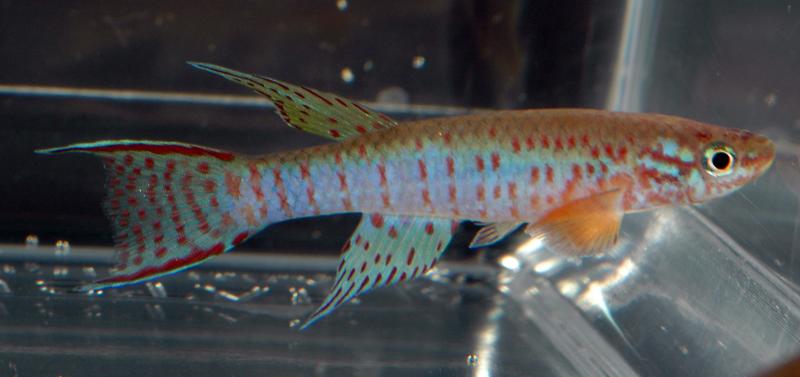
These photographs are used with each photographer's permission.
Send a photograph