Balantiocheilos melanopterus
Silver Shark
Formerly Barbus melanopterus Bleeker, 1850
Last revised 2026Edit this page
On this page13 sections
Quick factsEdit
Difficulty6 of 8 measures
Rated difficult because it needs a tank at least 2 m long.
- Space
- very large tank
- Water
- flexible
- Temp
- flexible
- Diet
- unknown
- Temperament
- unknown
- Social
- needs to be in a group
- Compatibility
- fine with others
Other demands
Each of these can raise the rating on its own, whatever the measures above say.
- Hardiness
- needs a well-established tank
- Needs strong current, with the filter turning the tank over 8–12 times an hour
- Needs a tank at least 2 m long
Before you buy
Needs a tight-fitting lid as this species is known to jump
Be sure to fit the tank with a heavy, tightly-fitting cover as it can be quite skittish at times and has a powerful leap.
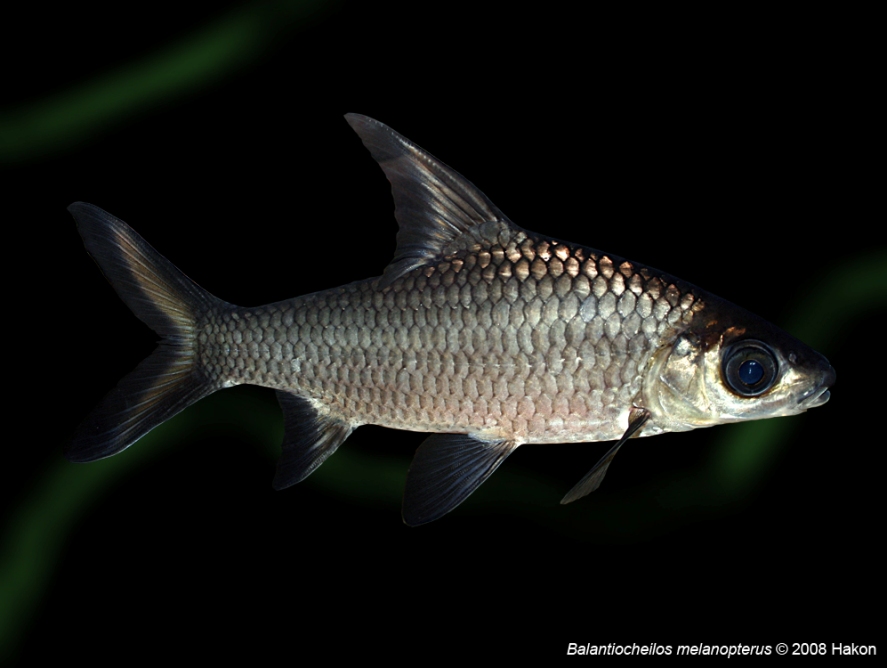
The silver shark, Balantiocheilos melanopterus, is a large cyprinid from Borneo, Sumatra and possibly Peninsular Malaysia. Also sold as the 'Bala shark', it is among the most commonly encountered ornamental fishes, yet it reaches 300 to 350 mm SL and long-term care is beyond most hobbyists. Wild populations have dwindled or vanished, it has been listed as Endangered by the IUCN since 1996, and fish on sale are almost certainly all commercially bred. It does not occur in Indochina.
Etymology
EditBalantiocheilos: from the Ancient Greek, and χείλος (cheílos), meaning 'lip', in reference to the posterior margin of the lower lip, which forms a pouch or pocket.
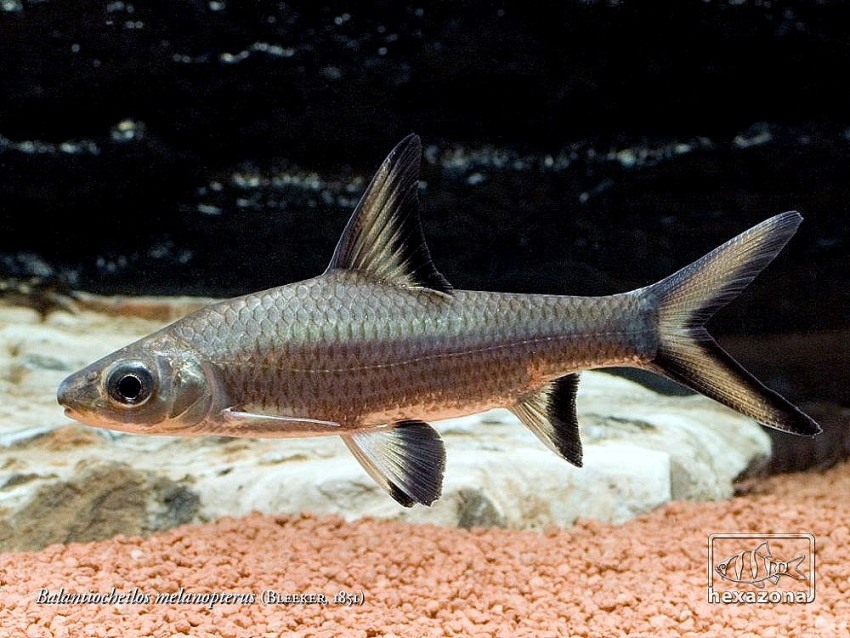
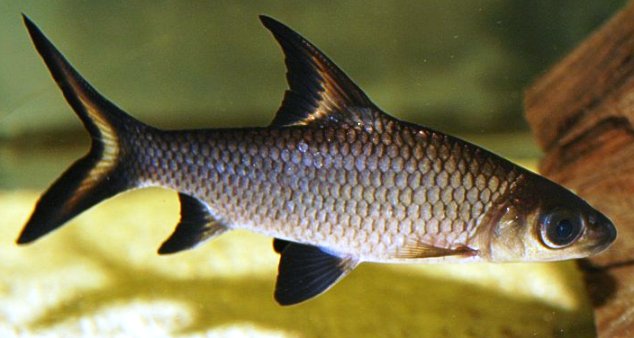
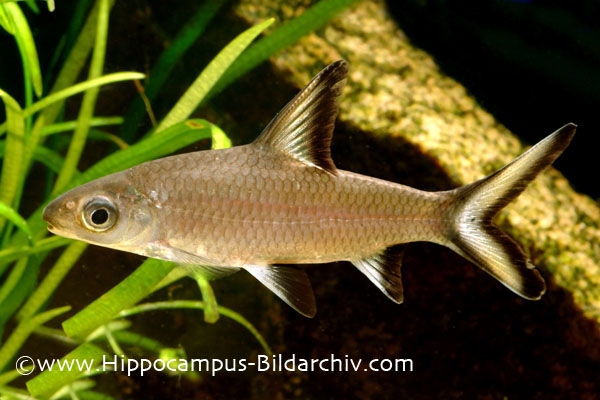
melanopterus: from the Ancient Greek μέλας (mélas), meaning 'black', and πτερόν (pterón), meaning 'wing', in reference to the black distal margins in the pelvic, dorsal, anal, and caudal fins.
Distribution
EditType locality is 'Bandjarmasin, Borneo, Indonesia', and work by Ng and Kottelat published in 2007 (see 'Notes') confirmed that contrary to much of the published information this species does not occur in Indochina and is restricted to Borneo, Sumatra and possibly Peninsular Malaysia.
The full extent of its current distribution is unclear as many populations have dwindled in numbers or even vanished completely over the last few decades, however.
For example it's now thought extirpated from the Batang Hari river drainage, Sumatra and in the Danau Sentarum National Park, Borneo numbers have been declining steadily since 1975. The precise cause has not been well-studied although pollution due to extensive forest fires has been suggested, and collection for the aquarium trade is unlikely to have contributed.
It's been listed as 'Endangered' on the IUCN Red List of Threatened Species since 1996 and it's near certain that wild fish are unavailable in the aquatic trade with 100% of those seen on sale originating from commercial breeding projects.
Habitat
Write a noteEditA pelagic species primarily occuring in rivers but also natural lakes such as the Danau Sentarum system.
Aquarium size
Write a noteEditAn aquarium with base dimensions of 240 ∗ 60 cm96 ∗ 24 in should be the smallest considered to house a group of adults.
Maintenance
Write a noteEditChoice of décor is not as critical as water quality and the amount of open swimming-space provided; we've seen very healthy-looking specimens being maintained in completely bare set-ups for example.
However should you possess the means to both provide and decorate a sufficiently-sized tank for long term care this species would look superb in a set-up designed to resemble a fast-flowing river with a substrate of variably-sized rocks and gravel, some large water-worn boulders and perhaps a couple of driftwood branches.
Like many other species that hail from running waters it is quite intolerant to the accumulation of organic wastes and requires spotless water at all times in order to thrive. It also does best if there is a high level of dissolved oxygen and a decent level of water movement in the tank.
An enormous external-style filter or two are going to be needed in order to provide the desired levels of oxygen, flow and surface area for bacterial colonisation. Be sure to fit the tank with a heavy, tightly-fitting cover as it can be quite skittish at times and has a powerful leap.
Water conditions
EditTemperature: 20 – 28 °C68 – 82 °F
pH: 6.0 – 8.0 but a value close to neutral is usually recommended.
Hardness: 2 – 15 dGH
These recommendations come from this profile’s own figures. They contain affiliate links, so we may earn a commission.
Diet
Write a noteEditLike many cyprinids B. melanopterus is omnivorous with stomach analyses of wild specimens revealing it to feed on insects, crustaceans, algae and other plant matter. In the aquarium it's just as easily-fed and will accept just about anything offered.
For it to develop its best colours and condition offer regular meals of small live and frozen foods such as bloodworm, Daphnia, and Artemia along with good quality dried flakes, granules and plenty of vegetable matter. Shelled peas, blanched courgette, spinach and chopped fruit all make good additions to the menu. Larger specimens will also take chopped earthworm, prawn, mussel, etc.
Behaviour and compatibility
Write a noteEditGiven its potential size this species is clearly unsuitable for the general community aquarium. Though normally quite peaceful it will also eat very small fishes and can upset slow-moving or more timid tankmates with its constant activity and vigorous feeding behaviour.
It's therefore only appropriate for very large tanks containing robust, similarly-sized tankmates that enjoy the same conditions. There are a number of suitable choices but recommendations include Hypsibarbus wetmorei, Barilius, Cyclocheilichthys, Osteochilus, Barbonymus, Mystacoleucus and larger Garra species.
Although it is gregarious by nature this is a shoaling rather than schooling species which develops a distinct pecking order and therefore should always be maintained in a group of five or more. If only two or three are purchased the subdominant fish may be bullied incessantly whereas solitary specimens can become aggressive towards similar-looking species.
Sexual dimorphism
Write a noteEditSexually mature females are noticeably thicker-bodied than males but it is impossible to accurately sex young fish.
Reproduction
Write a noteEditAs far as we know it has not been bred in aquaria although it is farmed for the trade in large numbers via the use of hormones.
Notes
EditMay also be seen on sale under the trade names 'Bala shark' or 'tricolor shark minnow' and perhaps among the most commonly-encountered ornamental fish species. It is unfortunate that the vast majority of those traded are juveniles and tend to come supplied with little to no information provided regarding their potential size and requirements, a fairly ironic situation given the apparently precarious status of wild populations.
Long-term care is simply beyond the resources of most hobbyists, and despite continued popularity it is among those species most frequently returned having outgrown small aquaria, and many stores are reluctant to accept them as the resale value is very low.
Very few fully-grown individuals are being maintained long-term in private systems, and since this is undoubtedly a long-lived species, its suitability for the home aquarium is questionable at best.
The genus Balantiocheilos was considered monotypic for well over 150 years with B. melanopterus the sole represenatative. However in 2007 Ng and Kottelat described B. ambusticauda from the lower and middle Chao Phraya and Mekong drainages in Thailand, a result of the authors comparing previously collected specimens of Balantiocheilos from Thailand, Sumatra and Borneo to each other rather than discovery of the new species in nature.
The holotype of B. ambusticauda was collected from the freshwater swamp Bueng Boraphet, Nakhon Sawan province, central Thailand in 1967, for example. It is distinguished from B. melanopterus in the following characters: a shorter snout (27.5-33.9% HL vs. 33.2-39.1) that is rounded (vs. obliquely truncate) in specimens larger than ca. 80 mm3.1 in SL; posteriorly directed groove at rictus curved (vs. straight); black margins on the pelvic and anal fins less broad (on distal third of both fins or less vs. on distal half or more, with pelvic fins sometimes entirely black).
In the few colour images that exist it appears to possess golden colouration on the head and dorsal surface of the body which further separate it from the uniformly silver B. melanopterus. It is also a smaller species with a maximum length of around 200 mm8 in SL, this having been previously noted by several authors including Rainboth (1996), although this was in reference to what were then thought of as Indonesian vs. Thai/Cambodian populations of B. melanopterus.
B. ambusticauda originally occurred between Bangkok and the lower Nan river in the Chao Phraya river basin, plus the Mekong and and Tonlé Sap systems as far as the lower Nam Ngum river, Laos in the Mekong drainage. However Rainboth only found it in a handful of small rivers at the eastern end of Tonlé Sap whereas in the 1950s it had been abundant in rivers downstream of the lake.
We've been unable to find any records for Cambodia post-1996 and it's almost certainly extirpated from Thailand where the last specimen was recorded in 1986.
Ng and Kottelat (2007)[2] surmised that the species may be extinct in nature although more recent records from Vietnam require ratification. There's no evidence to confirm reports that overfishing for the aquarium trade is to blame for the species' demise and it seems more reasonable to assume that Balantiochielos species are ill-equipped to cope with large-scale environmental change such as the damming of rivers.
References
- Rainboth, W. J. (1996). Fishes of the Cambodian Mekong. FAO Species Identification Field Guide for Fishery Purposes. FAO, Rome, 1-265
- Ng, H.H. and M. Kottelat (2007). Balantiocheilos ambusticauda, a new and possibly extinct species of cyprinid fish from Indochina (Cypriniformes: Cyprinidae). Zootaxa 1463, 13-20
- Kottelat, M. and E. Widjanarti (2005). The fishes of Danau Sentarum National Park and the Kapuas Lakes area, Kalimantan Barat, Indonesia. Raffles Bulletin of Zoology Supplement 13, 139-173
- Kottelat, M. (2013). The fishes of the inland waters of southeast Asia: a catalogue and core bibiography of the fishes known to occur in freshwaters, mangroves and estuaries. The Raffles Bulletin of Zoology Supplement 27, 1-663
- Roberts, T. R. (1989). The freshwater fishes of western Borneo (Kalimantan Barat, Indonesia). Memoirs of the California Academy of Sciences 14, 1-210
- Bleeker, P. (1850). Bijdrage tot de kennis der ichthyologische fauna van Borneo, met beschrijving van 16 nieuwe soorten van zoetwatervisschen. Natuurkundig Tijdschrift voor Nederlandsch Indië v. 1, 1-16
Species images · 4
These photographs are used with each photographer's permission.
Send a photographDistribution
Profile completeness23 of 24
Community
Questions about Balantiocheilos melanopterus?
Ask on Discord