Balitoropsis zollingeri
Formerly Homaloptera nigra Alfred, 1969 · Balitoropsis bartschi Smith, 1945 · Homaloptera zollingeri Bleeker, 1853 · Homaloptera javanica van Hasselt, 1823 · Homaloptera maxinae Fowler, 1937
Last revised 2026Edit this page
On this page13 sections
Quick factsEdit
Difficulty7 of 8 measures
Rated moderate because it needs a well-established tank and stable water.
- Space
- medium tank
- Water
- flexible
- Temp
- flexible
- Diet
- unknown
- Temperament
- peaceful
- Social
- needs to be in a group
- Compatibility
- choose tankmates carefully
Other demands
Each of these can raise the rating on its own, whatever the measures above say.
- Hardiness
- needs a well-established tank
- Needs strong current, with the filter turning the tank over 8–12 times an hour
Before you buy
Needs a tight-fitting lid as this species is known to jump
Since it needs stable water conditions and feeds on biofilm this species should never be added to a biologically immature set-up, and a tightly-fitting cover is necessary since it can literally climb glass.
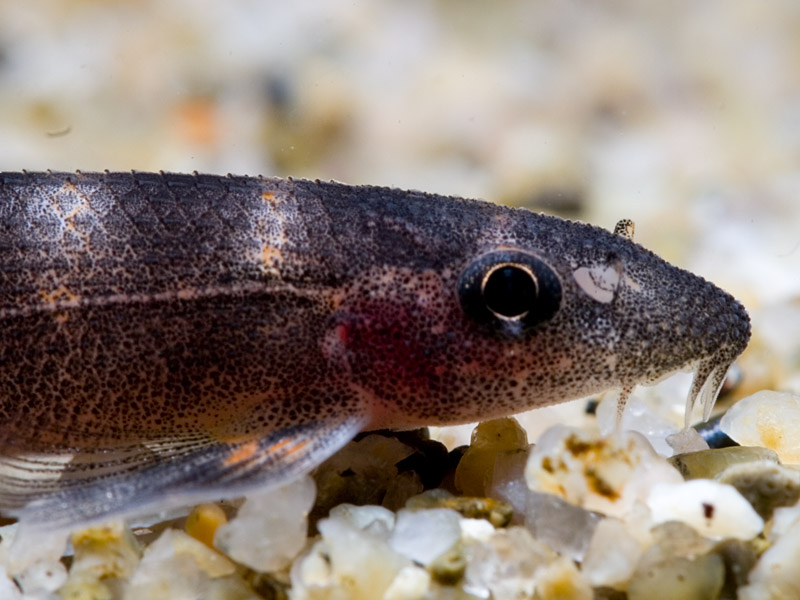
Balitoropsis zollingeri is a balitorid loach described from Java and recorded from Sumatra, Borneo, Peninsular Malaysia, Thailand, Laos and Cambodia. An obligate dweller of swiftly flowing streams and headwaters, it lives on riffles and runs over gravel, rocks and bedrock carpeted with biofilm. It needs clean, well-oxygenated water with strong turnover in the aquarium. It lives in aggregations in nature and is less bold when kept singly or in small numbers, so a group of six or more is best.
Etymology
EditBalitoropsis: from the generic name Balitora and the Ancient Greek ὄψις (ópsis), meaning 'aspect, appearance'.
zollingeri: named in honour of Swiss “naturalist explorer” and botanist Heinrich Zollinger (1818-1859), who donated his collection of fishes from Macassar (Indonesia) to Bleeker.
Distribution
EditType locality is 'Jakarta, Bandong, Java, Indonesia', presumably referring to the city of Bandung, West Java Province, Java, Indonesia.
It's since been recorded from Sumatra, Borneo, Peninsular Malaysia, the Chao Phraya and Mae Khlong watersheds in Thailand, and the Mekong River basin in Cambodia, Laos and Thailand.
Habitat
Write a noteEditAn obligate dweller of swiftly-flowing streams and headwaters containing clear, oxygen-saturated water. Adults inhabit riffles and runs and are likely to display a preference for shallower zones.
Substrates are generally composed of gravel, rocks, boulders or bedrock carpeted with a rich biofilm formed by algae and other micro-organisms.
Juveniles are often found in slower-moving stretches with gravel substrate and submerged tree roots. In both cases patches of aquatic plants are only occasionally present but riparian vegetation is usually well-developed.
In the Kahang River, part of the Endau drainage in Johor state, Peninsular Malaysia it's been recorded alongside Homalopteroides tweediei, H. nebulosus, Homaloptera parclitella, H. ogilviei, Malayochela maassi, Crossocheilus langei, Cyclocheilichthys apogon, Mystacoleucus marginatus, Rasbora dusonensis, R. elegans, R. paucisqualis, Trigonopoma gracile, 'Puntius' partipentazona, Nemacheilus masyae, N. selangoricus, Neohomaloptera johorensis, Acanthopsoides molobrion, Pangio cuneovirgata, P. doriae, P. kuhlii, P. malayana, P. piperata, P. shelfordii, Pseudomystus fuscus, Akysis microps, A. hendricksoni, and an unidentified species of Glyptothorax.
Aquarium size
Write a noteEditAn aquarium with base dimensions of 60 ∗ 30 cm24 ∗ 12 in or equivalent is required for long-term maintenance.
Maintenance
Write a noteEditMost importantly the water must be clean and well-oxygenated so we suggest the use of an over-sized filter as a minimum requirement. Turnover should ideally be 10-15 times per hour so additional powerheads, airstones, etc., should be employed as necessary to achieve the desired flow and oxygenation.
Base substrate can either be of gravel, sand or a mixture of both to which should be added a layer of water-worn rocks and pebbles of varying sizes.
Driftwood roots and branches are also suitable and aquatic plants from adaptable genera such as Microsorum, Crinum and Anubias spp. can also be included. The latter are particularly useful as these loaches appear to enjoy resting on their leaves.
Since it needs stable water conditions and feeds on biofilm this species should never be added to a biologically immature set-up, and a tightly-fitting cover is necessary since it can literally climb glass.
While regular partial water changes are essential aufwuchs can be allowed to grow on all surfaces except perhaps the viewing pane.
Water conditions
EditThese recommendations come from this profile’s own figures. They contain affiliate links, so we may earn a commission.
Diet
Write a noteEditBalitoropsis and Homaloptera spp. are specialised grazers feeding on biofilm, small crustaceans, insect larvae and other invertebrates.
In captivity some sinking dried foods may be accepted but regular meals of live or frozen Daphnia, Artemia, bloodworm, etc., are essential for the maintenance of good health and it's highly preferable if the tank contains rock and other solid surfaces with growths of algae and other aufwuchs.
Balitorids are often seen on sale in an emaciated state which can be difficult to correct. A good dealer will have done something about this prior to sale but if you decide to take a chance with severely weakened specimens they'll initially require a continual, easily-obtainable source of suitable foods in the absence of competitors if they're to recover.
Behaviour and compatibility
Write a noteEditNot an aggressive fish although its particular requirements limit the choice of suitable tankmates.
Species inhabiting similar environments include Barilius, Discherodontus, Garra, Devario, some Rasbora, gobies from genera such as Rhinogobius, Sicyopterus and Stiphodon plus Glyptothorax, Akysis and Oreoglanis spp. catfishes.
Many loaches from the family Nemacheilidae and most from Balitoridae are also suitable although harmless squabbles may occur with the latter group in particular. Research your choices before purchase to be sure.
It's found living in aggregations in nature so buy six or more to see it at its best as when kept singly, in pairs or trios it's less bold, although it should be noted that this is among the more retiring members of the genus.
Sexual dimorphism
Write a noteEditSexually mature females are usually a little larger and fuller-bodied than males.
Reproduction
Write a noteEditPresumably a seasonal spawner in nature but nothing has been recorded in aquaria.
Notes
EditThe genus Balitoropsis was created for the species B. bartschi Smith, 1945 and distinguished from Homaloptera (sensu lato) by having a deep preoral groove extending around the corners of the mouth and papillated lips. B. bartschi was subsequently synonymized with Homaloptera zollingeri. Kottelat (2012, 2013) recognized Balitoropsis as a genus with ten species, but Randall & Page (2012) initially considered it a putative subgenus within Homaloptera, an assemblage also containing H. leonardi, H. ophiolepis, H. sexmaculata, H. yunnanensis, H. maxinae, and H. tateregani.
Randall & Page (2015) later recognized Balitoropsis as a genus containing two species, B. zollingeri and B. ophiolepis. Randall & Riggs (2015) used morphological and molecular data to assess the status of species synonymized with B. zollingeri: Homaloptera maxinae Fowler 1937, Balitoropsis bartschi Smith 1945, and Homaloptera nigra Alfred 1969.
Following Randall & Page (2015), Balitoropsis is distinguished by the following combination of characters: without reddish tints on fins in life; dorsal-fin origin anterior to or above pelvic-fin origin; 8½ branched dorsal-fin rays; 7–9, 8 (M) branched pelvic-fin rays; forked caudal fin; keeled scales; 42–55 total lateral-line scales; 13–15 predorsal scales; large rostral cap; 2 thick rostral barbels in close proximity to one another; thick crescentic upper lip; fleshy pad between lateral portions of lower lip; anus closer to pelvic-fin insertion than to anal-fin origin.
Homaloptera and Pseudohomaloptera are the closest relatives of Balitoropsis which is distinguished from both genera by having the anus closer to the pelvic-fin base than to the anal-fin origin. Balitoropsis is further distinguished from Homaloptera by absence vs. presence of reddish tints on fins in life; 7–9 vs. 7 branched pelvic fin-rays; 13–15 vs. 20–27 predorsal scales; 42–55 vs. 59–73 total lateralline scales; crescentic vs. triangular upper lip.
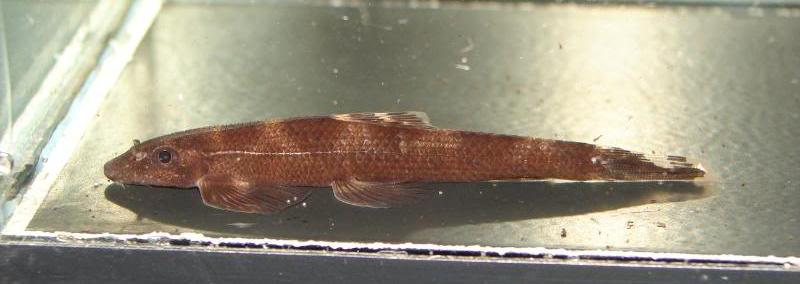
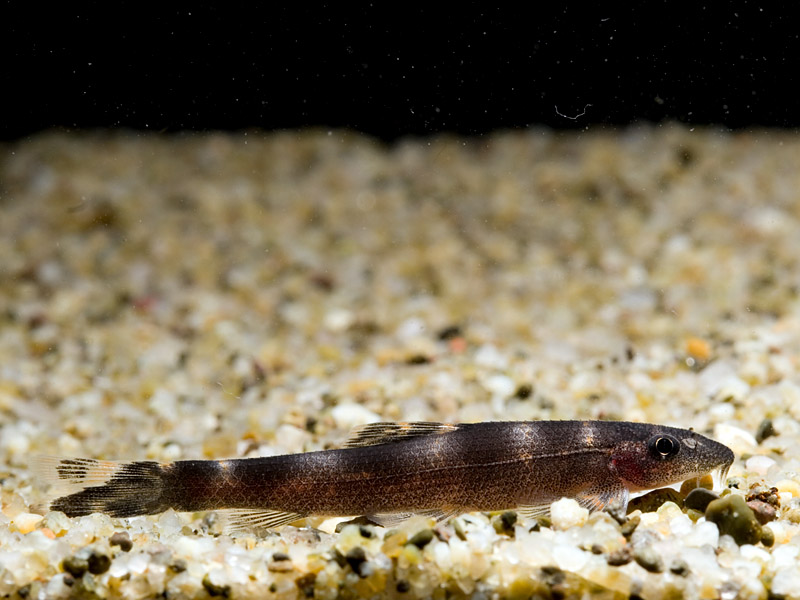
Balitoropsis zollingeri is distinguished from B. ophiolepis by mostly black caudal-fin with 1–3 black bands on distal extremity of white upper lobe vs. hyaline with multiple black bands; caudal-peduncle depth 8.0–9.3% vs. 4.0–5.1% SL; body depth 13.6–17.6% vs. 9.2–11.9% SL; 42–46 vs. 48–55 total lateral-line scales; and 17–20 vs. 13–14 circumpeduncular scales.
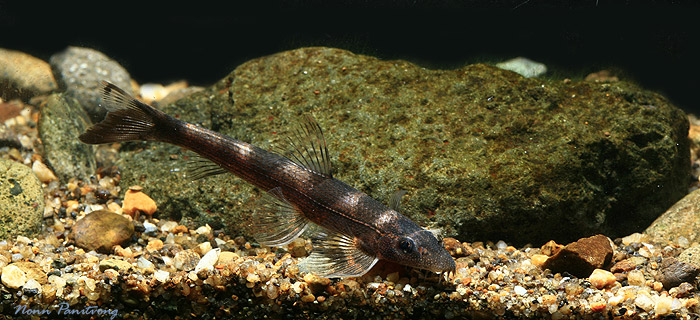
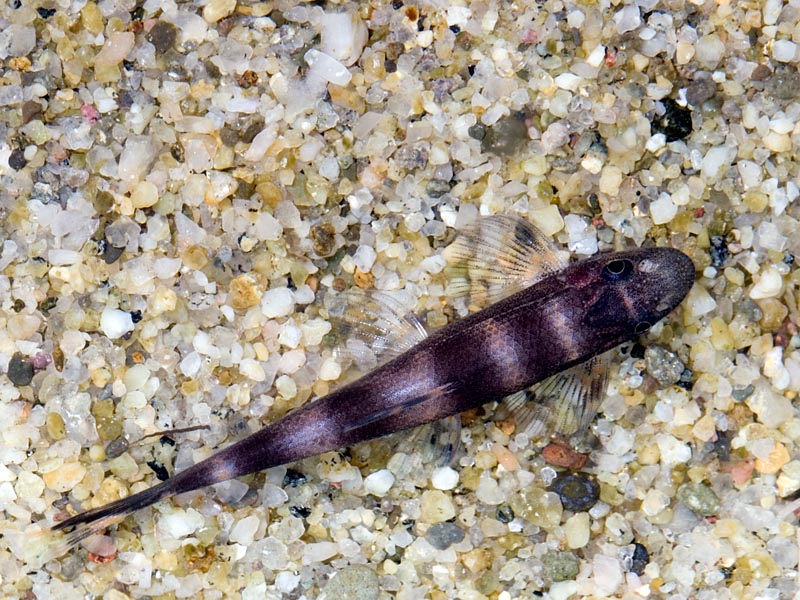
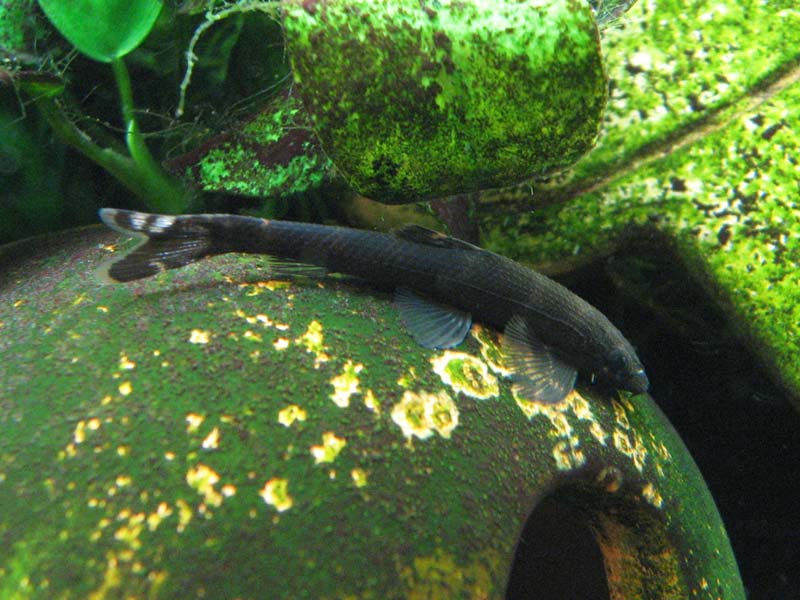
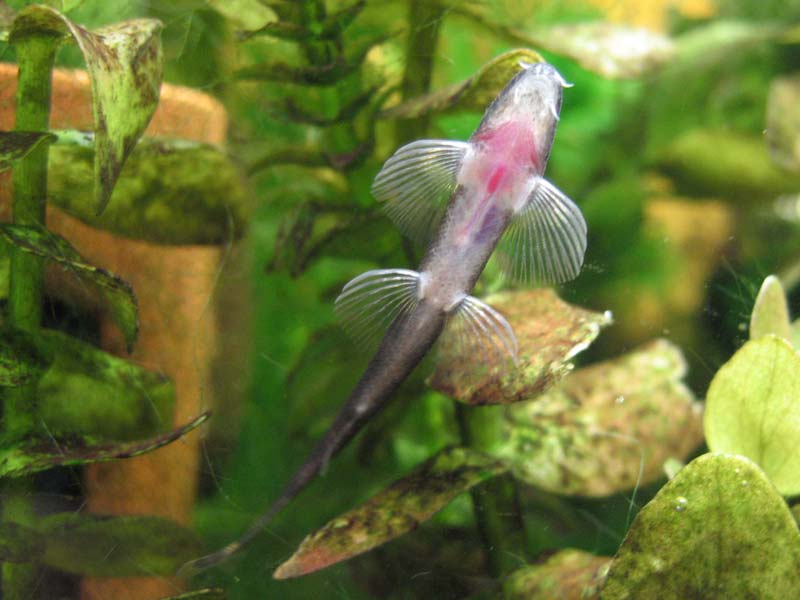
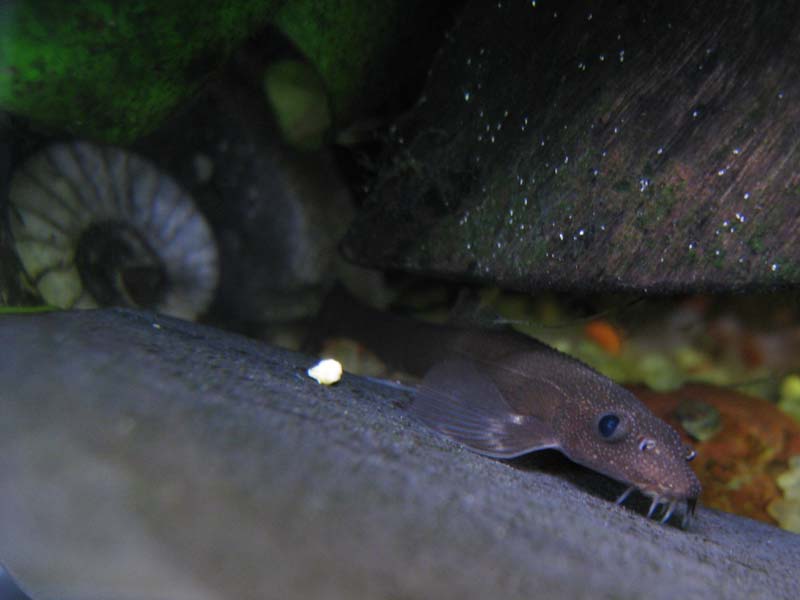
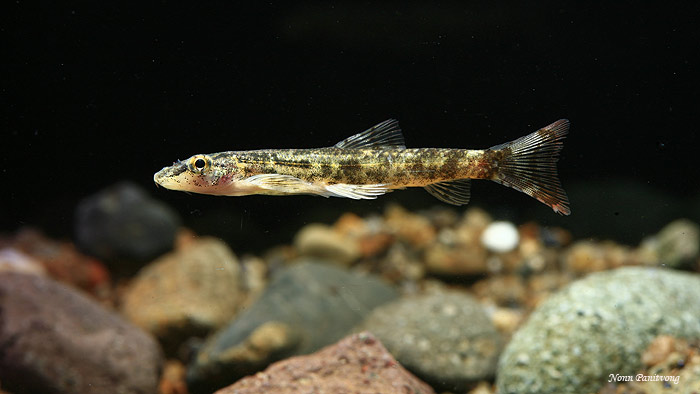
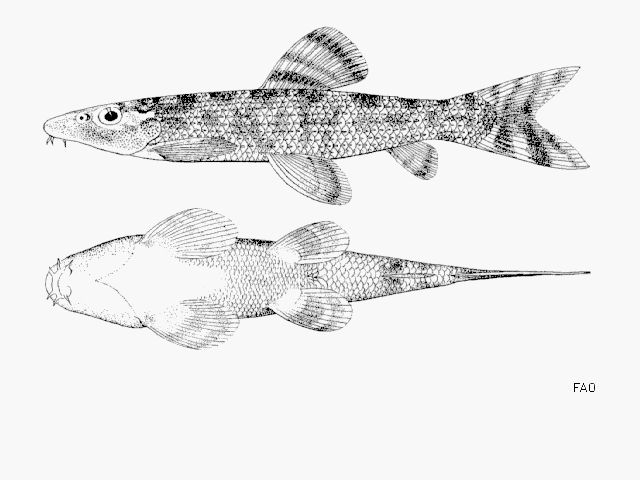
All balitorids make fascinating aquarium inhabitants and are often referred to as 'lizard' loaches due to their behaviour and appearance. Most have probably never been exported for the trade though B. zollingeri sometimes turns up among shipments of other species, and when available in numbers it is sometimes sold as 'black gecko' or 'lizard' loach. Like all balitorids it has morphology specialised for life in fast-flowing water, i.e., the paired fins are orientated and extended horizontally, head and body flattened, belly depressed. These features form a powerful sucking cup which allows the fish to cling tightly to solid surfaces. The ability to swim in open water is greatly reduced and they instead appear to crawl and hop their way over rocks and other surfaces.
The family Balitoridae as recognised by Kottelat (2012) is widely-distributed across much of the Indian subcontinent, Southeast Asia and China.
References
- Alfred, E. R. (1967). Homaloptera ogilviei, a new species of homalopterid fish from Malaya. Copeia 1967(3), 587-591
- Alfred, E. R. (1969). The Malayan Cyprinoid fishes of the family Homalopteridae. Zoologische Mededelingen 43, 213-237
- Kottelat, M. (1998). Homaloptera yuwonoi, a new species of hillstream loach from Borneo, with a new generic name for H. thamicola (Teleostei: Balitoridae). Ichthyological Exploration of Freshwaters 9(3), 267-272
- Kottelat, M. (2001). Fishes of Laos. WHT Publications, Colombo, 1-198
- Rainboth, W. J. (1996). Fishes of the Cambodian Mekong. FAO Species Identification Field Guide for Fishery Purposes. FAO, Rome, 1-265
- Roberts, T. R. (1989). The freshwater fishes of western Borneo (Kalimantan Barat, Indonesia). Memoirs of the California Academy of Sciences 14, 1-210
- Šlechtová, V., J. Bohlen and H. H. Tan (2007). Families of Cobitoidea (Teleostei; Cypriniformes) as revealed from nuclear genetic data and the position of the mysterious genera Barbucca, Psilorhynchus, Serpenticobitis and Vaillantella. Molecular Phylogenetics and Evolution 44(3), 1358-1365
- Tan, H. H. and P. K. L. Ng (2005). Homaloptera parclitella, a new species of torrent loach from the Malay Peninsula, with redescription of H. orthogoniata (Teleostei: Balitoridae). Ichthyological Exploration of Freshwaters 16(1), 1-12
- Tang, Q., H. Liu, R. Mayden and B. Xiong (2006). Comparison of evolutionary rates in the mitochondrial DNA cytochrome b gene and control region and their implications for phylogeny of the Cobitoidea (Teleostei: Cypriniformes). Molecular Phylogenetics and Evolution 39(2), 347-357
- Bleeker, P. (1853). Over eenige nieuwe soorten van Homaloptera v. Hass. (Balitora Gray) van Java en Sumatra. Natuurkundig Tijdschrift voor Nederlandsch Indië v. 4, 155-164
- Randall, Z. S. and L. M. Page (2012). Resurrection of the genus Homalopteroides (Teleostei: Balitoridae) with a redescription of H. modestus (Vinciguerra 1890). Zootaxa 3586, 329-346
- Kottelat, M. (2012). Conspectus cobitidum: an inventory of the loaches of the world (Teleostei: Cypriniformes: Cobitoidei). Raffles Bulletin of Zoology Supplement 26, 1-199
- Randall, Z. S. and P. A. Riggs (2015). Revision of the hillstream lizard loaches, genus Balitoropsis (Cypriniformes: Balitoridae). Zootaxa 3962(1), 206-225
- Randall, Z. S. and L. M. Page (2015). On the paraphyly of Homaloptera (Teleostei: Balitoridae) and description of a new genus of hillstream loaches from the Western Ghats of India. Zootaxa 3926(1), 57-86
- Kottelat, M. (2013). The fishes of the inland waters of southeast Asia: a catalogue and core bibliography of the fishes known to occur in freshwaters, mangroves and estuaries. The Raffles Bulletin of Zoology Supplement 27, 1-663
Species images · 10
These photographs are used with each photographer's permission.
Send a photographDistribution
Profile completeness22 of 24
Community
Questions about Balitoropsis zollingeri?
Ask on Discord