Belodontichthys dinema
Formerly Wallago dinema Bleeker, 1851 · Belodontichthys macrochir Bleeker, 1858
Last revised 2012Edit this page
On this page13 sections
Quick factsEdit
Difficulty6 of 8 measures
- Space
- very large tank
- Water
- flexible
- Temp
- flexible
- Diet
- unknown
- Temperament
- eats smaller fish
- Social
- fine alone
- Compatibility
- choose tankmates carefully
Other demands
Each of these can raise the rating on its own, whatever the measures above say.
- Hardiness
- unknown
- Needs a very large tank
Before you buy
Needs a tight-fitting lid as this species is known to jump
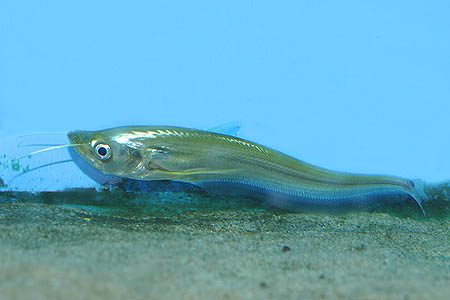
Belodontichthys dinema is a large, open-water predatory catfish from the Malay Peninsula, Sumatra and Borneo that reaches 100 cm TL in the wild. It eats only fish and needs a very large aquarium without tankmates small enough to swallow. Fish exported from Thailand or elsewhere in Indochina under this name are likely to be B. truncatus, the species found in the Mekong and Chao Phraya basins.
Etymology
EditBelodontichthys: from the Greek belos, meaning 'arrow', odous, meaning 'tooth', and ichthys, meaning 'fish', in reference to the arrow-shaped jaw teeth of this species.
dinema: from the Greek di-, meaning 'two', and nema, meaning 'thread', in reference to the pair of very thin, short barbels set far back on the chin.
Distribution
EditKnown from the Malay Peninsula, Sumatra and Borneo, in Malaysia and Indonesia.
In Borneo it's recorded from the Kapuas basin in West Kalimantan, including the lakes of the upper Kapuas (Roberts, 1989; Kottelat and Widjanarti, 2005), and in Sumatra from the central part of the island (Tan and Ng, 2000).
Type locality is 'Bandjarmasin', now Banjarmasin in South Kalimantan, Indonesian Borneo.
Older records from the Mekong and Chao Phraya basins in Thailand, Laos, Cambodia and Vietnam belong to B. truncatus. Kottelat and Ng (1999) described that species from fish previously identified as this one (see 'Notes').[1][2][3][4][5][6]
Habitat
Write a noteEditInhabits large rivers and their associated lakes, including the seasonally flooded lake system of the upper Kapuas in West Kalimantan (Kottelat and Widjanarti, 2005).
It swims in open water and feeds on smaller fishes.[3]
Aquarium size
Write a noteEditNeeds an aquarium measuring at least 180 ∗ 60 ∗ 60 cm72 ∗ 24 ∗ 24 in, and a fully grown fish needs far more space, since wild specimens reach 100 cm39 in TL.
Maintenance
Write a noteEditGive it plenty of open swimming space with a few large hiding places, such as lengths of wide plastic pipe. Few plants will survive the movements of a fish this size.
Filtration should be powerful and efficient, as it's a messy eater that produces a lot of waste, and large, regular water changes are essential.
Keep the tank covered with a heavy, tightly fitting lid, as it's a powerful jumper.
Water conditions
EditTemperature: 22 – 27 °C72 – 81 °F
pH: 5.6 – 7.0
Hardness: 1 – 10 dGH
These recommendations come from this profile’s own figures. They contain affiliate links, so we may earn a commission.
Diet
Write a noteEditAn obligate piscivore that feeds on smaller fishes.
Aquarium reports say it takes only live fish, so a keeper needs a steady supply of healthy feeder fish, quarantined before use.
Behaviour and compatibility
Write a noteEditEats any fish it can fit in its mouth, so it's best kept as a single specimen, or with robust fishes too large to be swallowed.
Sexual dimorphism
Write a noteEditMales are reported to have a strongly serrated pectoral-fin spine, and mature females are plumper than males.[8]
Reproduction
Write a noteEditNot recorded as bred in aquaria, and we have no information on how it breeds in the wild.
Notes
EditBelodontichthys contains two species. B. truncatus Kottelat and Ng, 1999 is the species found in the Mekong and Chao Phraya basins, and it has a shorter head (20.9–23.9% SL, against 24.2–26.0% in B. dinema), a shorter snout (35.4–39.6% of head length, against 39.0–43.1%) and shorter pectoral fins (21.9–25.8% SL, against 25.9–28.9%).
Fish exported from Thailand or elsewhere in Indochina under this name are likely to be B. truncatus.
Bleeker described the species as Wallago dinema in 1851 and renamed it Belodontichthys macrochir in 1858, based on the same type specimens. That second name was unnecessary and is an objective synonym.
FishBase describes a strongly compressed head and body, an upturned snout with the profile concave above the eye, a small dorsal fin with 4 rays, an anal fin with 85–96 rays, and pectoral fins longer than the head.
The IUCN Red List assesses it as Least Concern (2019).[1][5][7]
References
- Bleeker, P. (1851). Vierde bijdrage tot de kennis der ichthyologische fauna van Borneo, met beschrijving van eenige nieuwe soorten van zoetwatervisschen. Natuurkundig Tijdschrift voor Nederlandsch Indië v. 2, 193-208
- Roberts, T. R. (1989). The freshwater fishes of western Borneo (Kalimantan Barat, Indonesia). Memoirs of the California Academy of Sciences 14, 1-210
- Kottelat, M. and E. Widjanarti (2005). The fishes of Danau Sentarum National Park and the Kapuas Lakes area, Kalimantan Barat, Indonesia. Raffles Bulletin of Zoology Supplement 13, 139-173
- Tan, H. H. and H. H. Ng (2000). The catfishes (Teleostei: Siluriformes) of central Sumatra. Journal of Natural History 34(2), 267-303
- Kottelat, M.; Ng, H. H. (1999). Belodontichthys truncatus, a new species of silurid catfish from Indochina (Teleostei: Siluridae) Ichthyological Exploration of Freshwaters 10(4), 387-391
- Eschmeyer's Catalog of Fishes: Belodontichthys dinema California Academy of Sciencesresearcharchive.calacademy.org/research/ichthyology/catalog/fishcatget.asp?spid=46890
- Belodontichthys dinema summary page FishBasefishbase.se/summary/Belodontichthys-dinema.html
- Clarke, M. Dracula sheatfish, Belodontichthys truncatus Practical Fishkeepingpracticalfishkeeping.co.uk/features/dracula-sheatfish-belodontichthys-truncatus
Species images · 2
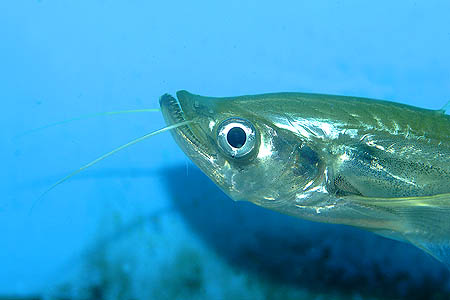
These photographs are used with each photographer's permission.
Send a photographDistribution
Profile completeness23 of 24
Community
Questions about Belodontichthys dinema?
Ask on Discord