Hyalobagrus flavus
Shadow Catfish
Last revised 2026Edit this page
On this page11 sections
Quick factsEdit
Difficulty5 of 8 measures
- Space
- medium tank
- Water
- flexible
- Temp
- flexible
- Diet
- unknown
- Temperament
- peaceful
- Social
- needs to be in a group
- Compatibility
- unknown
Other demands
Each of these can raise the rating on its own, whatever the measures above say.
- Hardiness
- unknown
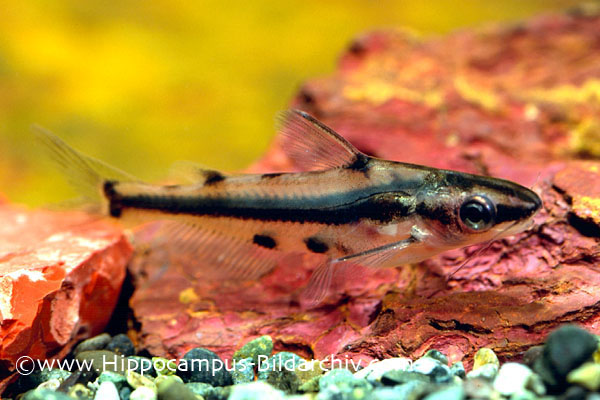
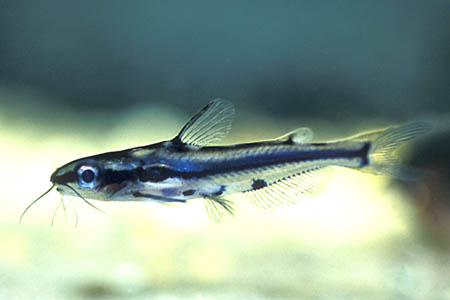
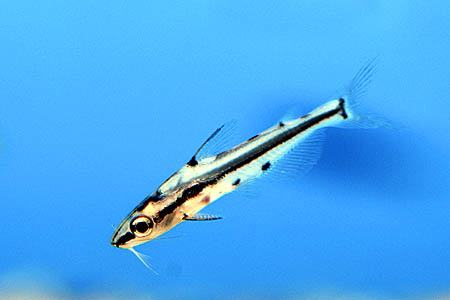
The shadow catfish, Hyalobagrus flavus, is a small bagrid catfish from the Batang Hari drainage in Sumatra and the Mentaya basin in Borneo. For many years it has been imported as Pelteobagrus ornatus. Unlike most catfish it is diurnal and spends much of its time swimming in shoals in midwater, and it suits a peaceful community with soft, acidic water.
Distribution
EditEndemic to parts of Indonesia.
Habitat
Write a noteEditThis is a riverine species found in the Batang Hari drainage in Sumatra and the Mentaya Basin in Borneo. It's biotope is typified by acidic blackwaters and it can often be found in large shoals, hovering under cover of floating vegetation, or amongst submerged grasses.
Aquarium size
Write a noteEdit45 ∗ 30 ∗ 30 cm18 ∗ 12 ∗ 12 in - ~41 litres~11 US gal.
Maintenance
Write a noteEditIt does best in soft, acidic water conditions. The fish are more outgoing if they are provided with some cover, so try planting the tank quite densely in some areas, whilst leaving some open spaces for swimming. The addition of some floating vegetation to diffuse the light is also a good idea. Other decor can include driftwood and smooth rocks. Water movement should be kept to a minimum. It is sensitive to deteriorating water quality, so efficient filtration and a regular maintenance routine are essential.
Water conditions
EditTemperature: 21 – 26 °C70 – 79 °F
pH: 5.5-7.0
Hardness: 5-12°H
These recommendations come from this profile’s own figures. They contain affiliate links, so we may earn a commission.
Diet
Write a noteEditThe basis of the diet should be small frozen and live foods such as bloodworm, brineshrimp, daphnia etc. Dried foods are usually accepted but the fish will not develop their best condition if fed on these exclusively.
Behaviour and compatibility
Write a noteEditA very peaceful and gregarious little catfish which does best when kept in a shoal of at least six individuals. Tankmates are completely ignored and it is therefore suitable for most communities of small to medium-sized, peaceful species. Recommended tankmates include rasboras, danios and small loaches.
Sexual dimorphism
Write a noteEditWhen gravid the green eggs of females are clearly visble through the virtually transparent body. Males have a small genital papilla just in front of their anal fin and are generally less round in the belly than females.
Reproduction
Write a noteEditNot thought to have been bred in captivity, although this is likely down to a lack of effort, rather than the degree of difficulty. Soft, acidic, tannin-stained water is probably a good start.
Notes
EditFor many years this species has (and still is) imported as Pelteobagrus ornatus. It was assigned to the new genus Hyalobagrus, and discovered to be a distinct species, during a taxonomic revision of the Bagridae family in 1998. The other 2 species which were also thought to be P. ornatus are H. leiacanthus and H. ornatus. Apparently these two are imported rarely, if ever.
Unlike the vast majority of catfish, H. flavus is a diurnal species, and spends much of its time swimming in shoals in midwater. This feature makes it ideal for the peaceful community tank and it's surprising it has not achieved greater popularity in the hobby.
There is a species of Crossocheilus, C. pseudobagroides, that is known to mimic this catfish in nature.
Species images · 3
These photographs are used with each photographer's permission.
Send a photographProfile completeness19 of 24
79% complete
Also missing: a recorded distribution, taxonomic authority, etymology.
Community
Questions about Hyalobagrus flavus?
Ask on Discord