Procatopus nototaenia
Large-finned Lampeye
Last revised 2012Edit this page
On this page11 sections
Quick factsEdit
Difficulty4 of 8 measures
- Space
- medium tank
- Water
- flexible
- Temp
- flexible
- Diet
- unknown
- Temperament
- unknown
- Social
- needs to be in a group
- Compatibility
- unknown
Other demands
Each of these can raise the rating on its own, whatever the measures above say.
- Hardiness
- unknown
Before you buy
Needs a tight-fitting lid as this species is known to jump
Like most killis, it's an excellent jumper and a tightly-fitting cover should be considered a prerequisite.
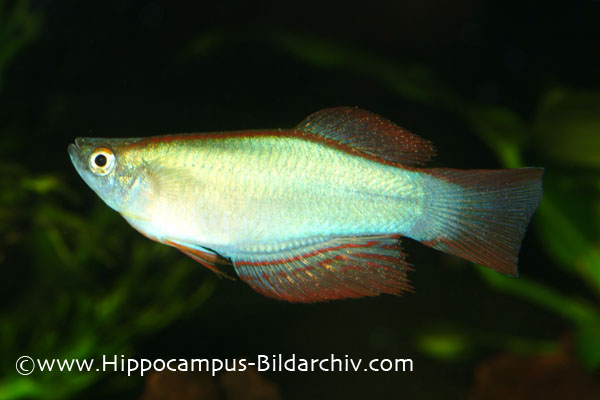
The large-finned lampeye, Procatopus nototaenia, is a killifish thought to be endemic to the Lobi and Kienke river basins in southwestern Cameroon. It lives in shady forest streams with clear, moderately flowing water. Several colour forms are known by collection locality, among them 'Kribi', 'Edea' and 'Kopongo', and should never be mixed. The males carry the differences in colour and finnage, their dorsal, anal and caudal fins lengthening as they mature.
Distribution
EditHabitat
Write a noteEditUsually found in shady forest streams with clear, moderately flowing water. These typically exhibit lush marginal plant growth with lots of overhanging cover.
Aquarium size
Write a noteEditGiven its active nature a tank measuring at least 60 ∗ 30 ∗ 30 cm24 ∗ 12 ∗ 12 in - ~54 litres~14 US gal is recommended to house a small group.
Maintenance
Write a noteEditThis species does well in heavily-planted aquaria in which the growth of aquatic plants provides plenty of shaded areas. The addition of some floating vegetation is also a good idea as it predominantly swims in the upper levels of the water column. Like most killis, it's an excellent jumper and a tightly-fitting cover should be considered a prerequisite.
It will also thrive in a tank set up to resemble its natural habitat of clear jungle streams. Use coarse gravel as substrate, adding some smooth, water worn rocks and driftwood twigs/branches to create the desired effect. Placing the filter or spraybar at one end of the tank will provide the desired flow, and locating these in such a way that the flow of water breaks the surface is useful in supplying additional oxygen. Most aquatic plants will fail to thrive in such conditions, but the African native genera Bolbitis and Anubias are tough and usually survive.
Hailing from such environments where the water is constantly being refreshed means that the species is particularly sensitive to accumulation of organic wastes. Small, frequent water changes of 10-20% tank volume are therefore a must in order to maintain high water quality.
Water conditions
EditTemperature: Prefers slightly cooler water in the range 68 - 77°F (20 - 25°C).
pH: Supposed to be an acidophile but we know of at least one aquarist who has spawned these in moderately hard water. Anywhere within the range 5.8 - 7.5 should be ok.
Hardness: 1 - 10°H
These recommendations come from this profile’s own figures. They contain affiliate links, so we may earn a commission.
Diet
Write a noteEditThe upturned mouth and keeled body shape suggest that this species feeds primarily on small invertebrates taken from the water surface in nature. In the aquarium it's particularly fond of live and frozen foods such as Daphnia, bloodworm and Artemia.
Behaviour and compatibility
Write a noteEditThis species does well in a community of other peaceful species that enjoy similar conditions. In an African-themed stream tank suitable tankmates include Alestiid characins such as Alestopetersius caudalis or Ladigesia roloffi, African Garra species, smaller Mochokid catfish and reophilic cichlids such as Steatocranus. It will also do well alongside smaller danionins, hill stream loaches, many South American characins and smaller Loricariids.
Don't keep it with any much larger or more vigorous fish as it is fairly shy and will easily be outcompeted for food. Similarly the elegant finnage of adult males can prove very tempting to any species that have a reputation for nipping fins. It's a schooling species by nature and looks far more impressive when maintained in groups so always buy a minimum of 6-8 specimens. Try to get a mixture of males and females as the males will exhibit more intense colouration in the presence of the opposite sex.
Sexual dimorphism
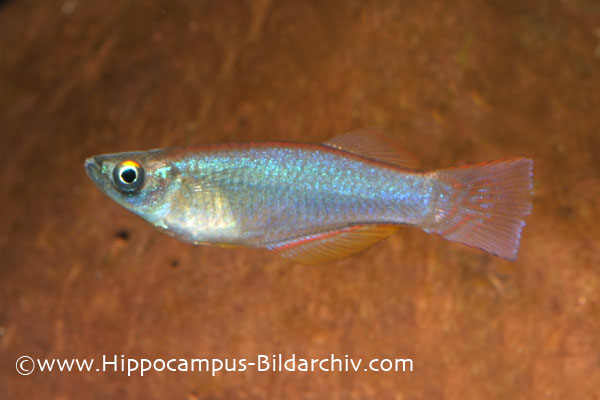
Write a noteEditMales are larger and much more colourful than females, which are a relatively plain silvery colour. The dorsal, anal and caudal fins of the male also become elongated as the fish matures, to spectacular effect in some populations.
Reproduction
Write a noteEditFor breeding purposes a bare, gently filtered tank with dim lighting is all that is needed. Like other Procatopus, this species follows a strategy of breeding known as crevice spawning, in which the eggs are laid in small nooks and crannies in order to avoid predation. A suitable medium can be provided by adding clumps of java moss or wrapping elastic bands around a spawning mop at regular intervals so that the mop is squeezed together. Appropriate pieces of bogwood or perhaps small inert rocks could also be used but it would be harder to remove the eggs. A small air-powered spomge filter should also be added to provide additional oxygenation and a bit of flow for the adults.
Condition these on small live and frozen foods. Once they reach sexual maturity they should spawn daily. The eggs should be transferred to a separate tank or suitable container (many breeders use ice-cream or margarine tubs) for hatching, easily achieved by gently pulling the spawning medium apart and removing eggs as you spot them. If you are finding that the fish are reluctant to spawn, try raising the temperature by a few degrees over several days.
Use water from the adults' tank in the hatching container, and avoid placing it in direct light of any kind. Some breeders prefer to add an airstone to the container. The length of the incubation period is dependant on temperature, but 10-14 days is normal. The tiny fry will require an infusoria-type food initially, followed by Artemia nauplii or microworm after 3-4 days. They grow slowly and for the first couple of months may appear to be having difficulty swimming as they adopt a strange head-up posture in the water. This is completely natural, and presumably helps them to find food in nature.
Notes
EditThe genus Procatopus currently comprises half a dozen members (P. aberrans, P. lambertii, P. nimbaensis, P. nototaenia, P. schioetzi and P. similis), all of which are are non-annual species existing in permanent bodies of water. They are actually more closely related to the livebearing species of the subfamily Poeciliinae than the popular Aplocheilid killifish. None are particularly popular in the aquarium trade, although specialist dealers may have them available from time-to-time. Some such as P. nototaenia and P. aberrans are quite widely available in hobbyist circles, though.
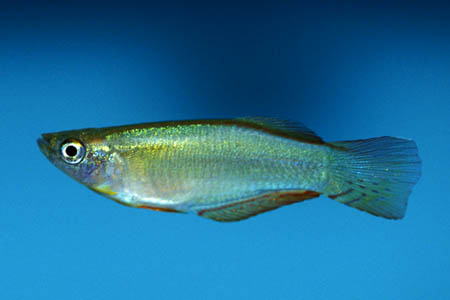
P. nototaenia is the type species. It exists in several colour forms depending on collection locality. These include "Kribi", "Yabassi", "Fifinda", "Makondo", "Edea" and "Kopongo". It is usually only the males of these that vary in colour and finnage, with females appearing almost identical and very difficult to tell apart. It goes without saying that the different forms should never be mixed in the aquarium in order to avoid hybridisation.
Species images · 3
These photographs are used with each photographer's permission.
Send a photographProfile completeness18 of 24
75% complete
Also missing: a recorded distribution, taxonomic authority, etymology.
Community
Questions about Procatopus nototaenia?
Ask on Discord