Every species
Filters
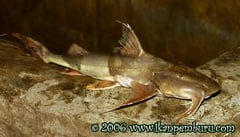
Bagarius rutilus
Ng & Kottelat, 2000
Max length1000mm SL39in SLTanknot recordedTemp18–23°C64–73°FpH6.0–7.5Bagarius rutilus is a sisorid catfish from the Red River and other drainages of northern Vietnam and Yunnan in southern China, possibly also Laos. Reaching 700 to 1000 mm SL, it is clearly unsuitable for the home aquarium, and small numbers are only occasionally exported. It has orange fins in life. Adults live in fast, turbulent rapids in large river channels and perform spawning migrations when rivers swell between March and June.

Bagarius suchusCrocodile Catfish
Roberts, 1983
Max length700mm SL28in SLTanknot recordedTemp18–23°C64–73°FpH6.0–7.5The crocodile catfish, Bagarius suchus, is a sisorid catfish from the Mekong system in Thailand, Laos and Cambodia and the Chao Phraya in Thailand. Reaching 650 to 700 mm SL, it is clearly unsuitable for the home aquarium. An exposed, rugose cranium, sharp ridges on the predorsal plate and a row of prominent humps along the back separate it from congeners. It is mostly collected from turbulent rapids in larger rivers, where it shelters among boulders and large rocks.

Bagarius vegrandis
Ng & Kottelat, 2021
Max length220mm SL9in SLTanknot recordedTempnot recordedpHnot recordedBagarius vegrandis is a small sisorid catfish from the Chao Phraya and Mekong drainages in Thailand, Laos and Cambodia. Described by Ng & Kottelat in 2021, it grows to about 22 cm SL, much smaller than any other Bagarius. Most records of B. bagarius from Indochina refer to it. It lives in rapids and rocky pools of large and medium-sized rivers.
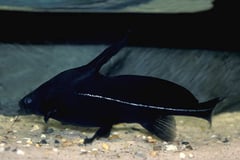
Bagrichthys macracanthusBlack Lancer
(Bleeker, 1854)
Max length230mm SL9in SLTank120 × 45cm48 × 18inTemp24–28°C75–82°FpH5.5–7.0The black lancer, Bagrichthys macracanthus, is a bagrid catfish described from Sumatra, Indonesia, and possibly endemic to that island. The name 'lancer' comes from the extended dorsal spine of several members of the genus. Fish from the Chao Phraya and Mekong once included in it were described as B. majusculus in 2002. A shy, nocturnal catfish of large, turbid rivers, it needs a dimly lit tank with plenty of hiding places and is territorial towards other bottom-dwellers.

Bagrichthys majusculusWhite-Whisker Lancer
Ng, 2002
Max length177mm SL7in SLTank120 × 45cm48 × 18inTemp24–28°C75–82°FpH5.5–7.0The white-whisker lancer, Bagrichthys majusculus, is a bagrid catfish from the Mekong and Chao Phraya river systems in Thailand and Laos. Described from the Mun River in eastern Thailand, it is most similar to B. macracanthus and B. vaillantii and differs from both in its longer pectoral-fin spines. It inhabits large, turbid, slow rivers and moves into flooded riparian zones to spawn in the wet season. A shy, nocturnal fish, it is territorial towards other bottom-dwellers, especially its own kind.

Bagrichthys obscurus
Ng, 1999
Max length249mm SL10in SLTank120 × 45cm48 × 18inTemp24–28°C75–82°FpH5.5–7.0Bagrichthys obscurus is a bagrid catfish from the Chao Phraya, Bang Pakong and Mekong watersheds in Thailand, Cambodia and Vietnam. One of the lancers, named for the extended dorsal spine in several members of the genus, it has a uniformly brown body with no pale stripe or blotches, a small mouth and a relatively short dorsal spine. It inhabits large, turbid rivers with slow flow, and is shy, nocturnal and territorial towards other bottom-dwellers.
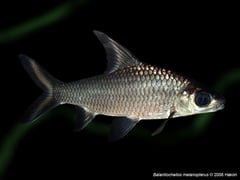
Balantiocheilos melanopterusSilver Shark
(Bleeker, 1850)
Max length350mm SL14in SLTank240 × 60cm96 × 24inTemp20–28°C68–82°FpH6.0–8.0The silver shark, Balantiocheilos melanopterus, is a large cyprinid from Borneo, Sumatra and possibly Peninsular Malaysia. Also sold as the 'Bala shark', it is among the most commonly encountered ornamental fishes, yet it reaches 300 to 350 mm SL and long-term care is beyond most hobbyists. Wild populations have dwindled or vanished, it has been listed as Endangered by the IUCN since 1996, and fish on sale are almost certainly all commercially bred. It does not occur in Indochina.
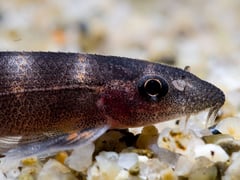
Balitoropsis zollingeri
(Bleeker, 1853)
Max length70mm SL2.8in SLTank60 × 30cm24 × 12inTemp20–25.5°C68–78°FpH6.0–7.5Balitoropsis zollingeri is a balitorid loach described from Java and recorded from Sumatra, Borneo, Peninsular Malaysia, Thailand, Laos and Cambodia. An obligate dweller of swiftly flowing streams and headwaters, it lives on riffles and runs over gravel, rocks and bedrock carpeted with biofilm. It needs clean, well-oxygenated water with strong turnover in the aquarium. It lives in aggregations in nature and is less bold when kept singly or in small numbers, so a group of six or more is best.
Balroglanis macracanthus
(Soares-Porto, 2000)
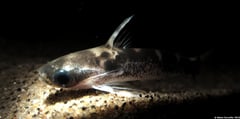
Max length71mm SL2.8in SLTank80 × 30cm31 × 12inTemp22–28°C72–82°FpH4.0–7.0Balroglanis macracanthus is a small driftwood catfish endemic to the upper rio Negro system in Brazil. Poorly known but occasionally available in the aquarium hobby, it shelters among submerged wood by day and forages at night. Like other auchenipterids it practises internal insemination, and females can carry eggs and sperm packets until conditions trigger fertilisation.

Bangana devdevi
(Hora, 1936)
Max length250mm SL10in SLTanknot recordedTempnot recordedpHnot recordedBangana devdevi is a cyprinid known with certainty from the Irrawaddy system in Manipur, India, and Myanmar, and the Salween in Myanmar and Thailand. Records from the Red River basin in Vietnam appear questionable. It presumably inhabits flowing river channels and larger tributaries and migrates seasonally, as related species do.

Barbodes aurotaeniatus
(Tirant, 1885)
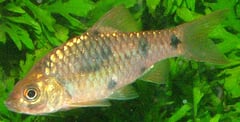
Max length65mm SL2.6in SLTank80 × 30cm31 × 12inTemp18–26°C64–79°FpH6.0–7.5Barbodes aurotaeniatus is a small cyprinid from the middle and lower Mekong basin in Laos, Vietnam, Cambodia and Thailand. Uncommon in the aquarium trade, it has a single pair of maxillary barbels, lacking the rostral barbels of other Barbodes, and usually four small vertical black markings on the flanks. It inhabits streams, irrigation canals and ditches, and is apparently very peaceful, best kept in a mixed-sex group of 6 to 10.
Barbodes banksi
(Herre, 1940)
Max length110mm SL4in SLTank120 × 45cm48 × 18inTemp22–28°C72–82°FpH6.0–7.5Barbodes banksi is a cyprinid from Peninsular Malaysia, Singapore and western Borneo, plus the Anambas and Natuna islands of Indonesia. It is tentatively considered distinct from the closely related B. binotatus, differing in a dark, wedge-shaped marking below the dorsal fin in place of a midlateral spot, though the two may be colour forms of a single species. Occasionally exported as bycatch, it lives in habitats from fast hill streams to canals and floodplain ponds.

Barbodes binotatusSpotted Barb
(Valenciennes, 1842)
Max length200mm SL8in SLTank120 × 45cm48 × 18inTemp18–30°C64–86°FpH6.0–7.5The spotted barb, Barbodes binotatus, is a cyprinid ranging from Myanmar and Thailand through the Greater Sunda Islands to the Philippines. So ubiquitous across its range that it's often called simply 'common barb', it occurs from sea level to at least 2000 m in habitats from fast-flowing hill streams to irrigation canals and floodplain ponds. The basic pattern of a dark spot at the dorsal-fin origin and another on the caudal peduncle varies with origin.
Barbodes dunckeriClown Barb
(Ahl, 1929)
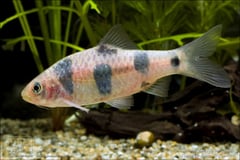
Max length120mm SL5in SLTank120 × 45cm48 × 18inTemp18–28°C64–82°FpH6.0–7.5The clown barb, Barbodes dunckeri, is a cyprinid from Peninsular Malaysia, described from Singapore, where it may now be extirpated. It has been widely misidentified as B. everetti, a distinct species from Borneo, and appears under that name in most aquarium literature. B. dunckeri has much larger dark body markings, no blotch at the rear of the dorsal-fin base and 4½ scales above the lateral line. Fish entering the ornamental trade appear to be farm-raised.
Barbodes everetti
(Boulenger, 1894)
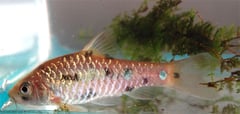
Max length120mm SL5in SLTank120 × 45cm48 × 18inTemp18–28°C64–82°FpH6.0–7.0Barbodes everetti is a cyprinid from Borneo, known from Sarawak and West Kalimantan, where it lives in clear forest streams in the foothills. Uncommon in the hobby, its name has been widely misapplied to the clown barb, B. dunckeri, from Peninsular Malaysia and Singapore. B. everetti is the less colourful of the two, with relatively small dark body markings, a dark blotch at the rear of the dorsal-fin base and 3½ scales above the lateral line.
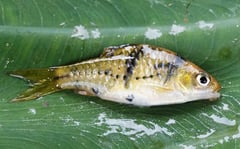
Barbodes kuchingensisFalse Spanner Barb
(Herre, 1940)
Max length120mm SL5in SLTank120 × 45cm48 × 18inTemp20–28°C68–82°FpH5.0–7.5The false spanner barb, Barbodes kuchingensis, is a cyprinid apparently endemic to western Borneo, from Sarawak into the Kapuas system. It lives mainly in shallow, clear forest streams and is rarely exported, while subadult B. everetti and some populations of Striuntius lateristriga are regularly traded under its name. B. kuchingensis sensu stricto has a prominent row of dark spots along the lateral line and a short streak extending from the upper part of the operculum.
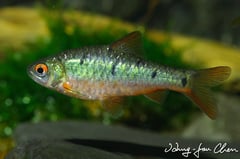
Barbodes semifasciolatusGolden Barb*
(Günther, 1868)
Max length75mm SL3.0in SLTank90 × 30cm36 × 12inTemp16–24°C61–75°FpH6.0–8.0Barbodes semifasciolatus, the green or Chinese barb, is a cyprinid from Vietnam, Taiwan, southwestern China and northern Laos. The natural green form is an infrequent find in the trade, but the selectively-bred golden variant, first produced in the 1960s, is farmed in huge numbers. Commercial fish are largely inbred, with reduced fins and other deformities not uncommon. The name 'Puntius schuberti' often given to the golden form is not an official scientific name.
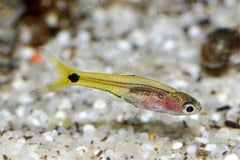
Barboides gracilis
Brüning, 1929
Max length18mm SL0.7in SLTank45 × 20cm18 × 8inTemp21–26°C70–79°FpH6.0–7.0Barboides gracilis is a miniature cyprinid from coastal West and Central Africa, ranging from Benin through Nigeria and Cameroon to Equatorial Guinea. Adults measure less than 20 mm SL, and it inhabits slow-moving, shady rainforest streams and swamps with dense marginal vegetation. It has a following among enthusiasts of planted 'nano' aquaria and may be sold as 'dwarf amber/ember barb'. Very peaceful but timid, it is best kept alone or with other diminutive West African species.

Barbonymus altusRed-tailed Tinfoil Barb
(Günther, 1868)
Max length210mm SL8in SLTank150 × 60cm60 × 24inTemp20–27°C68–81°FpH6.0–8.0The red-tailed tinfoil barb, Barbonymus altus, is a large cyprinid from Thailand, Laos, Cambodia and Vietnam. One of two species traded as 'tinfoil barb', it is usually sold at 50 to 75 mm with little information on its eventual size, and long-term care is beyond the resources of most hobbyists. Natural fish lack the black stripe along each caudal-fin lobe seen in B. schwanefeldii, and adults have a golden or bronze hue.

Barbonymus gonionotus
(Bleeker, 1849)
Max length300mm SL12in SLTank210 × 60cm84 × 24inTemp20–26°C68–79°FpH6.0–8.0Barbonymus gonionotus is a large cyprinid with an enormous distribution across Southeast Asia, from the Mekong to Java and Sumatra. It inhabits larger, slow-moving rivers and their floodplains, moving into flooded forest to feed and spawn, and is increasingly found in man-made canals and lakes. Plain grey caudal and dorsal fins and pale yellow pelvic and anal fins separate it from congeners. Populations in Peninsular Malaysia appear to be introduced.