Every species
Filters
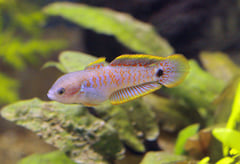
Tateurndina ocellicaudaPeacock Goby
authority not recorded
Max length75mm SL3.0in SLTank45 × 30cm18 × 12inTemp22–26°C72–79°FpH6.5–7.5The peacock goby, Tateurndina ocellicauda, is a small sleeper from Papua New Guinea, found in lowland rainforest streams, ponds and rivers. The name is misleading, as it belongs to the Eleotridae, the sleepers or gudgeons, which lack the fused pectoral fins of true gobies. A little territorial with its own kind, it suits communities of small, peaceful fish, and it spawns in caves and is easily bred under the right conditions.
Tatia galaxias
Mees, 1974
Max length126mm SL5in SLTanknot recordedTemp22–30°C72–86°FpH6.0–7.0Tatia galaxias is a wood catfish from the Orinoco river basin in Venezuela and Colombia, dark with small, round white spots like stars. It is sometimes confused with Tatia intermedia, in which the spots are longer and oval.
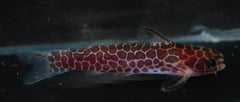
Tatia reticulataReticulated Driftwood Catfish
Mees, 1974
Max length27mm SL1.1in SLTank60 × 30cm24 × 12inTemp22–28°C72–82°FpH5.0–7.5The reticulated driftwood catfish, Tatia reticulata, is a small auchenipterid first known from the upper Rupununi River basin in Guyana. Its secretive, mostly nocturnal habits mean it may have been overlooked elsewhere, and it has been recorded from the rio Preto da Eva near Manaus, Brazil. Sometimes traded as 'purple oil catfish', it is highly gregarious and ideally kept in groups of at least eight.
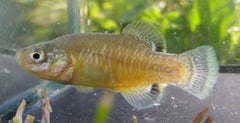
Tellia apodaFootless Toothcarp
Gervais, 1853
Max length45mm SL1.8in SLTank120 × 30cm48 × 12inTemp16–30°C61–86°FpH7.0–9.0The footless toothcarp, Tellia apoda, is endemic to a small area of the Tellian Atlas mountains in northeastern Algeria. It lacks ventral fins and sits apart from the other western Aphanius in genetic terms. The last collection was in 1990, and rumours suggest it may already be extinct through introduced Gambusia affinis and agricultural pollution. Fish in the hobby should all come from the population at Aïn M'Lila.

Telmatochromis vittatus
authority not recorded
Max length85mm SL3.3in SLTank75 × 30cm30 × 12inTemp23–27°C73–81°FpH8.0–9.5Telmatochromis vittatus is a lamprologine cichlid endemic to Lake Tanganyika, found in open water near rocky areas at 5 to 20 metres. Similar in lifestyle to Julidochromis species, it suits the smaller Tanganyikan community. It is told from T. brichardi and T. bifrenatus by its larger size, smaller eyes and more rounded nose, and should be kept as a pair because it is aggressive towards conspecifics.
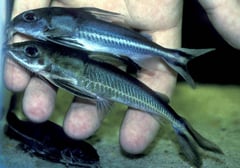
Tenellus leporhinusMouse Catfish
(Eigenmann, 1912)
Max length80mm SL3.1in SLTank60 × 38cm24 × 15inTemp22–25°C72–77°FpH6.3–7.0The mouse catfish, Tenellus leporhinus, is a doradid catfish recorded from Venezuela, Guyana and Brazil. Rare in the hobby, it sometimes shows up as bycatch among Hassar or Hemidoras species and is most often confused with Hemidoras stenopeltis. T. leporhinus has a clear dorsal fin with a dark patch at the base and a more rounded snout. It is shy and nocturnal.
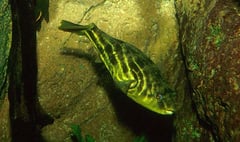
Tetraodon lineatusFahaka Puffer
authority not recorded
Max length430mm SL17in SLTanknot recordedTemp24–26°C75–79°FpH6.5–7.5The fahaka puffer, Tetraodon lineatus, is a large freshwater puffer from lakes and rivers across northern and West Africa, reaching 43 cm. Also known as the Nile puffer, it was previously named T. fahaka. One of the most aggressive puffers available, it learns to interact with its owner, but should be kept alone and needs no salt in its water.
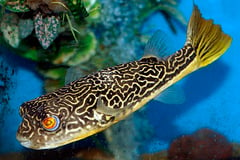
Tetraodon mbuGiant Puffer
authority not recorded
Max length750mm SL30in SLTank240 × 90cm96 × 36inTemp24–26°C75–79°FpH7.0–8.0The giant puffer, Tetraodon mbu, is a freshwater pufferfish from rivers and lakes in Central and East Africa, including Lake Tanganyika. Among the most aggressive puffers available, it can reach 75 cm and should be kept alone in a tank of around 240 by 90 by 90 cm. A molluscivore in nature, it needs snails and unshelled shellfish regularly to keep its continuously growing teeth worn down.
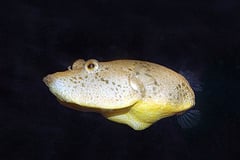
Tetraodon miurusCongo Puffer
authority not recorded
Max length150mm SL6in SLTank75 × 30cm30 × 12inTemp24–28°C75–82°FpH6.8–7.5The Congo puffer, Tetraodon miurus, is a predatory puffer from large rivers in the Republic of Congo and the Democratic Republic of Congo. A true ambush predator, it spends most of its time buried in the substrate, so a deep bed of sand is essential. It will eat any fish it can fit in its mouth, takes chunks from larger ones, and is not really safe with anything else.
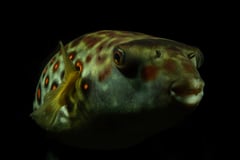
Tetraodon pustulatusCross River Pufferfish
Murray, 1857
Max length300mm SL12in SLTank150 × 60cm60 × 24inTemp20–28°C68–82°FpH6.5–7.5The Cross River pufferfish, Tetraodon pustulatus, is a puffer endemic to the Cross River basin of Nigeria and Cameroon. It lives in the moderately fast-flowing main channels and is assessed as endangered by the IUCN. Imports are scarce and costly. Primarily a molluscivore, it can share a tank with smaller, quick, peaceful fish, but similarly sized tankmates may be bitten.
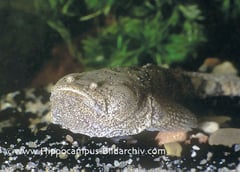
Thalassophryne amazonicaPrehistoric Monster Fish
authority not recorded
Max length150mm SL6in SLTank75 × 30cm30 × 12inTemp24–28°C75–82°FpHnot recordedThalassophryne amazonica is a freshwater toadfish from Amazon tributaries in Ecuador, Peru and Brazil. The only freshwater member of its genus, it spends most of its time buried in sand and is an obligate piscivore that needs a constant supply of live fish. Like other Thalassophryne, it is venomous, with hollow spines on each opercle and the dorsal fin, though its venom is not known to be very potent.

Thayeria boehlkeiFalse Penguin Tetra
authority not recorded
Max length36mm SL1.4in SLTank60 × 38cm24 × 15inTemp22–28°C72–82°FpHnot recordedThe false penguin tetra, Thayeria boehlkei, is a characin probably restricted to the upper Amazon in Peru and the Rio Araguaia in Brazil. By far the most popular Thayeria in the hobby, it is usually sold as the penguin tetra, a name first given to T. obliqua. Its thick black stripe runs from the lower caudal lobe along the body to the opercle. A schooling species, it should be kept in a group of at least six.
Thayeria ifatiHalf-striped Penguin Tetra
authority not recorded
Max length50mm SL2.0in SLTank60 × 38cm24 × 15inTemp23–28°C73–82°FpHnot recordedThe half-striped penguin tetra, Thayeria ifati, is a characin that appears to be endemic to the rivers Maroni and Approuague in French Guiana. Of the three Thayeria, T. ifati is the least often seen in the hobby. In this species the black stripe is confined to the upper part of the lower caudal lobe, and the dorsal and anal fins develop red tips in good condition. Like its congeners, it swims in an oblique, head-up style.

Thayeria obliquaPenguin Tetra
authority not recorded
Max length80mm SL3.1in SLTank60 × 38cm24 × 15inTemp22–28°C72–82°FpHnot recordedThe penguin tetra, Thayeria obliqua, is a characin from the central Amazon and Rio Tocantins basins and the Rio Guaporé in Brazil. The type species of the genus, it was the original penguin tetra, though T. boehlkei is now usually sold under that name. In T. obliqua the black caudal stripe tapers upwards and fades before reaching the dorsal fin. It should be kept in a group of at least six.
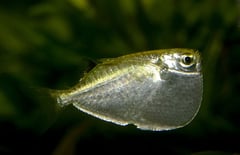
Thoracocharax stellatusSpotfin Hatchetfish
(Kner, 1858)
Max length70mm SL2.8in SLTank120 × 45cm48 × 18inTemp20–28°C68–82°FpH5.0–7.5The spotfin hatchetfish, Thoracocharax stellatus, is the most widespread neotropical hatchetfish, recorded from much of South America. It is told from its only congener, T. securis, by a prominent dark spot in the dorsal fin, and is sometimes traded as 'platinum hatchetfish'. It feeds almost entirely on insects, and a tightly fitting cover is needed because it can clear several metres in one jump.

Thorichthys meekiFiremouth Cichlid
Brind, 1918
Max length120mm SL5in SLTank120 × 30cm48 × 12inTemp20–32°C68–90°FpH6.5–8.5The firemouth cichlid, Thorichthys meeki, is a Central American cichlid from Mexico's Atlantic slope and the Yucatán south into Belize and Guatemala. A popular aquarium fish for a long time, it is almost always commercially raised. It is easily identified by the bright red or orange underside of the head, which is more pronounced in adults. It is not especially aggressive but becomes territorial when breeding.

Tilapia guinasana
authority not recorded
Max length140mm SL6in SLTank120 × 30cm48 × 12inTemp19–25°C66–77°FpH7.0–7.8Tilapia guinasana is a cichlid endemic to Lake Guinas, a deep sinkhole lake in Namibia, and is considered critically endangered. Groundwater extraction for agriculture is reducing the lake's water. With no natural predators there, the fish exist in many distinct colour forms, and captive breeding is encouraged, with the lines kept pure. In nature it grazes algae from the rocky walls of the lake.
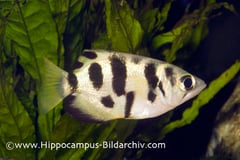
Toxotes chatareusLargescale Archerfish
authority not recorded
Max length400mm SL16in SLTank120 × 60cm48 × 24inTemp25–30°C77–86°FpH7.0–8.0The largescale archerfish, Toxotes chatareus, is an archerfish recorded from Pakistan and India through Southeast Asia to northern Australia. Its main habitats are brackish mangrove swamps and estuaries, and a brackish setup is recommended. Like its relatives, it shoots jets of water at insects on overhanging vegetation. It reaches 40 cm and is less often offered for sale than T. jaculatrix.
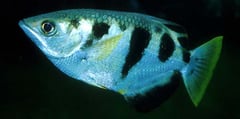
Toxotes jaculatrixBanded Archerfish
authority not recorded
Max length300mm SL12in SLTank120 × 60cm48 × 24inTemp25–30°C77–86°FpH7.0–8.0The banded archerfish, Toxotes jaculatrix, is an archerfish recorded from India through Southeast Asia to the Pacific islands and northern Australia. The most commonly available archerfish, it is sometimes sold as T. jaculator. It shoots jets of water at insects on overhanging vegetation. Its main habitats are brackish mangrove swamps and estuaries, and it is believed to migrate to full seawater to breed.
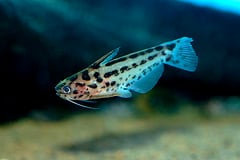
Trachelyichthys decaradiatus
authority not recorded
Max length80mm SL3.1in SLTank60 × 38cm24 × 15inTemp20–28°C68–82°FpH6.5–7.0Trachelyichthys decaradiatus is a small auchenipterid catfish known only from the Rupununi River in Guyana. It is very similar to T. exilis but has the eye set further back and a broader, shorter humeral process, and neither is seen very often in the hobby. Unlike most auchenipterids it usually feeds by day, and it is peaceful and does best in a group.