Toxotes chatareus
Largescale Archerfish
Last revised 2012Edit this page
On this page11 sections
Quick factsEdit
Difficulty5 of 8 measures
- Space
- large tank
- Water
- needs a steady pH
- Temp
- flexible
- Diet
- unknown
- Temperament
- peaceful
- Social
- needs to be in a group
- Compatibility
- unknown
Other demands
Each of these can raise the rating on its own, whatever the measures above say.
- Hardiness
- unknown
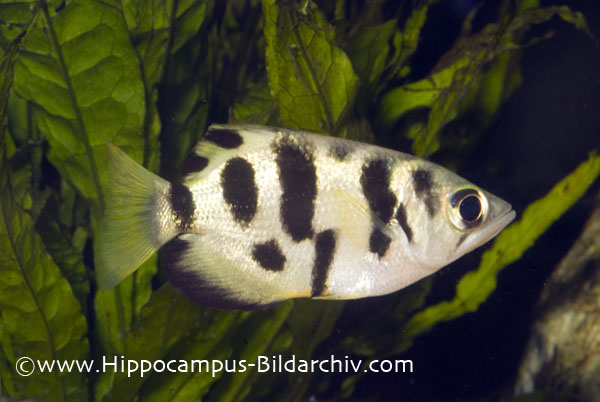
The largescale archerfish, Toxotes chatareus, is an archerfish recorded from Pakistan and India through Southeast Asia to northern Australia. Its main habitats are brackish mangrove swamps and estuaries, and a brackish setup is recommended. Like its relatives, it shoots jets of water at insects on overhanging vegetation. It reaches 40 cm and is less often offered for sale than T. jaculatrix.
Distribution
EditThis species has a massive natural distribution. It's been recorded from Pakistan, India, Bangladesh, Sri Lanka, Myanmar, Thailand, Vietnam, Laos, Cambodia, Malaysia, the Philippines, Indonesia, Papua New Guinea and northern Australia.
Habitat
Write a noteEditInhabits various biotopes, including freshwater rivers, streams, lakes and ponds. It's primary habitats though are brackish mangrove swamps and estuaries. It tends to be found in shady areas where there is dense growth of marginal and/or overhanging vegetation.
Aquarium size
Write a noteEdit120 ∗ 60 ∗ 60 cm48 ∗ 24 ∗ 24 in - ~432 litres~114 US gal for an adult fish.
Maintenance
Write a noteEditTwo types of setup may be considered for archerfish. The first would be a normal brackish aquarium setup containing mangrove roots and brackish tolerant plants. Waterflow should be slow. Another means of keeping archerfish is in a biotope setup, using a tall tank half-filled with water and an area of dry land and plants in the upper area of the tank. This has the benefit of encouraging natural feeding behaviour (see below). Water conditions in the biotope should be the same as mentioned above. Lighting should be suited to the types of plants used.
Water conditions
EditTemperature: 25 – 30 °C77 – 86 °F
pH: 7.0 - 8.0 (prefers the upper end of this range)
Hardness: 20 - 30°H
These recommendations come from this profile’s own figures. They contain affiliate links, so we may earn a commission.
Diet
Write a noteEditWild fish mostly feed on both terrestrial and aquatic invertebrates of various types, although small fish are also taken. The archer fish is famous for its feeding behaviour. It has the ability to shoot jets of water from its mouth at insects on overhanging vegetation. The insect then falls in the water and is eaten! If using the paludarium setup described above, it is possible to replicate this behaviour by introducing crickets or fruitflies into the planted area in the upper part of the tank. As they venture out along the plant leaves, they will eventually be picked off by the archer fish. The fish also accepts floating foods such as flake and pellets and will also relish frozen food such as bloodworm and brineshrimp.
Behaviour and compatibility
Write a noteEditGenerally peaceful although may eat much smaller fish. Can also be aggressive to conspecifics but this can be mitigated by keeping them in groups of 4 or 5 specimens. Can be kept with other larger sized brackish fish such as scats, monos and green chromides.
Sexual dimorphism
Write a noteEditNot known
Reproduction
Write a noteEditNo breeding recorded in captivity. Unlike, its near cousin, t. jaculatrix, the largescale archerfish has been recorded breeding in freshwater in the wild. Vast numbers of eggs are produced, numbering in the tens of thousands.
Notes
EditThe Largescale Archerfish is one of a fascinating group of fish that have evolved this very distinctive feeding pattern. The family contains six species, of which toxotes jaculatrix is the most commonly available (sometimes sold incorrectly as t. jaculator). Toxotes chatareus is offered for sale in the UK although much less frequently.
There are reports that juvenile archers can be kept in fresh water but it is recommended that a brackish setup is always used.
Eaten as a food fish in many of its native countries.
Species images · 3
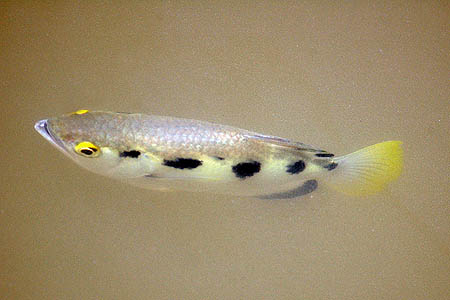
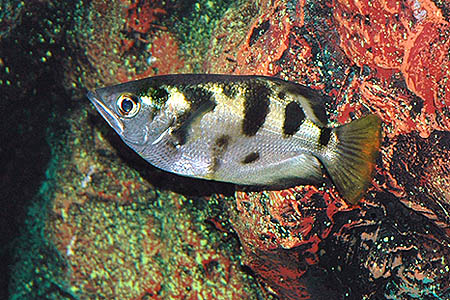
These photographs are used with each photographer's permission.
Send a photographProfile completeness19 of 24
79% complete
Also missing: a recorded distribution, taxonomic authority, etymology.
Community
Questions about Toxotes chatareus?
Ask on Discord