Every species
Filters
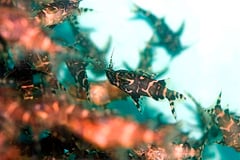
Synodontis nigriventrisUpside-down Catfish
David, 1936
Max length100mm SL3.9in SLTanknot recordedTemp24–28°C75–82°FpH6.0–7.5The upside-down catfish, Synodontis nigriventris, is a small Synodontis from the Democratic Republic of Congo, Republic of Congo and Cameroon. It lives among densely vegetated riverbanks and spends up to 90% of its time inverted, with a belly darker than its back. One of the most gentle members of the genus, it should be kept in groups of at least three or four.
Synodontis njassaeLake Malawi Synodontis
authority not recorded
Max length190mm SL7in SLTank120 × 30cm48 × 12inTemp23–28°C73–82°FpH7.5–8.5The Lake Malawi Synodontis, Synodontis njassae, is the only Synodontis catfish in Lake Malawi, to which it is endemic. Both large- and small-spotted morphs are available in the trade. A fairly vigorous species, it suits a community of hard water Lake Malawi cichlids but not shy species, and it will fight with other Synodontis but is not aggressive towards its own kind.
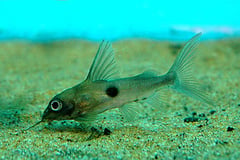
Synodontis notatusOne-spot Synodontis
Vaillant, 1893
Max length275mm SL11in SLTank120 × 30cm48 × 12inTemp22–25°C72–77°FpH6.5–7.5The one-spot Synodontis, Synodontis notata, is a large Synodontis catfish from the Democratic Republic of Congo and the Republic of Congo. Regional variants carry three, six or twelve spots or none, some sold under the invalid name S. ocellata, and similar species such as S. nummifer are often imported with it and all sold as notata. More active by day than many Synos, it is aggressive towards its own species, so only one should be kept unless the tank is very large.
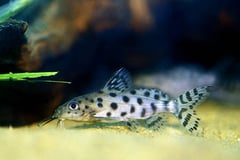
Synodontis ocelliferOcellated Synodontis
authority not recorded
Max length200mm SL8in SLTank90 × 30cm36 × 12inTemp23–28°C73–82°FpH6.2–8.0The ocellated Synodontis, Synodontis ocellifer, is a catfish from Nigeria, Gambia, Chad, Cameroon, Senegal, Mali, Ghana, Niger and Guinea. Often confused with similar Synodontis, it is distinguished by its very long adipose fin. One of the hardiest Synos available, it becomes slightly territorial as it matures, and many hybrids of it have been appearing on the market.
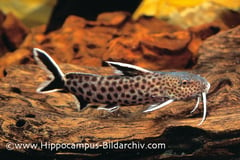
Synodontis petricolaDwarf Lake Synodontis
Matthes, 1959
Max length130mm SL5in SLTank90 × 30cm36 × 12inTemp24–28°C75–82°FpH7.5–8.5The dwarf lake Synodontis, Synodontis petricola, is a small, peaceful Synodontis catfish endemic to Lake Tanganyika. Unlike most of the genus it is bred quite often in aquaria, usually as an open-spawning egg scatterer, though it is also one of the few fish known to practise brood parasitism. It should be kept in a group of four or more, and a dwarf form adapts to a wider range of water chemistry.
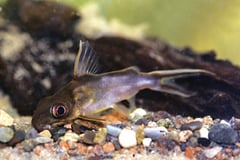
Synodontis pleuropsBig Eyed Synodontis
authority not recorded
Max length230mm SL9in SLTank120 × 30cm48 × 12inTemp22–26°C72–79°FpH6.0–7.0The big eyed Synodontis, Synodontis pleurops, is a Synodontis catfish from the Democratic Republic of Congo and Cameroon. Very large eyes and a downturned mouth suited to grazing algae make it hard to confuse with other species, though colouration and patterning vary considerably with locality. Very nocturnal, it is rarely seen unless the aquarium is dimly lit, and it keeps close to driftwood, rocks and broad plant leaves.
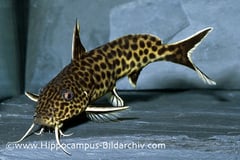
Synodontis polliPoll's Synodontis
authority not recorded
Max length100mm SL3.9in SLTank90 × 30cm36 × 12inTemp24–28°C75–82°FpH7.5–8.5Poll's Synodontis, Synodontis polli, is a Synodontis catfish endemic to Lake Tanganyika, where it lives in large schools at 30 to 125 metres. It inhabits muddy bottoms and is not comfortable in well-lit conditions without hiding places. Superficially similar to S. petricola, it has larger body spots and a longer head, and it is occasionally mis-identified in the trade as S. angelicus, S. petricola or Synodontis sp.
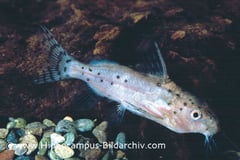
Synodontis robbianus
authority not recorded
Max length130mm SL5in SLTank90 × 30cm36 × 12inTemp22–25°C72–77°FpH6.0–7.5Synodontis robbianus is a Synodontis catfish found only in Nigeria, in the Lower Niger and Cross rivers. It is often confused with the similar but larger S. nigrita, from which its brownish base colour separates it, and it resembles several other Synos when juvenile. A hardy, adaptable species suited to a newcomer to Synodontis, it is not often seen for sale.
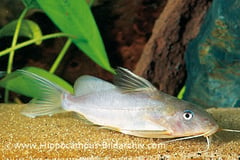
Synodontis schall
authority not recorded
Max length375mm SL15in SLTank120 × 60cm48 × 24inTemp22–27°C72–81°FpH6.0–8.0Synodontis schall is a large, predatory Synodontis catfish recorded from seventeen African countries, among them Nigeria, Egypt and Kenya. Regarded as the 'bad boy' of the genus in aquarium circles, it grows to 375 mm SL, is randomly aggressive and will eat smaller fish, so it should be kept only with tankmates that can stand their own ground. It is an important food fish in some of its native countries.
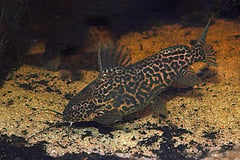
Synodontis schoutedeniVermiculated Synodontis
authority not recorded
Max length138mm SL5in SLTank90 × 30cm36 × 12inTemp22–27°C72–81°FpH6.0–7.5The vermiculated Synodontis, Synodontis schoutedeni, is a peaceful Synodontis catfish found only in the Democratic Republic of Congo. Its colour and patterning vary considerably, and the vermiculated pattern seems to intensify with age in well-kept fish. Of moderate adult size, it seems very susceptible to bloating, so feeding of dried foods is best kept to a minimum.
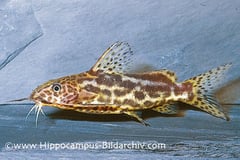
Synodontis waterloti
authority not recorded
Max length185mm SL7in SLTank90 × 30cm36 × 12inTemp23–25°C73–77°FpH6.5–7.5Synodontis waterloti is a Synodontis catfish from Guinea, Liberia, Ivory Coast, Guinea-Bissau, Sierra Leone and Ghana. Uncommonly imported, it has distinctive serrated edges to the pectoral fins and shows its strongest colouration over a light substrate. It becomes slightly territorial as it matures, and its adult size of 185 mm SL makes it unsuitable for the general community.

Systomus orphoides
(Valenciennes, 1842)
Max length250mm SL10in SLTank200 × 60cm79 × 24inTemp18–26°C64–79°FpH6.0–8.0Systomus orphoides is a large cyprinid ranging from Myanmar to Vietnam and south through Peninsular Malaysia to Borneo, Sumatra and Java. It mostly inhabits flowing tributaries and large streams, moving onto inundated farmland and forest in the wet season to feed and spawn. Not often available in the trade and usually seen as bycatch, it grows to 250 mm SL, is quite boisterous, and needs more-or-less spotless water.

Taeniacara candidi
authority not recorded
Max length64mm SL2.5in SLTank45 × 38cm18 × 15inTemp27–30°C81–86°FpH4.5–5.8Taeniacara candidi is a dwarf cichlid from Brazil, ranging from the lower Rio Negro along the Amazon as far as the Rio Tapajós. It needs very specific water parameters and is seen as a challenge even by experienced keepers, commonly sitting at the bottom of the tank for a day or more after a water change. Said to be one of the most aggressive dwarf cichlids, it has a slimmer body than most Apistogramma, and the female guards the fry very aggressively.
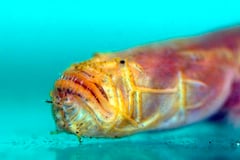
Taenioides cirratusBearded Worm Goby
authority not recorded
Max length300mm SL12in SLTanknot recordedTemp22–27°C72–81°FpH7.5–8.5The bearded worm goby, Taenioides cirratus, is a mud-burrowing goby of coastal, usually estuarine waters from India to Japan and New Caledonia. It digs networks of sloping tunnels in the substrate, and has greatly reduced eyes, teeth on the outside of its mouth and the ability to breathe air and survive out of water for some time. Growing to 300 mm SL, it will eat anything small enough and is probably best kept in a species set-up.
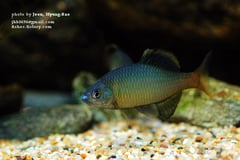
Tanakia signiferKorean Bitterling
(Berg, 1907)
Max length75mm SL3.0in SLTanknot recordedTempnot recordedpHnot recordedThe Korean bitterling, Tanakia signifer, is endemic to the Korean peninsula, where it occurs in southern North Korea and northern South Korea. It is considered endangered in South Korea, where it lives only in the Han river system and many populations have been extirpated. It inhabits cool, clean, shallow water over coarse sand or gravel, and like all bitterlings it spawns in living unionid mussels.

Tanganicodus irsacae
Poll, 1950
Max length70mm SL2.8in SLTank75 × 30cm30 × 12inTemp24–28°C75–82°FpH8.0–9.0Tanganicodus irsacae is a goby cichlid endemic to the northern part of Lake Tanganyika, living among pebbles and rocks in water under 1 metre deep. In this surge zone it scrapes algae from the rocks. Quite delicate in aquaria, it needs the highest water quality, a higher pH than many Tanganyikans and a relatively specialised diet, and it is aggressive towards its own kind. A bi-parental mouthbrooder, it is difficult to breed.
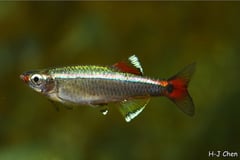
Tanichthys albonubesWhite Cloud Mountain Minnow
Lin, 1932
Max length40mm SL1.6in SLTank60 × 30cm24 × 12inTemp14–22°C57–72°FpH6.0–8.5The White Cloud Mountain minnow, Tanichthys albonubes, is a small cyprinid from Guangdong and Hainan in southern China and from northeastern Vietnam. It appears to have been extirpated from White Cloud Mountain itself and is considered endangered in China, but all the fish on sale are commercially bred. Inbreeding among farm-bred stock has left many genetically weak and prone to disease or deformity, and permanent exposure to warmer conditions is likely to shorten its life.
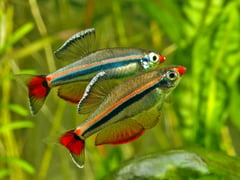
Tanichthys micagemmae
Freyhof & Herder, 2001
Max length30mm SL1.2in SLTank45 × 30cm18 × 12inTemp18–23°C64–73°FpH6.5–7.5Tanichthys micagemmae is a small cyprinid from the Ben Hai river system in north central Vietnam. Sold under trade names such as 'Vietnamese minnow', 'cardinal minnow' and 'royal white cloud', it is smaller than T. albonubes, lacks that species' reddish-brown body colour and has reddish ventral and anal fins. At the type locality it was found only in the margins of a fast-flowing, shallow stream where the flow was much reduced.
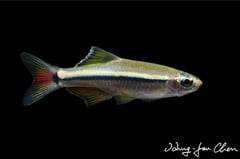
Tanichthys sp. 'Vietnam'
authority not recorded
Max length30mm SL1.2in SLTank45 × 30cm18 × 12inTemp18–25°C64–77°FpH6.0–7.5Tanichthys sp. 'Vietnam' is a small cyprinid known only from Da Nang province in central Vietnam, first collected in 2009. Sold as T. sp. 'lemon' or 'yellow white cloud', it has also been misidentified as T. thacbaensis, a valid species from much further north in Vietnam. Its ventral and anal fins are bright yellow, and it is smaller than T. albonubes and lacks that species' reddish-brown body colour.

Tariqilabeo latius
(Hamilton, 1822)
Max length150mm SL6in SLTank150 × 45cm60 × 18inTemp18–24°C64–75°FpH6.0–7.5Tariqilabeo latius is a cyprinid widespread in India, described from the Tista River on the border with Bangladesh. It lives everywhere from boulder-strewn Himalayan hill streams to silt-laden tributaries and pools. Not often available in the trade, it sometimes turns up in shipments of Indian Garra, and its relatively plain pattern makes it unlikely to be confused with congeners. Juveniles are gregarious and active, but adults tend to become sedentary and solitary.