River
Araguaia
Only species with a profile on Seriously Fish are counted.
- Species
- 17
- Families
- 10
- Photographed
- 17 of 17
- Difficulty rated
- 17 of 17
Basin
Shares fishes withspecies recorded from both
Runs through
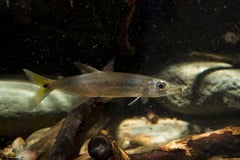
Acestrorhynchus microlepisPike Tetra
Acestrorhynchidae · Jardine, 1841
The pike tetra, Acestrorhynchus microlepis, is a predatory acestrorhynchid from northern Amazon drainages and the Orinoco. It also occurs in coastal rivers of Guyana, Suriname and French Guiana. A member of the A. microlepis group, it has a small blackish spot behind the gill cover and is separable from the very similar A. grandoculis only by counts. It tends to take smaller prey such as tetras, and acestrorhynchids are cannibalistic, so a group must be of comparable size.
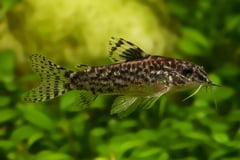
Aspidoras pauciradiatus
Callichthyidae · Weitzman & Nijssen, 1970
Aspidoras pauciradiatus is a small armoured catfish that appears restricted to the upper Araguaia basin in Goiás state, Brazil. Sometimes called the 'false corydoras' or 'sixray corydoras', it has 6 soft dorsal-fin rays against 7 in other Aspidoras, plus a distinctive colour pattern. Aspidoras are told from the very similar Corydoras mainly by having two cranial fontanels.

Colomesus asellusAmazon Puffer
Tetraodontidae · Müller & Troschel, 1849
The Amazon puffer, Colomesus asellus, is a freshwater puffer found throughout much of the Amazon basin, with records north to Guyana and Venezuela. Also traded as the South American puffer or 'SAP', it is told from congeners by a transverse row of dermal flaps across the chin. It lives mostly in well-oxygenated river habitats, is intolerant of organic waste, and forms loose aggregations, so a group of 6 or more is best, away from the general community.
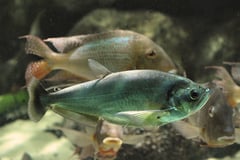
Hydrolycus scomberoidesVampire Tetra
Cynodontidae · Cuvier, 1819
The vampire tetra, Hydrolycus scomberoides, is a predatory dogtooth characin from the central and upper Amazon in Brazil, Bolivia, Peru and Ecuador. Also sold as 'scomb' and 'sabre tooth tetra', it is regularly confused with the much larger payara, H. armatus. At up to 300 mm it still needs a huge tank and specialist care, and newly-imported specimens often refuse anything but live food.

Hyphessobrycon amandaeEmber Tetra
Characidae · Géry & Uj, 1987
The ember tetra, Hyphessobrycon amandae, is a tiny characid from the rio das Mortes, a tributary of the Araguaia in Mato Grosso, Brazil. Also traded as the 'Amanda's', 'dwarf red', 'red' and 'fire' tetra, it grows to around 20 mm SL. Very peaceful and gregarious, it makes a good dither fish for Apistogramma and other dwarf cichlids and spawns often in a mature aquarium.

Hyphessobrycon heterorhabdusFlag Tetra
Characidae · Ulrey, 1894
The flag tetra, Hyphessobrycon heterorhabdus, is a characid from Pará and Maranhão states in eastern Brazil, also known as 'Belgian flag tetra'. Its name has been misapplied to similar fishes across much of the Amazon, the Orinoco and the Guianas, and the true species may reach no further upstream than the rio Tapajós. It lives almost exclusively in small, shaded forest streams called igarapés.

Hyphessobrycon stegemanniSavanna Tetra
Characidae · Géry, 1961
The savanna tetra, Hyphessobrycon stegemanni, is a characid from the middle rio Tocantins and rio Araguaia basins in central Brazil. In the hobby its name has often been misapplied to Hemigrammus ataktos, since both occur in the Tocantins and have a dark lateral stripe. Its range lies almost entirely in the cerrado, the tropical wooded grassland of central Brazil.

Megalamphodus haraldschultziCrystal Red Tetra
Characidae · (Travassos, 1960)
The crystal red tetra, Megalamphodus haraldschultzi, is a small characid endemic to the rio Araguaia system in Brazil. It is occasionally available, usually as bycatch among shipments of other fishes, and is sometimes traded as 'Araguaia red' or 'Schultz's tetra'. It is most easily separated from the similar Megalamphodus eques by the dorsal-fin marking, which is less extensive and bordered above by a white blotch and below by a yellowish band.
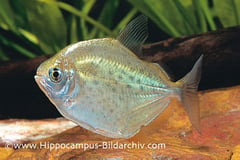
Metynnis lippincottianus
Serrasalmidae · Cope, 1870
Metynnis lippincottianus is a spotted silver dollar from Brazil and French Guiana, found in the lower and middle Amazon and the Oyapock system. It is occasionally seen for sale, sometimes as 'silver dollar', and its spotted pattern tells it apart from M. argenteus and M. hypsauchen. The spots are less pronounced than in M. maculatus, with which it shares a common name. The precise extent of its range is unclear.
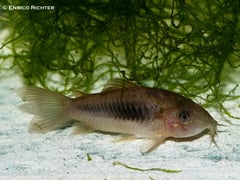
Osteogaster aeneaBronze Cory
Callichthyidae · (Gill, 1858)
The bronze cory, Osteogaster aenea, long known as Corydoras aeneus, is an armoured catfish described from Trinidad and accepted to occur across much of South America. That range looks more like a complex of similar, distinct species than a single one, and fish from outside Trinidad are of uncertain identity. Aquarium fish are almost all commercially farmed, and the names C. schultzei and C. venezuelanus are routinely misapplied to them.

Retroculus lapidifer
Cichlidae · Castelnau, 1855
Retroculus lapidifer is a rheophilic cichlid from the rio Tocantins and Araguaia systems and nearby coastal drainages of northeastern Brazil. It lives in rapids and fast-flowing stretches of clear water rivers, and needs a set-up designed to resemble a flowing river, with a base of at least 210 by 60 cm and water of 26 to 32 °C. A biparental substrate-spawner, it has been bred in aquaria and is available in the trade on a sporadic basis.
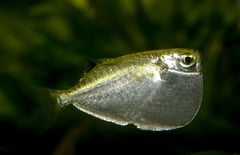
Thoracocharax stellatusSpotfin Hatchetfish
Gasteropelecidae · Kner, 1858
The spotfin hatchetfish, Thoracocharax stellatus, is the most widespread neotropical hatchetfish, recorded from much of South America. It is told from its only congener, T. securis, by a prominent dark spot in the dorsal fin, and is sometimes traded as 'platinum hatchetfish'. It feeds almost entirely on insects, and a tightly fitting cover is needed because it can clear several metres in one jump.

Aequidens tetramerusSaddle Cichlid
Cichlidae · Heckel, 1840
The saddle cichlid, Aequidens tetramerus, is a cichlid found across much of northern South America, from the Amazon and Orinoco basins to the Guianas. The type species of its genus, it occurs in several colour forms, and fish from Ecuador and Peru are sought after for the red or orange colouration on the lower head and belly. As currently recognised it is likely to represent a group of related fishes, some of which may be described as distinct species.
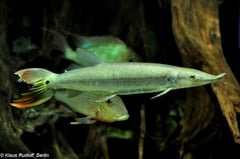
Boulengerella cuvieri
Ctenoluciidae · Spix & Agassiz, 1829
Boulengerella cuvieri is a pelagic ctenoluciid characin from much of the Amazon basin, the Río Orinoco and coastal drainages of the Guianas. The largest officially recorded specimen measured 675 mm, but it appears to grow larger, possibly beyond 800 mm. Given that size and its natural behaviour it is largely unsuitable for the home aquarium. Its entire dorsal-fin base lies ahead of the anal-fin origin, a character shared only with B. lucius and B. xyrekes among ctenoluciids.
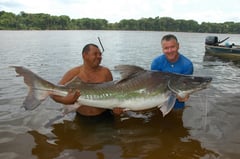
Brachyplatystoma filamentosumPiraíba
Pimelodidae · Lichtenstein, 1819
The piraíba, Brachyplatystoma filamentosum, is the largest catfish of the Amazon basin, also found in the Orinoco and river systems of the Guianas. Adults typically measure 2 to 2.5 m and weigh over 150 kg. In the Amazon only fish over around 160 cm are called 'Piraíba', and smaller ones 'filhote'. It is suitable only for public aquaria and a very small minority of private aquarists.
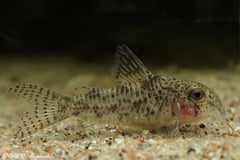
Hoplisoma cochuiBarredtail Cory
Callichthyidae · (Myers & Weitzman, 1954)
The barredtail cory, Hoplisoma cochui, long known as Corydoras cochui, is a small armoured catfish native to the upper rio Araguaia in central Brazil. It grows to around 35 mm SL and has been assigned the code C022. It can be told apart from the similar H. habrosum by the 4 to 5 dark markings along each side of the body, where H. habrosum has 2 to 3.

Laetacara araguaiae
Cichlidae · Ottoni & Costa, 2009
Laetacara araguaiae is a small cichlid from Brazil, known from the rios Tapajós, Xingu and Tocantins, right-bank tributaries of the lower Amazon. Known in the hobby as L. sp. 'Buckelkopf' before it was described, it grows to around 35 mm SL and is a biparental substrate-spawner. Some populations differ from one another in colour pattern, and 7-8 dorsal-fin rays separate it from all congeners.