River · also known as Casiquiare canal
Casiquiare
Only species with a profile on Seriously Fish are counted.
- Species
- 23
- Families
- 11
- Photographed
- 22 of 23
- Difficulty rated
- 23 of 23
Basin
Also in the Amazon basinspecies recorded from both
Shares fishes with rivers elsewherespecies recorded from both
Runs through
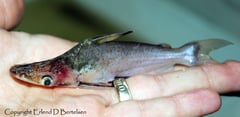
Ageneiosus ucayalensisDuck Catfish
Auchenipteridae · Castelnau, 1855
The duck catfish, Ageneiosus ucayalensis, is an auchenipterid catfish described from Peru and recorded across the Amazon, Orinoco and Guianas. Body patterning apparently varies with locality, and fish from black water habitats, particularly on the Guiana Shield, tend to be darker. Growing to around 290 mm SL and capable of taking large prey, it is safe only with similarly sized catfishes or large pelagic characins, mostly a combination for public aquaria.

Astyanax bimaculatusTwo Spot Astyanax
Characidae · (Linnaeus, 1758)
The two spot astyanax, Astyanax bimaculatus, is a characid ranging from Panama through most of the Amazon and Orinoco basins. It lives in a wide variety of biotopes, from swiftly-flowing rivers and streams to ponds, ditches and reservoirs. The name is currently applied to what is considered a species complex of at least four taxa, and aquarium fish most often arrive as contaminants among shipments of other species.

Biotodoma wavriniOrinoco Eartheater
Cichlidae · (Gosse, 1963)
The Orinoco eartheater, Biotodoma wavrini, is a geophagine cichlid from the Orinoco and rio Negro basins of Venezuela, Colombia and Brazil. One natural habitat is the Río Cinaruco, a low-nutrient blackwater tributary of the Orinoco. It can be told from B. cupido by its noticeably elongate body and a dark flank blotch on or below the upper lateral line. Unless breeding it is surprisingly peaceful, and trade populations include 'Cuao', 'Orinoco', 'San Antonio' and 'Sipapo Ventuari'.
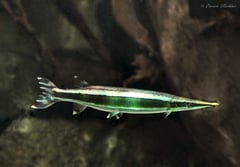
Boulengerella lateristrigaStriped Pike 'Characin'
Ctenoluciidae · (Boulenger, 1895)
The striped pike 'characin', Boulengerella lateristriga, is a ctenoluciid from the rio Negro basin and parts of the upper Río Orinoco. It appears limited to black water rivers and tributaries, where the water is stained darkly with humic acids and the pH can be as low as 3.0 or 4.0. A thin dark stripe from the rear of the eye to the caudal peduncle and dark crossbars on the caudal-fin lobes separate it from the similar B. maculata. It grows to 258 mm SL.
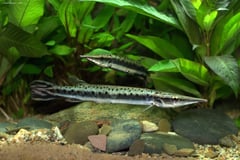
Boulengerella maculata
Ctenoluciidae · (Valenciennes, 1850)
Boulengerella maculata is a pelagic ctenoluciid found throughout much of the Amazon, Orinoco and Tocantins river systems. Colour pattern varies considerably, with some specimens much paler than others, and this may be correlated with water type. Random dark spots on the upper body, and a dark stripe only behind the eye when one is present, separate it from the similar B. lateristriga. It reaches 329 mm SL and needs an aquarium with base dimensions of 240 by 90 cm or more.
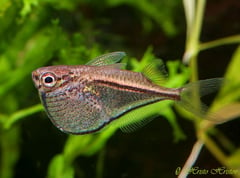
Carnegiella marthaeBlackwing Hatchetfish
Gasteropelecidae · Myers, 1927
The blackwing hatchetfish, Carnegiella marthae, is a small freshwater hatchetfish from the upper Orinoco in Venezuela and the rio Negro in Brazil. It appears to be a stenotypic inhabitant of blackwater, found in igapó and igarapé habitats with overhanging vegetation and leaf litter. Very peaceful but small and timid, it is best kept in a group of 10 or more with similarly sized, peaceful fishes.
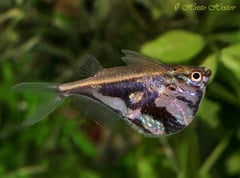
Carnegiella strigataMarbled Hatchetfish
Gasteropelecidae · (Günther, 1864)
The marbled hatchetfish, Carnegiella strigata, is a hatchetfish from the Amazon and Orinoco basins and coastal rivers of Guyana and Suriname. Popular in the hobby, it is collected for the trade mostly in the rio Negro basin in Brazil. Its larger size and dark, marbled pattern set it apart from congeners, though the pattern varies and the wide range may be open to question. It appears to live only in blackwater.
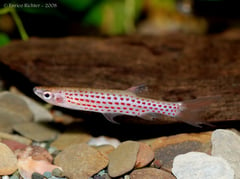
Copella meinkeniSpotted Splashing Tetra
Lebiasinidae · Zarske & Géry, 2006
The spotted splashing tetra, Copella meinkeni, is a small lebiasinid from the central Amazon region, with most records from the rio Negro and Orinoco. It has been widely referred to as C. nattereri in aquarium literature, but lacks that species' dark lateral stripe and has 5-6 rows of bright red spots on the body. The similar C. callolepis is also traded. It inhabits forest streams with tea-coloured water and lays its eggs among vegetation.
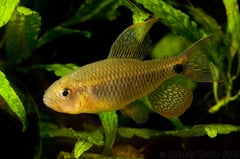
Crenuchus spilurusSailfin Characin
Crenuchidae · Günther, 1863
The sailfin characin, Crenuchus spilurus, is a crenuchid from much of the Amazon and Orinoco drainages and coastal rivers of the Guianas. The only described member of its genus, it varies considerably in colour pattern and morphology across that range. It lives in tea-stained forest streams, and its timid, predominantly benthic nature means it does not always make an ideal community fish. Males guard eggs laid on the roof of a small cave, often formed from leaf litter.

Geophagus abalios
Cichlidae · López-Fernández & Taphorn, 2004
Geophagus abalios is a cichlid from black and clear water tributaries of the río Orinoco in Venezuela, across the Llanos and south to the Casiquiare. One of the more commonly-traded members of the genus, it is rarely sold under the correct name and usually misidentified as G. altifrons or G. surinamensis. Juveniles are available cheaply because it is one of the few Geophagus bred commercially. Vertically split anterior flank bars separate it from the very similar G. brokopondo.

Geophagus dicrozoster
Cichlidae · López-Fernández & Taphorn, 2004
Geophagus dicrozoster is a cichlid from tributaries of the río Orinoco in Venezuela, extending to the Casiquiare and the headwaters of the Negro. Commonly traded but rarely under the correct name, it is usually sold as G. altifrons or G. surinamensis, and it is one of the few Geophagus bred commercially. Seven flank bars, the fourth and fifth meeting in a 'Y', and a relatively elongate profile identify it. It appears restricted to acidic blackwater.

Geophagus winemilleri
Cichlidae · López-Fernández & Taphorn, 2004
Geophagus winemilleri is a cichlid from southern Venezuela and probably northern Brazil, recorded from the upper Río Negro, Río Siapa and Casiquiare. It is rare in the hobby, though other species are sometimes sold under its name. A dark preopercular marking and four ventrally-inclined bars on each flank help identify it, and it may be restricted to acidic blackwater.
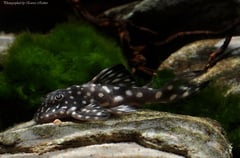
Hypancistrus inspectorL102
Loricariidae · Armbruster, 2002
The snowball pleco (L102), Hypancistrus inspector, is a suckermouth catfish from the upper rio Negro in Brazil and the Casiquiare in Venezuela. Brown to black with large whitish to yellow spots, it is most similar to H. contradens. It is normally collected from rocky rapids, is a cave-spawner with male brood care, and should not be kept with other Hypancistrus in order to prevent hybridisation.

Iguanodectes spilurusGreen Line Lizard Tetra
Iguanodectidae · (Günther, 1864)
The green line lizard tetra, Iguanodectes spilurus, is a characin found throughout the Amazon, Orinoco, Essequibo and Tocantins river systems. The most widespread Iguanodectes species, it has also been called the 'slender', 'spindle' or 'iguana' tetra, and differs from its congeners in its translucent dorsal and anal fins, lack of a red lateral stripe and prominent dark caudal-fin marking. It is sensitive to poor water conditions.
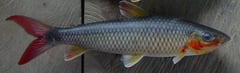
Leporinus brunneus
Anostomidae · Myers, 1950
Leporinus brunneus is an anostomid from the rios Madeira and Negro in Brazil, the Orinoco in Venezuela and Colombia, and the Casiquiare canal. The largest officially recorded specimen measured 256 mm, and an aquarium with base dimensions of at least 210 by 60 cm is needed.

Paracheirodon axelrodiCardinal Tetra
Characidae · (Schultz, 1956)
The cardinal tetra, Paracheirodon axelrodi, is a small characid from the rio Negro and Orinoco drainages of Brazil, Colombia and Venezuela. Immensely popular in the hobby, it is now commercially bred on a large scale, but a significant proportion of trade fish are still wild caught or come from community-led projects such as Project Piaba. Rio Negro and Orinoco populations differ in colour pattern, and wild fish are less tolerant of deteriorating water conditions than commercially-produced ones.
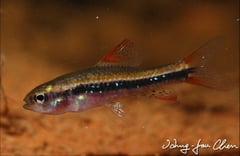
Poecilocharax weitzmaniBlack Darter Tetra
Crenuchidae · Géry, 1965
The black darter tetra, Poecilocharax weitzmani, is a crenuchid recorded from Brazil, Colombia, Peru and Venezuela. It has been collected from the upper Río Negro, Río Orinoco and Río Solimões drainages. Also traded as 'Black Morpho' tetra, it requires specialist care and is notoriously reluctant to accept dried foods. Unlike most small characids it does not form schools, and males are aggressively territorial towards one another. The Peruvian populations may apparently represent an undescribed species.

Satanoperca daemonThreespot Eartheater
Cichlidae · (Heckel, 1840)
The threespot eartheater, Satanoperca daemon, is a cichlid from the rio Negro, Casiquiare and upper Orinoco systems in Brazil, Venezuela and Colombia. It is mostly observed in acidic, mineral-poor blackwater. Relatively common in the aquarium trade, it is by no means easy to maintain, needing particular attention to space, diet, water quality and chemistry. Two dark blotches on the flank separate it from the similar S. lilith, which has only one.
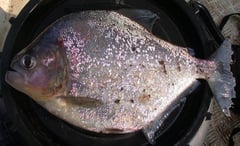
Serrasalmus gouldingiGoulding's Piranha
Serrasalmidae · Fink & Machado-Allison, 1992
Goulding's piranha, Serrasalmus gouldingi, is a deep-bodied piranha from the rio Negro drainage in Brazil and the Casiquiare system in Venezuela. It occasionally appears in the ornamental trade, sometimes as 'blue tiger piranha'. The eye is bluish or coppery, the body carries vertically-elongate dark spots and the caudal-fin has a blackish basal band. Its native rivers are acidic, mineral-poor blackwater, and it is best kept alone.
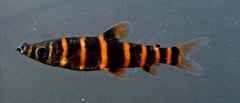
Synaptolaemus latofasciatus
Anostomidae · (Steindachner, 1910)
Synaptolaemus latofasciatus is a headstander from the upper Orinoco, the Casiquiare Canal and the middle-to-lower Amazon in Venezuela and Brazil. Described from a single specimen and placed in Leporinus until 2011, it was then recognised as the fish described as Synaptolaemus cingulatus. Alternating transverse bands of orange or yellow and dark brown or black run along the entire body, and snout shape and colour pattern vary with locality.
Hemiancistrus subviridisGreen Phantom Plec
Loricariidae · Werneke, Sabaj Pérez, Lujan & Armbruster, 2005
Hemiancistrus subviridis is a suckermouth catfish from the upper Orinoco and Casiquiare drainages in southern Venezuela, where it lives in cracks between granite rocks in flowing water. Known in the hobby as the green phantom plec, it shares the code L200 with Baryancistrus demantoides. Only B. demantoides has a membrane joining its dorsal and adipose fins. It looks very like L128, the blue phantom plec, and along the Orinoco the two fish grade into each other in colour.

Laetacara fulvipinnis
Cichlidae · Staeck & Schindler, 2007
Laetacara fulvipinnis is a cichlid from the Orinoco, the Casiquiare and the upper and middle rio Negro in Venezuela and Brazil. Known in the hobby as L. sp. 'orangeflossen' before it was described, it takes its name from the reddish-yellow anal and caudal fins. It has been collected among leaf litter and submerged vegetation in very shallow, soft, acidic blackwater, and grows to around 74 mm SL. A biparental substrate-spawner, it lays its eggs on a solid surface such as a plant leaf.
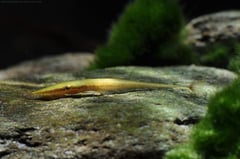
Acestridium dichromumGreen Whiptail
Loricariidae · Retzer, Nico & Provenzano, 1999
The green whiptail, Acestridium dichromum, is a small loricariid catfish from the upper rio Negro in Brazil and the upper Orinoco in Venezuela. It is known only from those two basins and the drainages between them, including the Casiquiare Canal.