River
Ventuari
Only species with a profile on Seriously Fish are counted.
- Species
- 15
- Families
- 9
- Photographed
- 14 of 15
- Difficulty rated
- 15 of 15
Basin
Also in the Orinoco basinspecies recorded from both
Shares fishes with rivers elsewherespecies recorded from both
Runs through
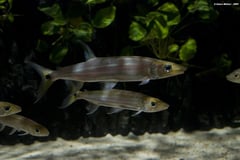
Acestrorhynchus falcirostrisBig-Eyed Cachorro
Acestrorhynchidae · (Cuvier, 1819)
The big-eyed cachorro, Acestrorhynchus falcirostris, is a large predatory acestrorhynchid from northern Amazon drainages and the Orinoco. The two dark body stripes of the A. nasutus group appear only in its juveniles, and at 320 to 350 mm SL it grows far larger than the other members. A black fringe to the rear of the operculum gives it a 'collared' look. It needs open water, and a group must be of comparable size because acestrorhynchids are cannibalistic.
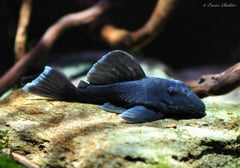
Baryancistrus begginiL239
Loricariidae · Lujan, Arce & Armbruster, 2009
Known as L239 before description, Baryancistrus beggini is a small loricariid from the Orinoco and lower río Guaviare in Venezuela and Colombia. Its body and fins are uniformly black to brownish with a turquoise to bluish sheen. Placement in Baryancistrus is tentative. Territorial with conspecifics but somewhat delicate, it is not recommended for the general community aquarium.
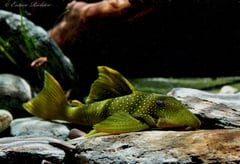
Baryancistrus demantoidesGreen Phantom Pleco
Loricariidae · Werneke, Sabaj Pérez, Lujan & Armbruster, 2005
The green phantom pleco, Baryancistrus demantoides, is a suckermouth catfish known only from where the río Ventuari meets the Orinoco in Venezuela. It closely resembles Hemiancistrus subviridis, which lives alongside it, and both have been marketed as L200. B. demantoides is the less common and more expensive of the two, sometimes sold as 'L200 high-fin' or 'L200a' for its longer dorsal-fin spine. Males become increasingly intolerant of conspecifics as they age.

Biotodoma wavriniOrinoco Eartheater
Cichlidae · (Gosse, 1963)
The Orinoco eartheater, Biotodoma wavrini, is a geophagine cichlid from the Orinoco and rio Negro basins of Venezuela, Colombia and Brazil. One natural habitat is the Río Cinaruco, a low-nutrient blackwater tributary of the Orinoco. It can be told from B. cupido by its noticeably elongate body and a dark flank blotch on or below the upper lateral line. Unless breeding it is surprisingly peaceful, and trade populations include 'Cuao', 'Orinoco', 'San Antonio' and 'Sipapo Ventuari'.
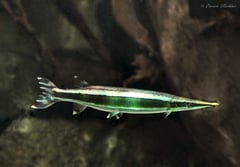
Boulengerella lateristrigaStriped Pike 'Characin'
Ctenoluciidae · (Boulenger, 1895)
The striped pike 'characin', Boulengerella lateristriga, is a ctenoluciid from the rio Negro basin and parts of the upper Río Orinoco. It appears limited to black water rivers and tributaries, where the water is stained darkly with humic acids and the pH can be as low as 3.0 or 4.0. A thin dark stripe from the rear of the eye to the caudal peduncle and dark crossbars on the caudal-fin lobes separate it from the similar B. maculata. It grows to 258 mm SL.

Geophagus abalios
Cichlidae · López-Fernández & Taphorn, 2004
Geophagus abalios is a cichlid from black and clear water tributaries of the río Orinoco in Venezuela, across the Llanos and south to the Casiquiare. One of the more commonly-traded members of the genus, it is rarely sold under the correct name and usually misidentified as G. altifrons or G. surinamensis. Juveniles are available cheaply because it is one of the few Geophagus bred commercially. Vertically split anterior flank bars separate it from the very similar G. brokopondo.

Geophagus dicrozoster
Cichlidae · López-Fernández & Taphorn, 2004
Geophagus dicrozoster is a cichlid from tributaries of the río Orinoco in Venezuela, extending to the Casiquiare and the headwaters of the Negro. Commonly traded but rarely under the correct name, it is usually sold as G. altifrons or G. surinamensis, and it is one of the few Geophagus bred commercially. Seven flank bars, the fourth and fifth meeting in a 'Y', and a relatively elongate profile identify it. It appears restricted to acidic blackwater.

Iguanodectes spilurusGreen Line Lizard Tetra
Iguanodectidae · (Günther, 1864)
The green line lizard tetra, Iguanodectes spilurus, is a characin found throughout the Amazon, Orinoco, Essequibo and Tocantins river systems. The most widespread Iguanodectes species, it has also been called the 'slender', 'spindle' or 'iguana' tetra, and differs from its congeners in its translucent dorsal and anal fins, lack of a red lateral stripe and prominent dark caudal-fin marking. It is sensitive to poor water conditions.

Megalamphodus sweglesiRed Phantom Tetra
Characidae · Géry, 1961
The red phantom tetra, Megalamphodus sweglesi, is a small characid endemic to the upper and middle Río Orinoco watershed in Colombia and Venezuela. It apparently favours minor tributaries, oxbows and flooded forests, and in Venezuela is often found in morichals. Bred commercially in several countries, it has been traded in more than one colour form, and Zarske (2014) concluded that the particularly red form sold as 'red' or 'var. rubra' is conspecific.

Satanoperca daemonThreespot Eartheater
Cichlidae · (Heckel, 1840)
The threespot eartheater, Satanoperca daemon, is a cichlid from the rio Negro, Casiquiare and upper Orinoco systems in Brazil, Venezuela and Colombia. It is mostly observed in acidic, mineral-poor blackwater. Relatively common in the aquarium trade, it is by no means easy to maintain, needing particular attention to space, diet, water quality and chemistry. Two dark blotches on the flank separate it from the similar S. lilith, which has only one.
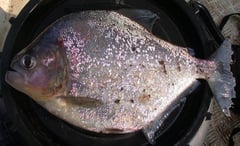
Serrasalmus gouldingiGoulding's Piranha
Serrasalmidae · Fink & Machado-Allison, 1992
Goulding's piranha, Serrasalmus gouldingi, is a deep-bodied piranha from the rio Negro drainage in Brazil and the Casiquiare system in Venezuela. It occasionally appears in the ornamental trade, sometimes as 'blue tiger piranha'. The eye is bluish or coppery, the body carries vertically-elongate dark spots and the caudal-fin has a blackish basal band. Its native rivers are acidic, mineral-poor blackwater, and it is best kept alone.
Hemiancistrus subviridisGreen Phantom Plec
Loricariidae · Werneke, Sabaj Pérez, Lujan & Armbruster, 2005
Hemiancistrus subviridis is a suckermouth catfish from the upper Orinoco and Casiquiare drainages in southern Venezuela, where it lives in cracks between granite rocks in flowing water. Known in the hobby as the green phantom plec, it shares the code L200 with Baryancistrus demantoides. Only B. demantoides has a membrane joining its dorsal and adipose fins. It looks very like L128, the blue phantom plec, and along the Orinoco the two fish grade into each other in colour.
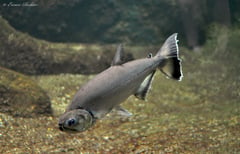
Hydrolycus armatusPayara
Cynodontidae · (Jardine, 1841)
The payara, Hydrolycus armatus, is a large, predatory dogtooth characin from the eastern Amazon, the Orinoco and the Essequibo in Guyana. Given its eventual size and natural behaviour it probably should not be considered a home aquarium subject at all, though juveniles are sometimes sold. It is regularly confused with the smaller H. scomberoides, and no other member of the genus has white margins to the anal and caudal fins.
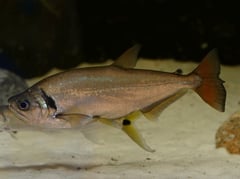
Hydrolycus tatauaia
Cynodontidae · Toledo-Piza, Menezes & Santos, 1999
Hydrolycus tatauaia is a large, predatory dogtooth characin from the lower and central Amazon, the upper Orinoco and coastal drainages of Guyana. A pelagic species of flowing main river channels, it performs long upstream migrations to spawn. Its adult size and natural behaviour mean only a handful of private aquarists have the facilities to house it long-term.
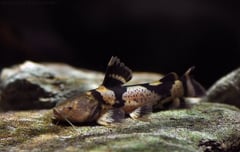
Pseudopimelodus bufoniusGiant Bumblebee Catfish
Pseudopimelodidae · (Valenciennes, 1840)
The giant bumblebee catfish, Pseudopimelodus bufonius, is distributed throughout northeastern South America, from Venezuela to eastern Brazil. Its range extends from the Lake Maracaibo basin, and it grows to 245 mm SL. The type locality is uncertain but probably Cayenne, French Guiana.