River
Corrientes
Only species with a profile on Seriously Fish are counted.
- Species
- 5
- Families
- 5
- Photographed
- 5 of 5
- Difficulty rated
- 5 of 5
Basin
Also in the Amazon basinspecies recorded from both
Shares fishes with rivers elsewherespecies recorded from both
Runs through

Apistogramma borelliiBorelli's Dwarf Cichlid
Cichlidae · Regan, 1906
Borelli's dwarf cichlid, Apistogramma borellii, is from southern Brazil, Paraguay, Argentina and Uruguay. Also known as the umbrella or yellow dwarf cichlid, it occurs in creeks and tributaries of the rio Paraguay, lower rio Paraná and Uruguay systems. Captive-raised fish are the recommended choice for the community aquarium, while wild examples are best kept alone or with small dither fishes.
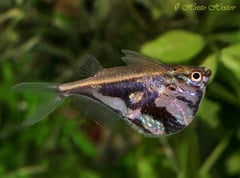
Carnegiella strigataMarbled Hatchetfish
Gasteropelecidae · Günther, 1864
The marbled hatchetfish, Carnegiella strigata, is a hatchetfish from the Amazon and Orinoco basins and coastal rivers of Guyana and Suriname. Popular in the hobby, it is collected for the trade mostly in the rio Negro basin in Brazil. Its larger size and dark, marbled pattern set it apart from congeners, though the pattern varies and the wide range may be open to question. It appears to live only in blackwater.

Colomesus asellusAmazon Puffer
Tetraodontidae · Müller & Troschel, 1849
The Amazon puffer, Colomesus asellus, is a freshwater puffer found throughout much of the Amazon basin, with records north to Guyana and Venezuela. Also traded as the South American puffer or 'SAP', it is told from congeners by a transverse row of dermal flaps across the chin. It lives mostly in well-oxygenated river habitats, is intolerant of organic waste, and forms loose aggregations, so a group of 6 or more is best, away from the general community.
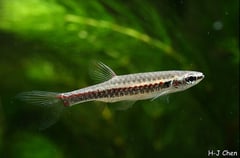
Copella nattereri
Lebiasinidae · Steindachner, 1876
Copella nattereri is a small lebiasinid widespread in the middle and upper Amazon drainage in Peru and Brazil. It is sometimes traded as C. sp. 'red line', 'spotted tetra' or C. nigrofasciata, and its name was long applied to C. callolepis and C. meinkeni. Of the three it alone has a dark lateral stripe, and it has no more than three rows of red spots on the flanks. It inhabits forest streams and flooded forest.

Hyphessobrycon peruvianusPeruvian Tetra
Characidae · Ladiges, 1938
The Peruvian tetra, Hyphessobrycon peruvianus, is a characid known only from the upper Amazon basin in Peru. Popular in the trade, it is sometimes confused with H. loretoensis and H. metae and has repeatedly appeared under the latter name in aquarium literature. A more elongate body, a dark band reaching the tips of the median caudal-fin rays and red markings at the base of both caudal lobes set it apart.