River
Cuiabá
Only species with a profile on Seriously Fish are counted.
- Species
- 7
- Families
- 6
- Photographed
- 7 of 7
- Difficulty rated
- 7 of 7
Shares fishes withspecies recorded from both
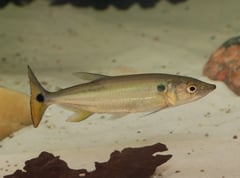
Acestrorhynchus pantaneiroPantanal Barracuda Tetra
Acestrorhynchidae · Menezes, 1992
The Pantanal barracuda tetra, Acestrorhynchus pantaneiro, is a predatory acestrorhynchid from the Paraná, Uruguay and de la Plata basins. It also occurs in the rio Mamoré in Bolivia. A member of the A. lacustris group with a round humeral spot, it is virtually impossible to tell from its relatives in the trade unless collection data is known. It lives in open water, and a group must be of comparable size because acestrorhynchids are cannibalistic.
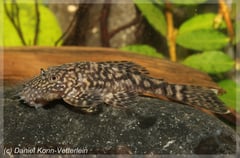
Ancistrus claroLDA 008
Loricariidae · Knaack, 1999
Ancistrus claro, the gold marble bristlenose catfish (LDA 008), is a suckermouth catfish from the rios Claro and Coxipó in Mato Grosso, Brazil. It inhabits flowing streams over boulders and bedrock. Sometimes confused with unidentified fishes such as A. sp. 'L352', it has long maxillary barbels and small spots on the head, with vermiform lines on the body in males and spots all over in females. A peaceful cave-spawner, it has been bred in aquaria on numerous occasions.

Megalamphodus megalopterusBlack Phantom Tetra
Characidae · (Eigenmann, 1915)
The black phantom tetra, Megalamphodus megalopterus, is a characid from the upper rio Madeira and upper rio Paraguai in Bolivia and Brazil. Most records are from the rio Guaporé (Río Iténez in Bolivia). Popular in the hobby and bred commercially in several countries, it is also available as a 'long-finned' strain. Adult males have black fins with the pelvic, dorsal and anal enlarged, while females are deeper-bodied with reddish pelvic, anal and adipose fins.

Phenacogaster tegatus
Characidae · Eigenmann, 1911
Phenacogaster tegatus is a small characid from the upper rio Paraguay basin in Brazil and Paraguay and the Río Paraná in northeastern Argentina. It has been traded as 'six-eyed tetra', in reference to the two dark spots on each flank plus the eye. Peaceful but somewhat unsuitable for the general community aquarium, it is best kept in a group of at least 8-10 alongside similarly-sized characids and other small, non-predatory fishes.
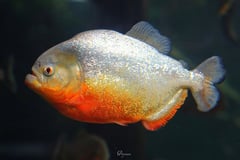
Pygocentrus nattereriRed Bellied Piranha
Serrasalmidae · Kner, 1858
The red bellied piranha, Pygocentrus nattereri, occurs through much of the Amazon basin and south into the Paraná and Uruguay river systems. Famed as a rapacious predator, it is among the most notorious freshwater fishes in the world. According to Herbert Axelrod (1976), the myth began with a feeding frenzy staged for Theodore Roosevelt in Brazil in 1913. Usually only juveniles form aggregations, and the species is relatively easy to breed in the aquarium.

Satanoperca pappaterraPantanal Eartheater
Cichlidae · Heckel, 1840
The Pantanal eartheater, Satanoperca pappaterra, is a cichlid from the rio Guaporé and upper rio Paraguai basins in Brazil, Bolivia and Paraguay. Relatively rare in the ornamental trade and much sought after, it is easily told from all known congeners by a series of prominent black blotches beneath the dorsal-fin and a well-defined dark band along the side of the body. It has been introduced to the upper rio Paraná in southeastern Brazil.
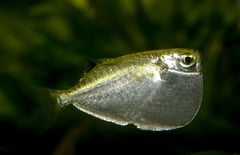
Thoracocharax stellatusSpotfin Hatchetfish
Gasteropelecidae · Kner, 1858
The spotfin hatchetfish, Thoracocharax stellatus, is the most widespread neotropical hatchetfish, recorded from much of South America. It is told from its only congener, T. securis, by a prominent dark spot in the dorsal fin, and is sometimes traded as 'platinum hatchetfish'. It feeds almost entirely on insects, and a tightly fitting cover is needed because it can clear several metres in one jump.