River
Guaviare
Only species with a profile on Seriously Fish are counted.
- Species
- 12
- Families
- 8
- Photographed
- 10 of 12
- Difficulty rated
- 12 of 12
Basin
Also in the Orinoco basinspecies recorded from both
Shares fishes with rivers elsewherespecies recorded from both
Runs through
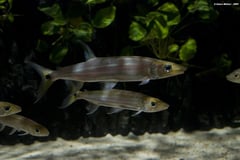
Acestrorhynchus falcirostrisBig-Eyed Cachorro
Acestrorhynchidae · Cuvier, 1819
The big-eyed cachorro, Acestrorhynchus falcirostris, is a large predatory acestrorhynchid from northern Amazon drainages and the Orinoco. The two dark body stripes of the A. nasutus group appear only in its juveniles, and at 320 to 350 mm SL it grows far larger than the other members. A black fringe to the rear of the operculum gives it a 'collared' look. It needs open water, and a group must be of comparable size because acestrorhynchids are cannibalistic.
Apistogramma alacrinaRedspot Dwarf Cichlid
Cichlidae · Kullander, 2004
The redspot dwarf cichlid, Apistogramma alacrina, is from the Río Guaviare (Orinoco) and Río Orteguaza (Amazon) drainages in Colombia. It differs from all other described members of the genus in having dark blotches at the dorsal and ventral base of the pectoral fins. Three very similar fishes coded A106, A107 and A108 may or may not be conspecific with it, since they show some differences in colour pattern and morphology.
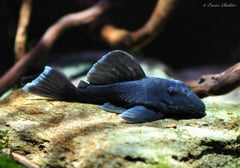
Baryancistrus begginiL239
Loricariidae · Lujan, Arce & Armbruster, 2009
Known as L239 before description, Baryancistrus beggini is a small loricariid from the Orinoco and lower río Guaviare in Venezuela and Colombia. Its body and fins are uniformly black to brownish with a turquoise to bluish sheen. Placement in Baryancistrus is tentative. Territorial with conspecifics but somewhat delicate, it is not recommended for the general community aquarium.
Chaetostoma formosaeStriped Bulldog Pleco
Loricariidae · Ballen, 2011
The striped bulldog pleco, Chaetostoma formosae, is a suckermouth catfish from piedmont streams of the upper Meta and Guaviare systems in Colombia. The commonest member of the genus in the hobby, it is still misidentified as C. thompsoni and sold under several names and L-numbers. An obligate inhabitant of fast-flowing headwater streams, it needs clean, well-oxygenated water with strong flow and does best in a dedicated species set-up.
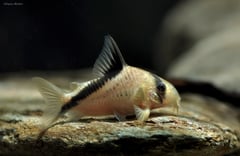
Hoplisoma meliniFalse Bandit Cory
Callichthyidae · (Lönnberg & Rendahl, 1930)
The false bandit cory, Hoplisoma melini, long known as Corydoras melini, is an armoured catfish from tributaries of the rios Negro, Caquetá and Orinoco in Brazil and Colombia. Its oblique dark bar along the back splits into two above the caudal peduncle, a feature shared only with H. davidsandsi, from which the dark markings on its flanks separate it. The rio Tiquié population is known in the hobby as 'C084', and a similar, slightly larger form from Peru as 'C085'.

Hyphessobrycon metaePurple Tetra
Characidae · Eigenmann & Henn, 1914
The purple tetra, Hyphessobrycon metae, is a characid endemic to the middle Río Orinoco watershed in Colombia and Venezuela. Also known as 'Río Meta tetra', it is often misidentified, and H. peruvianus has repeatedly appeared under its name. The dark band on the caudal peduncle, without a broad dark band along the lower body, separates it from H. peruvianus and H. loretoensis.

Megalamphodus sweglesiRed Phantom Tetra
Characidae · Géry, 1961
The red phantom tetra, Megalamphodus sweglesi, is a small characid endemic to the upper and middle Río Orinoco watershed in Colombia and Venezuela. It apparently favours minor tributaries, oxbows and flooded forests, and in Venezuela is often found in morichals. Bred commercially in several countries, it has been traded in more than one colour form, and Zarske (2014) concluded that the particularly red form sold as 'red' or 'var. rubra' is conspecific.
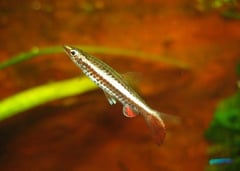
Nannostomus equesHockeystick Pencilfish
Lebiasinidae · Steindachner, 1876
The hockeystick pencilfish, Nannostomus eques, is a lebiasinid from the central and upper Amazon, the Orinoco drainage and rivers of Guyana. It swims at an oblique angle, a trait shared only with N. unifasciatus among congeners, and is also known as the 'rocket', 'diptail' or 'tubemouth' pencilfish. Genetic research on rio Negro populations raises the possibility that the species may be a complex of cryptic taxa.

Paracheirodon axelrodiCardinal Tetra
Characidae · Schultz, 1956
The cardinal tetra, Paracheirodon axelrodi, is a small characid from the rio Negro and Orinoco drainages of Brazil, Colombia and Venezuela. Immensely popular in the hobby, it is now commercially bred on a large scale, but a significant proportion of trade fish are still wild caught or come from community-led projects such as Project Piaba. Rio Negro and Orinoco populations differ in colour pattern, and wild fish are less tolerant of deteriorating water conditions than commercially-produced ones.
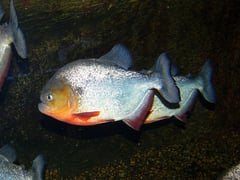
Pygocentrus caribaBlack Spot Piranha
Serrasalmidae · Humboldt, 1821
The black spot piranha, Pygocentrus cariba, is restricted to the Río Orinoco basin in Colombia and Venezuela. Many of its habitats lie within the llanos, and it has been recorded from river channels, tributaries and floodplain lakes, many of them acidic blackwater environments. Specimens over 100 mm SL have a large humeral spot and few spots on the body, which separates it from P. nattereri. It is best maintained alone.

Satanoperca daemonThreespot Eartheater
Cichlidae · Heckel, 1840
The threespot eartheater, Satanoperca daemon, is a cichlid from the rio Negro, Casiquiare and upper Orinoco systems in Brazil, Venezuela and Colombia. It is mostly observed in acidic, mineral-poor blackwater. Relatively common in the aquarium trade, it is by no means easy to maintain, needing particular attention to space, diet, water quality and chemistry. Two dark blotches on the flank separate it from the similar S. lilith, which has only one.
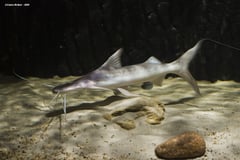
Brachyplatystoma platynemumSlobbering Catfish
Pimelodidae · Boulenger, 1898
The slobbering catfish, Brachyplatystoma platynemum, is a large migratory pimelodid catfish from the Amazon and Orinoco basins. The name refers to its relatively thick barbels, which give the impression that the fish is drooling. It travels considerable distances along deeper, flowing channels, and sexually mature adults have been observed in the upper rio Madeira basin, some 3000 km from the estuary. It grows to 1000 mm SL.