River
Vichada
Only species with a profile on Seriously Fish are counted.
- Species
- 8
- Families
- 5
- Photographed
- 8 of 8
- Difficulty rated
- 8 of 8
Basin
Also in the Orinoco basinspecies recorded from both
Shares fishes with rivers elsewherespecies recorded from both
Runs through

Apistogramma hongsloi
Cichlidae · Kullander, 1979
Apistogramma hongsloi is a dwarf cichlid from the Río Vichada and middle Río Meta basins in Colombia and the middle Orinoco in Venezuela. Coded A110 under the DATZ system, it has similar-looking, possibly conspecific populations referred to as A111 to A115 depending on locality. It lives in small tributaries and still waters, and males grow to 55 to 60 mm and females to 40 to 45 mm.
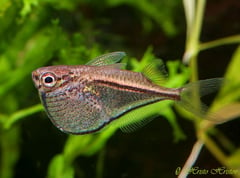
Carnegiella marthaeBlackwing Hatchetfish
Gasteropelecidae · Myers, 1927
The blackwing hatchetfish, Carnegiella marthae, is a small freshwater hatchetfish from the upper Orinoco in Venezuela and the rio Negro in Brazil. It appears to be a stenotypic inhabitant of blackwater, found in igapó and igarapé habitats with overhanging vegetation and leaf litter. Very peaceful but small and timid, it is best kept in a group of 10 or more with similarly sized, peaceful fishes.

Megalamphodus sweglesiRed Phantom Tetra
Characidae · Géry, 1961
The red phantom tetra, Megalamphodus sweglesi, is a small characid endemic to the upper and middle Río Orinoco watershed in Colombia and Venezuela. It apparently favours minor tributaries, oxbows and flooded forests, and in Venezuela is often found in morichals. Bred commercially in several countries, it has been traded in more than one colour form, and Zarske (2014) concluded that the particularly red form sold as 'red' or 'var. rubra' is conspecific.
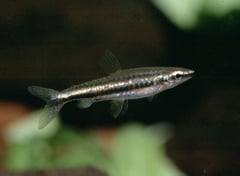
Nannostomus marilynaeGreenstripe Pencilfish
Lebiasinidae · Weitzman & Cobb, 1975
The greenstripe pencilfish, Nannostomus marilynae, occurs in the rio Negro in Brazil and the Río Vichada in the upper Orinoco basin, Colombia. Also known as 'Marilyn's pencilfish', it is rarely traded in numbers and more often seen as bycatch among shipments of Paracheirodon axelrodi. It most resembles N. minimus, but males lack the highly modified anal-fin of that species.

Paracheirodon axelrodiCardinal Tetra
Characidae · Schultz, 1956
The cardinal tetra, Paracheirodon axelrodi, is a small characid from the rio Negro and Orinoco drainages of Brazil, Colombia and Venezuela. Immensely popular in the hobby, it is now commercially bred on a large scale, but a significant proportion of trade fish are still wild caught or come from community-led projects such as Project Piaba. Rio Negro and Orinoco populations differ in colour pattern, and wild fish are less tolerant of deteriorating water conditions than commercially-produced ones.

Paracheirodon simulansGreen Neon Tetra
Characidae · Géry, 1963
The green neon tetra, Paracheirodon simulans, is a small characid from the rio Negro and Orinoco drainages of Brazil, Colombia and Venezuela. An exclusive inhabitant of blackwater, it lives only in the upper, terra firme reaches of tributaries and is sometimes traded as 'false neon tetra' or 'blue neon tetra'. A greener lateral stripe that extends to the caudal-fin base and duller red flanks separate it from P. innesi and P. axelrodi.
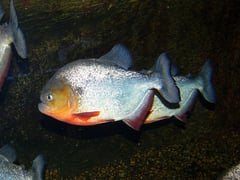
Pygocentrus caribaBlack Spot Piranha
Serrasalmidae · Humboldt, 1821
The black spot piranha, Pygocentrus cariba, is restricted to the Río Orinoco basin in Colombia and Venezuela. Many of its habitats lie within the llanos, and it has been recorded from river channels, tributaries and floodplain lakes, many of them acidic blackwater environments. Specimens over 100 mm SL have a large humeral spot and few spots on the body, which separates it from P. nattereri. It is best maintained alone.

Satanoperca daemonThreespot Eartheater
Cichlidae · Heckel, 1840
The threespot eartheater, Satanoperca daemon, is a cichlid from the rio Negro, Casiquiare and upper Orinoco systems in Brazil, Venezuela and Colombia. It is mostly observed in acidic, mineral-poor blackwater. Relatively common in the aquarium trade, it is by no means easy to maintain, needing particular attention to space, diet, water quality and chemistry. Two dark blotches on the flank separate it from the similar S. lilith, which has only one.