River
Tomo
Only species with a profile on Seriously Fish are counted.
- Species
- 4
- Families
- 3
- Photographed
- 4 of 4
- Difficulty rated
- 4 of 4
Basin
Also in the Orinoco basinspecies recorded from both
Shares fishes with rivers elsewherespecies recorded from both
Runs through

Hyphessobrycon metaePurple Tetra
Characidae · Eigenmann & Henn, 1914
The purple tetra, Hyphessobrycon metae, is a characid endemic to the middle Río Orinoco watershed in Colombia and Venezuela. Also known as 'Río Meta tetra', it is often misidentified, and H. peruvianus has repeatedly appeared under its name. The dark band on the caudal peduncle, without a broad dark band along the lower body, separates it from H. peruvianus and H. loretoensis.

Megalamphodus sweglesiRed Phantom Tetra
Characidae · Géry, 1961
The red phantom tetra, Megalamphodus sweglesi, is a small characid endemic to the upper and middle Río Orinoco watershed in Colombia and Venezuela. It apparently favours minor tributaries, oxbows and flooded forests, and in Venezuela is often found in morichals. Bred commercially in several countries, it has been traded in more than one colour form, and Zarske (2014) concluded that the particularly red form sold as 'red' or 'var. rubra' is conspecific.
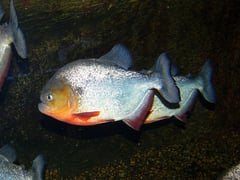
Pygocentrus caribaBlack Spot Piranha
Serrasalmidae · Humboldt, 1821
The black spot piranha, Pygocentrus cariba, is restricted to the Río Orinoco basin in Colombia and Venezuela. Many of its habitats lie within the llanos, and it has been recorded from river channels, tributaries and floodplain lakes, many of them acidic blackwater environments. Specimens over 100 mm SL have a large humeral spot and few spots on the body, which separates it from P. nattereri. It is best maintained alone.

Satanoperca daemonThreespot Eartheater
Cichlidae · Heckel, 1840
The threespot eartheater, Satanoperca daemon, is a cichlid from the rio Negro, Casiquiare and upper Orinoco systems in Brazil, Venezuela and Colombia. It is mostly observed in acidic, mineral-poor blackwater. Relatively common in the aquarium trade, it is by no means easy to maintain, needing particular attention to space, diet, water quality and chemistry. Two dark blotches on the flank separate it from the similar S. lilith, which has only one.