River
Manacacías
Only species with a profile on Seriously Fish are counted.
- Species
- 3
- Families
- 2
- Photographed
- 3 of 3
- Difficulty rated
- 3 of 3
Basin
Also in the Orinoco basinspecies recorded from both
Shares fishes with rivers elsewherespecies recorded from both
Runs through
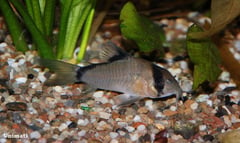
Hoplisoma metaeBandit Cory
Callichthyidae · (Eigenmann, 1914)
The bandit cory, Hoplisoma metae, long known as Corydoras metae, is an armoured catfish endemic to the upper Río Meta, an Orinoco tributary in eastern Colombia. It appears to be absent from the lower Meta and has not been recorded in Venezuela. Also called 'masked' or 'Meta' cory, it has an oblique dark bar on the rear of the body that ends at the caudal-fin base without splitting, and no other dark markings on the body.

Hyphessobrycon metaePurple Tetra
Characidae · Eigenmann & Henn, 1914
The purple tetra, Hyphessobrycon metae, is a characid endemic to the middle Río Orinoco watershed in Colombia and Venezuela. Also known as 'Río Meta tetra', it is often misidentified, and H. peruvianus has repeatedly appeared under its name. The dark band on the caudal peduncle, without a broad dark band along the lower body, separates it from H. peruvianus and H. loretoensis.

Megalamphodus sweglesiRed Phantom Tetra
Characidae · Géry, 1961
The red phantom tetra, Megalamphodus sweglesi, is a small characid endemic to the upper and middle Río Orinoco watershed in Colombia and Venezuela. It apparently favours minor tributaries, oxbows and flooded forests, and in Venezuela is often found in morichals. Bred commercially in several countries, it has been traded in more than one colour form, and Zarske (2014) concluded that the particularly red form sold as 'red' or 'var. rubra' is conspecific.