River
Metica
Only species with a profile on Seriously Fish are counted.
- Species
- 6
- Families
- 5
- Photographed
- 6 of 6
- Difficulty rated
- 6 of 6
Basin
Also in the Orinoco basinspecies recorded from both
Shares fishes with rivers elsewherespecies recorded from both
Runs through

Apistogramma macmasteri
Cichlidae · Kullander, 1979
Apistogramma macmasteri is a dwarf cichlid known only from the Río Guaytiquía and Río Metica basins in the upper Río Meta system, Colombia. Coded A120 under the DATZ system, it has a similar-looking, possibly conspecific population referred to as A122, and A121 is the ornamental 'red' form. Captive-raised fish are the recommended choice for the community aquarium.
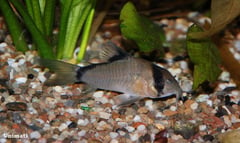
Hoplisoma metaeBandit Cory
Callichthyidae · (Eigenmann, 1914)
The bandit cory, Hoplisoma metae, long known as Corydoras metae, is an armoured catfish endemic to the upper Río Meta, an Orinoco tributary in eastern Colombia. It appears to be absent from the lower Meta and has not been recorded in Venezuela. Also called 'masked' or 'Meta' cory, it has an oblique dark bar on the rear of the body that ends at the caudal-fin base without splitting, and no other dark markings on the body.

Hyphessobrycon metaePurple Tetra
Characidae · Eigenmann & Henn, 1914
The purple tetra, Hyphessobrycon metae, is a characid endemic to the middle Río Orinoco watershed in Colombia and Venezuela. Also known as 'Río Meta tetra', it is often misidentified, and H. peruvianus has repeatedly appeared under its name. The dark band on the caudal peduncle, without a broad dark band along the lower body, separates it from H. peruvianus and H. loretoensis.

Megalamphodus sweglesiRed Phantom Tetra
Characidae · Géry, 1961
The red phantom tetra, Megalamphodus sweglesi, is a small characid endemic to the upper and middle Río Orinoco watershed in Colombia and Venezuela. It apparently favours minor tributaries, oxbows and flooded forests, and in Venezuela is often found in morichals. Bred commercially in several countries, it has been traded in more than one colour form, and Zarske (2014) concluded that the particularly red form sold as 'red' or 'var. rubra' is conspecific.
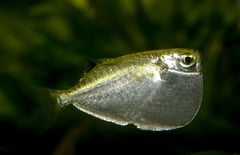
Thoracocharax stellatusSpotfin Hatchetfish
Gasteropelecidae · Kner, 1858
The spotfin hatchetfish, Thoracocharax stellatus, is the most widespread neotropical hatchetfish, recorded from much of South America. It is told from its only congener, T. securis, by a prominent dark spot in the dorsal fin, and is sometimes traded as 'platinum hatchetfish'. It feeds almost entirely on insects, and a tightly fitting cover is needed because it can clear several metres in one jump.
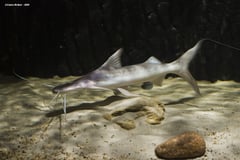
Brachyplatystoma platynemumSlobbering Catfish
Pimelodidae · Boulenger, 1898
The slobbering catfish, Brachyplatystoma platynemum, is a large migratory pimelodid catfish from the Amazon and Orinoco basins. The name refers to its relatively thick barbels, which give the impression that the fish is drooling. It travels considerable distances along deeper, flowing channels, and sexually mature adults have been observed in the upper rio Madeira basin, some 3000 km from the estuary. It grows to 1000 mm SL.