River
Marauiá
Only species with a profile on Seriously Fish are counted.
- Species
- 4
- Families
- 2
- Photographed
- 4 of 4
- Difficulty rated
- 4 of 4
Basin
Also in the Amazon basinspecies recorded from both
Shares fishes with rivers elsewherespecies recorded from both
Runs through
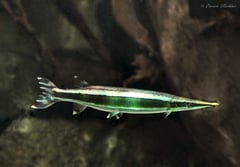
Boulengerella lateristrigaStriped Pike 'Characin'
Ctenoluciidae · Boulenger, 1895
The striped pike 'characin', Boulengerella lateristriga, is a ctenoluciid from the rio Negro basin and parts of the upper Río Orinoco. It appears limited to black water rivers and tributaries, where the water is stained darkly with humic acids and the pH can be as low as 3.0 or 4.0. A thin dark stripe from the rear of the eye to the caudal peduncle and dark crossbars on the caudal-fin lobes separate it from the similar B. maculata. It grows to 258 mm SL.
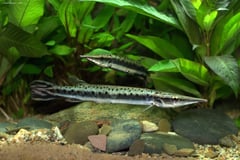
Boulengerella maculata
Ctenoluciidae · Valenciennes, 1850
Boulengerella maculata is a pelagic ctenoluciid found throughout much of the Amazon, Orinoco and Tocantins river systems. Colour pattern varies considerably, with some specimens much paler than others, and this may be correlated with water type. Random dark spots on the upper body, and a dark stripe only behind the eye when one is present, separate it from the similar B. lateristriga. It reaches 329 mm SL and needs an aquarium with base dimensions of 240 by 90 cm or more.

Megalamphodus socolofiLesser Bleeding Heart Tetra
Characidae · (Weitzman, 1977)
The lesser bleeding heart tetra, Megalamphodus socolofi, is a characid known only from the rio Negro basin and the rio Nhamundá in Brazil. One of three similar species in the 'bleeding heart' subgroup, it shares their reddish humeral spot, found in no other characid. Generally peaceful, although adult males are territorial to an extent, it mostly inhabits sluggish tributaries, side arms and forest lakes.
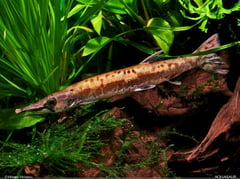
Boulengerella lucius
Ctenoluciidae · Cuvier, 1816
Boulengerella lucius is a large, pelagic ctenoluciid from the central Amazon region in Brazil and the Río Orinoco in Venezuela. Named for its resemblance to the northern pike, it grows to 420 mm and is largely unsuitable for the home aquarium. Juveniles and subadults are sometimes available in the trade, often misidentified as B. maculata. Dark patches between the median caudal-fin rays and random dark spots on the lower flanks separate it from B. cuvieri and B. xyrekes.