River
Trombetas
Only species with a profile on Seriously Fish are counted.
- Species
- 19
- Families
- 9
- Photographed
- 19 of 19
- Difficulty rated
- 19 of 19
Basin
Also in the Amazon basinspecies recorded from both
Shares fishes with rivers elsewherespecies recorded from both
Runs through

Astyanax bimaculatusTwo Spot Astyanax
Characidae · (Linnaeus, 1758)
The two spot astyanax, Astyanax bimaculatus, is a characid ranging from Panama through most of the Amazon and Orinoco basins. It lives in a wide variety of biotopes, from swiftly-flowing rivers and streams to ponds, ditches and reservoirs. The name is currently applied to what is considered a species complex of at least four taxa, and aquarium fish most often arrive as contaminants among shipments of other species.
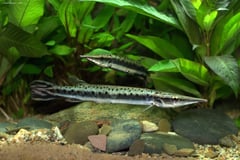
Boulengerella maculata
Ctenoluciidae · (Valenciennes, 1850)
Boulengerella maculata is a pelagic ctenoluciid found throughout much of the Amazon, Orinoco and Tocantins river systems. Colour pattern varies considerably, with some specimens much paler than others, and this may be correlated with water type. Random dark spots on the upper body, and a dark stripe only behind the eye when one is present, separate it from the similar B. lateristriga. It reaches 329 mm SL and needs an aquarium with base dimensions of 240 by 90 cm or more.

Colomesus asellusAmazon Puffer
Tetraodontidae · (Müller & Troschel, 1849)
The Amazon puffer, Colomesus asellus, is a freshwater puffer found throughout much of the Amazon basin, with records north to Guyana and Venezuela. Also traded as the South American puffer or 'SAP', it is told from congeners by a transverse row of dermal flaps across the chin. It lives mostly in well-oxygenated river habitats, is intolerant of organic waste, and forms loose aggregations, so a group of 6 or more is best, away from the general community.
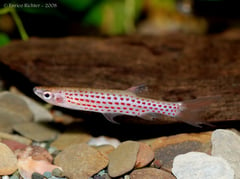
Copella meinkeniSpotted Splashing Tetra
Lebiasinidae · Zarske & Géry, 2006
The spotted splashing tetra, Copella meinkeni, is a small lebiasinid from the central Amazon region, with most records from the rio Negro and Orinoco. It has been widely referred to as C. nattereri in aquarium literature, but lacks that species' dark lateral stripe and has 5-6 rows of bright red spots on the body. The similar C. callolepis is also traded. It inhabits forest streams with tea-coloured water and lays its eggs among vegetation.
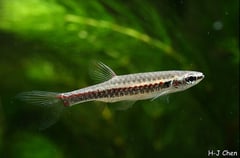
Copella nattereri
Lebiasinidae · (Steindachner, 1876)
Copella nattereri is a small lebiasinid widespread in the middle and upper Amazon drainage in Peru and Brazil. It is sometimes traded as C. sp. 'red line', 'spotted tetra' or C. nigrofasciata, and its name was long applied to C. callolepis and C. meinkeni. Of the three it alone has a dark lateral stripe, and it has no more than three rows of red spots on the flanks. It inhabits forest streams and flooded forest.
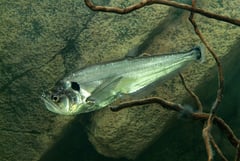
Cynodon gibbus
Cynodontidae · (Agassiz, 1829)
Cynodon gibbus is a cynodontid from much of the Amazon basin, the middle and lower Orinoco, and the Rupununi River in Guyana. A pelagic fish of main river channels and larger tributaries, it grows to around 280 mm SL. It is rare in the trade but arguably more suitable for the home aquarium than some of its better-known relatives, given its size and relatively docile behaviour. Being easily dominated, it is best kept alone or with similarly sized, non-aggressive fishes.

Geophagus altifrons
Cichlidae · Heckel, 1840
Geophagus altifrons is a large cichlid from the middle-to-lower Amazon basin in Brazil, including the Xingu, Tapajós, Madeira, Negro and Purus. Despite being the type species it is among the most frequently-misidentified members of the genus, partly because populations from the Orinoco, the Guianas and the Tocantins are now species in their own right. In adults the dark midlateral marking is reduced to 1-2 scales or absent, a feature unique to the species, but juveniles are very difficult to identify.

Geophagus proximus
Cichlidae · (Castelnau, 1855)
Geophagus proximus is a large cichlid from the Amazon system in Peru and Brazil, from the río Ucayali along the Solimões-Amazon to the rio Trombetas. Rare in the hobby, its name is often attached to shipments of other Geophagus species. It has a dark preopercular marking, no bars on the flanks and a large, roughly oblong midlateral marking. It is found mostly in the lower reaches of rivers and in floodplain lakes, favouring clear and black water.
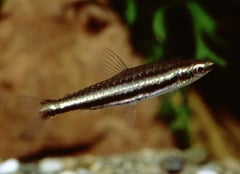
Nannostomus digrammusTwostripe Pencilfish
Lebiasinidae · (Fowler, 1913)
The twostripe pencilfish, Nannostomus digrammus, is a lebiasinid from the central Amazon basin in Brazil and the Rupununi basin in Guyana. Rare in the hobby, it usually arrives as bycatch among shipments of other fishes. It is most similar to N. bifasciatus but has an adipose-fin, and its small size and timid nature make it a poor community fish.
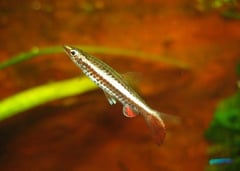
Nannostomus equesHockeystick Pencilfish
Lebiasinidae · Steindachner, 1876
The hockeystick pencilfish, Nannostomus eques, is a lebiasinid from the central and upper Amazon, the Orinoco drainage and rivers of Guyana. It swims at an oblique angle, a trait shared only with N. unifasciatus among congeners, and is also known as the 'rocket', 'diptail' or 'tubemouth' pencilfish. Genetic research on rio Negro populations raises the possibility that the species may be a complex of cryptic taxa.
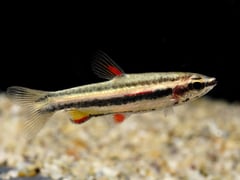
Nannostomus marginatusDwarf Pencilfish
Lebiasinidae · Eigenmann, 1909
The dwarf pencilfish, Nannostomus marginatus, is a lebiasinid of Guyana, Suriname and the middle-to-lower Amazon in Peru, Colombia and Brazil. Enduringly popular, it lacks the red body colour of males of the related N. mortenthaleri and N. rubrocaudatus, showing three dark lateral stripes with no red or purple between them. Colour varies between populations, and its small size and timid nature make it a poor community fish.

Satanoperca acuticepsSharphead Eartheater
Cichlidae · (Heckel, 1840)
The sharphead eartheater, Satanoperca acuticeps, is a cichlid from the central Amazon basin in Brazil, including the lower rio Negro and rio Branco. Relatively rare in the trade, it is sometimes confused with S. daemon and S. lilith but has three dark flank blotches (vs. two in S. daemon, one in S. lilith). Unless breeding it is surprisingly peaceful, and it is very rarely bred in aquaria.

Satanoperca lilith
Cichlidae · Kullander & Ferreira, 1988
Satanoperca lilith is an eartheater cichlid known only from Brazil, where it is widely distributed along the Solimões/Amazon main channel. Despite that extensive range it is uncommon in the ornamental trade, where it is sometimes called 'one-spotted demon fish' or 'one spot eartheater'. A single dark blotch on the flank separates it from the closely similar S. daemon, which has two.
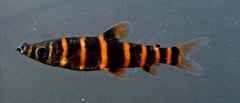
Synaptolaemus latofasciatus
Anostomidae · (Steindachner, 1910)
Synaptolaemus latofasciatus is a headstander from the upper Orinoco, the Casiquiare Canal and the middle-to-lower Amazon in Venezuela and Brazil. Described from a single specimen and placed in Leporinus until 2011, it was then recognised as the fish described as Synaptolaemus cingulatus. Alternating transverse bands of orange or yellow and dark brown or black run along the entire body, and snout shape and colour pattern vary with locality.
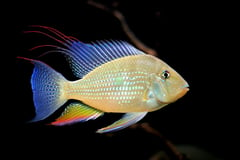
Acarichthys heckeliiThreadfin Acara
Cichlidae · (Müller & Troschel, 1849)
The threadfin acara, Acarichthys heckelii, is a cichlid from the northern Amazon basin in Colombia, Peru and Brazil and the Essequibo in Guyana. The only member of its genus, it grows to around 200 mm and digs incessantly, and it is susceptible to deteriorating water quality. Some adults show sudden, extreme aggression towards conspecifics that can kill weaker fish, and the problem decreases as tank and group size increase.
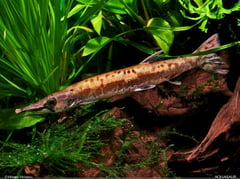
Boulengerella lucius
Ctenoluciidae · (Cuvier, 1816)
Boulengerella lucius is a large, pelagic ctenoluciid from the central Amazon region in Brazil and the Río Orinoco in Venezuela. Named for its resemblance to the northern pike, it grows to 420 mm and is largely unsuitable for the home aquarium. Juveniles and subadults are sometimes available in the trade, often misidentified as B. maculata. Dark patches between the median caudal-fin rays and random dark spots on the lower flanks separate it from B. cuvieri and B. xyrekes.
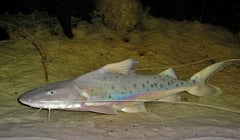
Brachyplatystoma capapretum
Pimelodidae · Lundberg & Akama, 2005
Brachyplatystoma capapretum is a large, piscivorous pimelodid catfish found throughout much of the Amazon basin, from near Belém to Iquitos in Peru. The largest recorded specimen measured 880 mm, and it is suitable only for public aquaria and a very small minority of private aquarists. It is very similar to B. filamentosum but smaller, with shorter maxillary barbels, a moderately forked caudal-fin with lobes of equal size, and adults very dark above.

Laetacara thayeri
Cichlidae · (Steindachner, 1875)
Laetacara thayeri is a cichlid from the middle and upper Amazon basin in western Brazil and northern Peru. It is relatively rare in the aquarium trade. Ctenoid scales on the sides of the head and the lack of a dark spot at the caudal-fin base separate it from all congeners. Males grow larger than females and develop more-extended dorsal, anal and caudal fins.

Iguanodectes variatus
Iguanodectidae · Géry, 1993
Iguanodectes variatus is a characin from Brazil, recorded from the Guaporé, Madeira, Branco, Trombetas and Urubu river systems in the Amazon basin. It belongs to a small genus of elongate fishes in the family Iguanodectidae and grows to around 103 mm SL.