River
Tefé
Only species with a profile on Seriously Fish are counted.
- Species
- 9
- Families
- 7
- Photographed
- 9 of 9
- Difficulty rated
- 9 of 9
Basin
Also in the Amazon basinspecies recorded from both
Shares fishes with rivers elsewherespecies recorded from both
Runs through

Apistogramma agassiziiAgassiz's Dwarf Cichlid
Cichlidae · Steindachner, 1875
Apistogramma agassizii is a dwarf cichlid found through much of the Amazon/Solimões basin, from the Río Ucayali in Peru to the Capim River in Brazil. Colour and pattern vary considerably with locality, and numerous ornamental forms have been selectively bred for the trade. It inhabits slower-moving tributaries and creeks where leaf litter collects. Captive-raised fish suit the community aquarium, while wild fish are best kept alone or with small dither fishes.
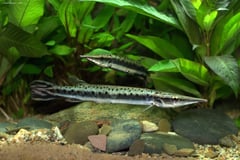
Boulengerella maculata
Ctenoluciidae · Valenciennes, 1850
Boulengerella maculata is a pelagic ctenoluciid found throughout much of the Amazon, Orinoco and Tocantins river systems. Colour pattern varies considerably, with some specimens much paler than others, and this may be correlated with water type. Random dark spots on the upper body, and a dark stripe only behind the eye when one is present, separate it from the similar B. lateristriga. It reaches 329 mm SL and needs an aquarium with base dimensions of 240 by 90 cm or more.

Colomesus asellusAmazon Puffer
Tetraodontidae · Müller & Troschel, 1849
The Amazon puffer, Colomesus asellus, is a freshwater puffer found throughout much of the Amazon basin, with records north to Guyana and Venezuela. Also traded as the South American puffer or 'SAP', it is told from congeners by a transverse row of dermal flaps across the chin. It lives mostly in well-oxygenated river habitats, is intolerant of organic waste, and forms loose aggregations, so a group of 6 or more is best, away from the general community.

Megalamphodus erythrostigmaBleeding Heart Tetra
Characidae · (Fowler, 1943)
The bleeding heart tetra, Megalamphodus erythrostigma, is a characid from the upper Amazon basin where the borders of Brazil, Peru and Colombia meet. The best-known of three similar species in the 'bleeding heart' subgroup, it has the reddish humeral spot found in no other characid. Generally peaceful, although adult males are territorial to an extent, it mostly inhabits sluggish tributaries, side arms and forest lakes.
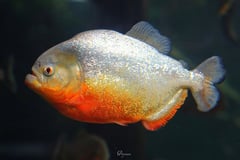
Pygocentrus nattereriRed Bellied Piranha
Serrasalmidae · Kner, 1858
The red bellied piranha, Pygocentrus nattereri, occurs through much of the Amazon basin and south into the Paraná and Uruguay river systems. Famed as a rapacious predator, it is among the most notorious freshwater fishes in the world. According to Herbert Axelrod (1976), the myth began with a feeding frenzy staged for Theodore Roosevelt in Brazil in 1913. Usually only juveniles form aggregations, and the species is relatively easy to breed in the aquarium.

Satanoperca acuticepsSharphead Eartheater
Cichlidae · Heckel, 1840
The sharphead eartheater, Satanoperca acuticeps, is a cichlid from the central Amazon basin in Brazil, including the lower rio Negro and rio Branco. Relatively rare in the trade, it is sometimes confused with S. daemon and S. lilith but has three dark flank blotches (vs. two in S. daemon, one in S. lilith). Unless breeding it is surprisingly peaceful, and it is very rarely bred in aquaria.

Satanoperca lilith
Cichlidae · Kullander & Ferreira, 1988
Satanoperca lilith is an eartheater cichlid known only from Brazil, where it is widely distributed along the Solimões/Amazon main channel. Despite that extensive range it is uncommon in the ornamental trade, where it is sometimes called 'one-spotted demon fish' or 'one spot eartheater'. A single dark blotch on the flank separates it from the closely similar S. daemon, which has two.
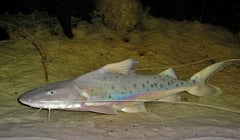
Brachyplatystoma capapretum
Pimelodidae · Lundberg & Akama, 2005
Brachyplatystoma capapretum is a large, piscivorous pimelodid catfish found throughout much of the Amazon basin, from near Belém to Iquitos in Peru. The largest recorded specimen measured 880 mm, and it is suitable only for public aquaria and a very small minority of private aquarists. It is very similar to B. filamentosum but smaller, with shorter maxillary barbels, a moderately forked caudal-fin with lobes of equal size, and adults very dark above.
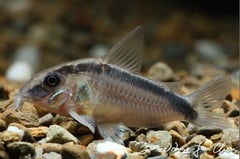
Brochis arcuataSkunk Cory; C020
Callichthyidae · (Elwin, 1938)
The skunk cory, Brochis arcuata, long known as Corydoras arcuatus, is an armoured catfish from the upper Amazon region in Brazil, Peru, Ecuador and Colombia. It is among the more popular Corydoras in the hobby and is also known as the 'arched cory' or C020. Several similar-looking congeners exist, particularly Hoplisoma urucu, in which the black body stripe ends behind the eye, and the larger C. narcissus from the rio Purus.