River
Cinaruco
Only species with a profile on Seriously Fish are counted.
- Species
- 6
- Families
- 4
- Photographed
- 5 of 6
- Difficulty rated
- 6 of 6
Basin
Also in the Orinoco basinspecies recorded from both
Shares fishes with rivers elsewherespecies recorded from both
Runs through

Biotodoma wavriniOrinoco Eartheater
Cichlidae · (Gosse, 1963)
The Orinoco eartheater, Biotodoma wavrini, is a geophagine cichlid from the Orinoco and rio Negro basins of Venezuela, Colombia and Brazil. One natural habitat is the Río Cinaruco, a low-nutrient blackwater tributary of the Orinoco. It can be told from B. cupido by its noticeably elongate body and a dark flank blotch on or below the upper lateral line. Unless breeding it is surprisingly peaceful, and trade populations include 'Cuao', 'Orinoco', 'San Antonio' and 'Sipapo Ventuari'.

Geophagus abalios
Cichlidae · López-Fernández & Taphorn, 2004
Geophagus abalios is a cichlid from black and clear water tributaries of the río Orinoco in Venezuela, across the Llanos and south to the Casiquiare. One of the more commonly-traded members of the genus, it is rarely sold under the correct name and usually misidentified as G. altifrons or G. surinamensis. Juveniles are available cheaply because it is one of the few Geophagus bred commercially. Vertically split anterior flank bars separate it from the very similar G. brokopondo.

Megalamphodus sweglesiRed Phantom Tetra
Characidae · Géry, 1961
The red phantom tetra, Megalamphodus sweglesi, is a small characid endemic to the upper and middle Río Orinoco watershed in Colombia and Venezuela. It apparently favours minor tributaries, oxbows and flooded forests, and in Venezuela is often found in morichals. Bred commercially in several countries, it has been traded in more than one colour form, and Zarske (2014) concluded that the particularly red form sold as 'red' or 'var. rubra' is conspecific.

Satanoperca daemonThreespot Eartheater
Cichlidae · (Heckel, 1840)
The threespot eartheater, Satanoperca daemon, is a cichlid from the rio Negro, Casiquiare and upper Orinoco systems in Brazil, Venezuela and Colombia. It is mostly observed in acidic, mineral-poor blackwater. Relatively common in the aquarium trade, it is by no means easy to maintain, needing particular attention to space, diet, water quality and chemistry. Two dark blotches on the flank separate it from the similar S. lilith, which has only one.
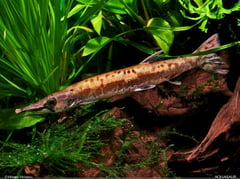
Boulengerella lucius
Ctenoluciidae · (Cuvier, 1816)
Boulengerella lucius is a large, pelagic ctenoluciid from the central Amazon region in Brazil and the Río Orinoco in Venezuela. Named for its resemblance to the northern pike, it grows to 420 mm and is largely unsuitable for the home aquarium. Juveniles and subadults are sometimes available in the trade, often misidentified as B. maculata. Dark patches between the median caudal-fin rays and random dark spots on the lower flanks separate it from B. cuvieri and B. xyrekes.
Tatia galaxias
Auchenipteridae · Mees, 1974
Tatia galaxias is a wood catfish from the Orinoco river basin in Venezuela and Colombia, dark with small, round white spots like stars. It is sometimes confused with Tatia intermedia, in which the spots are longer and oval.