River
Karnaphuli
Only species with a profile on Seriously Fish are counted.
- Species
- 6
- Families
- 3
- Photographed
- 6 of 6
- Difficulty rated
- 6 of 6
Basin
Shares fishes withspecies recorded from both
Runs through
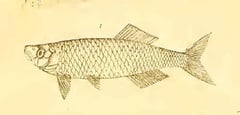
Devario aequipinnatus
Cyprinidae · (McClelland, 1839)
Devario aequipinnatus is a striped devario from hill streams in northeastern India, Bangladesh and Nepal. It is recognised by three straight dark stripes along each side, of which the middle one is widest. The name was long applied to almost any striped Devario, including the commercially bred giant danio, which is covered here under D. malabaricus.

Xenentodon cancilaFreshwater Needlefish
Belonidae · (Hamilton, 1822)
The freshwater needlefish, Xenentodon cancila, is a belonid from Pakistan east through India, Bangladesh, Nepal, Sri Lanka, Myanmar and Thailand. Often called 'freshwater garfish', it only superficially resembles the true gars, and most of its relatives in the Belonidae are marine or estuarine. A near-exclusive inhabitant of the upper water column, it is surprisingly peaceful with anything too large to swallow and is best kept in numbers of four or more, in a tank of 180 ∗ 60 cm or more.

Chitala chitalaIndian Featherback
Notopteridae · (Hamilton, 1822)
The Indian featherback, Chitala chitala, is a very large notopterid probably restricted to Pakistan, India, Nepal and Bangladesh. Its name has been widely misapplied in the trade, most often to the Southeast Asian C. ornata, but it is very rarely exported for aquaria and is fished and cultured for food in India. Growing to 1220 mm SL, it has non-ocellated black spots above the anal fin and is the only Chitala normally showing gold or silver bars on the back.

Garra dampaensis
Cyprinidae · Laironunga, Lainuntluanga & Lairamliana, 2013
Garra dampaensis is a cyprinid known only from the Seling River in the Dampa tiger reserve, Mizoram, northeastern India. The Seling belongs to the Karnaphuli drainage. It has been collected from clear, shallow, moderately fast-flowing streams with rocky substrates, and is recognised among Indian Garra partly by a W-shaped black band across the middle of the caudal fin.

Gymnostomus ariza
Cyprinidae · (Hamilton, 1807)
Gymnostomus ariza is a cyprinid widely distributed from the Indus basin in Pakistan through India, Bangladesh and Myanmar. Growing to around 300 mm SL, it inhabits flowing streams and tributaries with clear water. It has a confusing taxonomic history, having been placed in Bangana, Cirrhinus and Labeo in recent years. It breeds in temporarily-inundated zones in the wet season and is also produced commercially for food.

Labeo calbasuOrangefin Labeo
Cyprinidae · (Hamilton, 1822)
The orangefin labeo, Labeo calbasu, is a large cyprinid from Pakistan, Nepal, India, Bangladesh, Myanmar and southern China. Growing to 800 mm, it is an important food and game fish across its native range and is not a suitable subject for the home aquarium. It is known as 'black rohu' in parts of India and Bangladesh, and inhabits the lower reaches of major rivers, lakes and reservoirs.