River
Xe Kaman
Only species with a profile on Seriously Fish are counted.
- Species
- 4
- Families
- 3
- Photographed
- 4 of 4
- Difficulty rated
- 4 of 4
Basin
Also in the Mekong basinspecies recorded from both
Shares fishes with rivers elsewherespecies recorded from both
Runs through
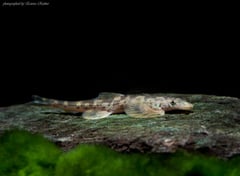
Annamia normaniVietnamese Giraffe Loach
Gastromyzontidae · Hora, 1931
The Vietnamese giraffe loach, Annamia normani, is a hillstream loach from Mekong tributaries in Vietnam, Laos and Cambodia and from coastal Vietnam. An obligate resident of riffles and rapids, it has been traded as the 'Vietnamese lizard loach' and 'Vietnamese Homaloptera'. Adults studied in the Duc My River were specialised grazers of cyanobacteria. Many of its known habitats are threatened by planned hydroelectric projects.

Barbodes aurotaeniatus
Cyprinidae · Tirant, 1885
Barbodes aurotaeniatus is a small cyprinid from the middle and lower Mekong basin in Laos, Vietnam, Cambodia and Thailand. Uncommon in the aquarium trade, it has a single pair of maxillary barbels, lacking the rostral barbels of other Barbodes, and usually four small vertical black markings on the flanks. It inhabits streams, irrigation canals and ditches, and is apparently very peaceful, best kept in a mixed-sex group of 6 to 10.

Channa gachuaDwarf Snakehead
Channidae · Hamilton, 1822
The dwarf snakehead, Channa gachua, is a snakehead recorded across an enormous range from Iran to Taiwan and Bali. There is significant evidence that C. gachua as currently understood is a complex of similar-looking species in need of taxonomic review. A mouthbrooder bred regularly in captivity, it can share a well-chosen community with peaceful fishes too large to be prey, but populations should not be mixed as some may hybridise.
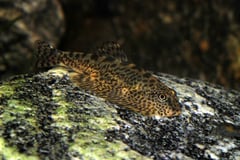
Sewellia speciosa
Gastromyzontidae · Roberts, 1998
Sewellia speciosa is a hillstream loach that appears endemic to the Xe Kong river drainage in central Vietnam and southern Laos. It first became available in early 2010 and sometimes appears on trade lists as 'Laos sucker' or 'Laos Sakura sucker'. The spotted body without stripes separates it from the morphologically similar S. lineolata, which is striped, and it inhabits shallow, fast-flowing, highly-oxygenated headwaters.