Aphyocharax nattereri
Dawn Tetra · Augenflecksalmler
Formerly Chirodon nattereri Steindachner, 1882 · Chirodon pulcher Steindachner, 1882 · Cheirodon steindachneri Eigenmann & Eigenmann, 1891 · Aphyocharax paraguayensis Eigenmann, 1915
Last revised 2026Edit this page
On this page13 sections
Quick factsEdit
Difficulty5 of 8 measures
- Space
- medium tank
- Water
- flexible
- Temp
- flexible
- Diet
- unknown
- Temperament
- unknown
- Social
- needs to be in a group
- Compatibility
- fine with others
Other demands
Each of these can raise the rating on its own, whatever the measures above say.
- Hardiness
- unknown
Before you buy
Needs a tight-fitting lid as this species is known to jump
The tank must have a very tightly-fitting cover as it will jump on occasion.
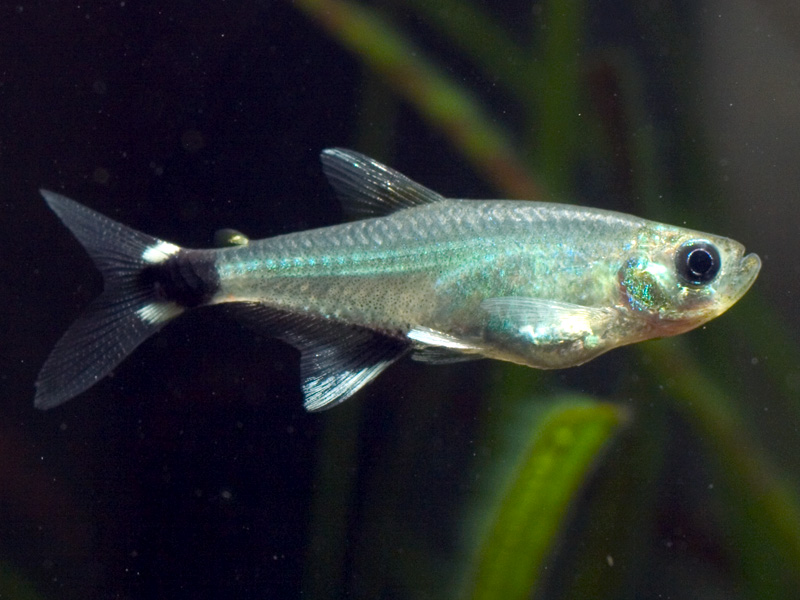
The dawn tetra, Aphyocharax nattereri, is a small characid from southern Brazil, Bolivia and Paraguay. In the hobby it is usually called A. paraguayensis, a name considered a synonym of A. nattereri since 2003. Confusion remains, because the type locality of A. nattereri lies on the main Amazon channel, far from most confirmed localities. It is most often imported as a contaminant among shipments of other species.
Etymology
EditAphyocharax: from the Greek aphýē (Gr. ἀφύη), meaning 'small fry' (i.e., small fish) and chárax (Gr. χάραξ), a pointed stake of a palisade, referring to densely packed sharp teeth and a common root-name formation in the order Characiformes.
nattereri: patronym not identified, probably named for Austrian naturalist Johann Natterer (1787-1843).
Distribution
EditHabitat
Write a noteEditStreams, rivers and tributaries. These are usually shaded by floating or overhanging vegetative cover.
Aquarium size
Write a noteEditAn aquarium with base dimensions of 60 ∗ 30 cm24 ∗ 12 in is suitable for a small group.
Maintenance
Write a noteEditLooks most at home in a planted aquarium. Provide areas of dense vegetation, along with some open areas for swimming. Other décor can consist of twisted roots and pieces of bogwood.
Some floating vegetation is also a good idea, as it tends to swim in the upper reaches of the tank. The tank must have a very tightly-fitting cover as it will jump on occasion.
Water conditions
EditThese recommendations come from this profile’s own figures. They contain affiliate links, so we may earn a commission.
Diet
Write a noteEditUnfussy and will accept most dried, frozen and live foods.
Behaviour and compatibility
Write a noteEditPeaceful enough but may nip a little at long-finned or slow-moving tankmates, and can bother sedentary species with its constant activity.
Try keeping it in a mixed shoal with other characins, along with Corydoras catfish and small Loricariids. It's also a suitable companion for Apistogramma spp. and other South American dwarf cichlids. Always keep it in a group of at least six as it's a shoaling fish by nature.
Sexual dimorphism
Write a noteEditFemales are fuller-bodied when inbreeding condition. Males have stronger markings on the anal fin than females.
Reproduction
Write a noteEditSet up a separate small tank in which to spawn the fish with clumps of fine-leaved plants such as Java moss to act as a spawning medium. Soft, acidic water (gH 2-5°, pH 5.5-6.0) is ideal; consider the use of reverse osmosis to achieve the desired effect.
A small air-powered sponge filter completes the setup and will provide adequate aeration. The fish should be conditioned in a group in a separate tank on a high quality diet of frozen and live foods.
When the females are noticeably full of eggs and the males are displaying their best colours, select the fattest female and best-coloured male and transfer them to the spawing tank.
Once they are in situ, continue to feed lots of live and frozen foods until you notice eggs. If the fish are in condition this will probably be the following morning. The eggs are usually deposited among the plants, but aren't adhesive, and many will fall to the tank floor or even float.
The adults should be removed post-spawning as they will eat them given the opportunity. The eggs hatch in 24 hours or so, and after the tiny fry have used up their yolk sacs they should be offered infusoria-type food for the first few days, followed by microworm and/or brine shrimp nauplii.
This is quite a fecund species considering its size, and you may end up with several hundred fry on your hands.
Notes
EditThis species is normally referred to as A. paraguayensis, but that name has been considered a synonym of A. nattereri since 2003.
Confusion remains however, as the type locality for the latter is 'Villa Bella', now known as Parintins, a settlement on the main Amazon river channel between Manaus and Santarém and many kilometres away from the majority of confirmed localities.
Not a particularly popular tetra in the ornamental trade, A. nattereri is most often imported as a contaminant amongst shipments of other species. It is sometimes available in larger numbers, usually very cheaply.
References
- Lima in Reis, R. E. , S. O. Kullander, and C. J. Ferraris. (2003). Check list of the freshwater fishes of South and Central America. CLOFFSCA, 1-729
- Steindachner, F. (1882). Beiträge zur Kenntniss der Flussfische Südamerika's (IV). Anzeiger der Akademie der Wissenschaften in Wien, Mathematisch-Naturwissenschaftliche Classe v. 19 (no. 19), 175-180
Species images · 1
These photographs are used with each photographer's permission.
Send a photographDistribution
Profile completeness22 of 24
Community
Questions about Aphyocharax nattereri?
Ask on Discord