River
Pilcomayo
Only species with a profile on Seriously Fish are counted.
- Species
- 4
- Families
- 3
- Photographed
- 4 of 4
- Difficulty rated
- 4 of 4
Basin
Also in the Parana basinspecies recorded from both
Shares fishes with rivers elsewherespecies recorded from both
Runs through

Aphyocharax nattereriDawn Tetra
Characidae · Steindachner, 1882
The dawn tetra, Aphyocharax nattereri, is a small characid from southern Brazil, Bolivia and Paraguay. In the hobby it is usually called A. paraguayensis, a name considered a synonym of A. nattereri since 2003. Confusion remains, because the type locality of A. nattereri lies on the main Amazon channel, far from most confirmed localities. It is most often imported as a contaminant among shipments of other species.
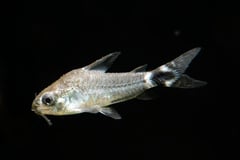
Gastrodermus hastatusTail-spot Pygmy Cory
Callichthyidae · (Eigenmann & Eigenmann, 1888)
The tail-spot pygmy cory, Gastrodermus hastatus, long known as Corydoras hastatus, is a tiny armoured catfish with a wide range across the Amazon and Río Paraguay basins. It is known from Brazil, Bolivia, Paraguay and northeastern Argentina. Unlike most congeners it swims in midwater, forming mixed schools with similarly patterned small characids such as Serrapinnus kriegi. It is frequently confused with G. pygmaeus, but has a dark, roughly diamond-shaped spot on the caudal peduncle where G. pygmaeus has a dark lateral stripe.

Hyphessobrycon anisitsiBuenos Aires Tetra
Characidae · Eigenmann, 1907
The Buenos Aires tetra, Hyphessobrycon anisitsi, is a characid from the Paraná and Uruguay river systems in Brazil, Paraguay, Argentina and Uruguay. A popular and hardy aquarium fish, it is also available as a line-bred albino strain, sometimes traded as 'golden'. It has a reputation for fin-nipping, though mostly when too few are kept or space is limited, and a group of at least 8-10 is the minimum.
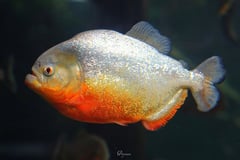
Pygocentrus nattereriRed Bellied Piranha
Serrasalmidae · Kner, 1858
The red bellied piranha, Pygocentrus nattereri, occurs through much of the Amazon basin and south into the Paraná and Uruguay river systems. Famed as a rapacious predator, it is among the most notorious freshwater fishes in the world. According to Herbert Axelrod (1976), the myth began with a feeding frenzy staged for Theodore Roosevelt in Brazil in 1913. Usually only juveniles form aggregations, and the species is relatively easy to breed in the aquarium.