Distichodus lusosso
Long-nosed Distichodus
On this page11 sections
Quick facts
Difficulty4 of 8 measures
More bars, more demanding. Hardiness is not averaged with the rest.
- Space
- very large tank
- Water
- mild adjustment
- Temp
- steady heat
- Diet
- unknown
- Temperament
- peaceful
- Social
- unknown
- Compatibility
- unknown
Hardiness on its own can raise the rating, whatever the measures above say.
- Hardiness
- unknown
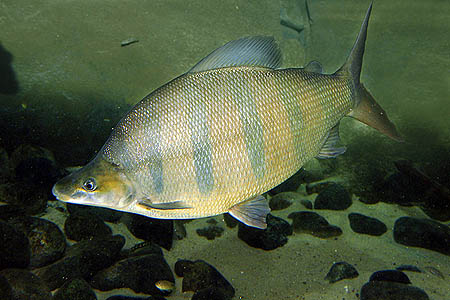
One of only a handful of Distichodus seen with any regularity in the hobby. This species is undeniable attractive when juvenile, but unfortunately loses much of its colour and patterning as it matures. It is superficially similar to the more commonly seen D. sexfasciatus but has a much smaller adult size and a narrow, pointed head....
Distribution
Cameroon, Republic of Congo, Democratic Republic of Congo.
Habitat
Inhabits large rivers.
Aquarium size
A single specimen would need a tank measuring at least 60" x 18" x 18" (150cm x 45cm x 45cm) - 275 litres.
Maintenance
Not a good choice for the planted tank, as it will munch most greenery. Furnish the tank with smooth rocks and driftwood branches instead. Sand or gravel can be used as substrate. If you want to try some plants, use species such as Anubias or Bolbitis, as most fish leave these alone. A little water flow is appreciated. It's an excellent jumper, so the tank must have a tightly-fitting, heavy cover.
Water conditions
Temperature: 22 – 26 °C72 – 79 °F
pH: 6.5-7.5
Hardness: 2-20°H
Diet
Omnivorous and will accept most foods offered. It should be fed a decent proportion of vegetable matter to keep it in the best of health. A diet of live and frozen foods such as earthworms, prawn and mussel, along with frozen peas (remove the shells), Spirulina flake and blanched spinach would provide the desired balance.
These recommendations come from this profile’s own figures. They contain affiliate links, so we may earn a commission.
Behaviour and compatibility
Somewhat unpredictable. While some specimens remain peaceful with similarly-sized tankmates, others can become very spiteful as they mature. Certainly don't attempt to keep one of these with much smaller or shy species. Some of this potential aggression can be removed by keeping it in a group, provided enough space is available. Other tankmates in a big tank could include bichirs, large characins, cyprinids, catfish and Loricariids.
Sexual dimorphism
Unknown.
Reproduction
Unrecorded in the hobby.
Notes
One of only a handful of Distichodus seen with any regularity in the hobby. This species is undeniable attractive when juvenile, but unfortunately loses much of its colour and patterning as it matures. It is superficially similar to the more commonly seen D. sexfasciatus but has a much smaller adult size and a narrow, pointed head.
Species images · 1
Used with the photographer’s permission. Not licensed for reuse.
Profile completeness17 of 24
71% complete
Also missing: aquarium size, a recorded distribution, taxonomic authority, etymology.
Community
Questions about Distichodus lusosso?
Ask on Discord