Henicorhynchus caudimaculatus
Formerly Cirrhinus lineatus Smith, 1945 · Gymnostomus lineatus Smith, 1945
Last revised 2026Edit this page
On this page6 sections
Quick factsEdit
Difficulty3 of 8 measures
- Space
- large tank
- Water
- unknown
- Temp
- unknown
- Diet
- unknown
- Temperament
- unknown
- Social
- needs to be in a group
- Compatibility
- fine with others
Other demands
Each of these can raise the rating on its own, whatever the measures above say.
- Hardiness
- unknown
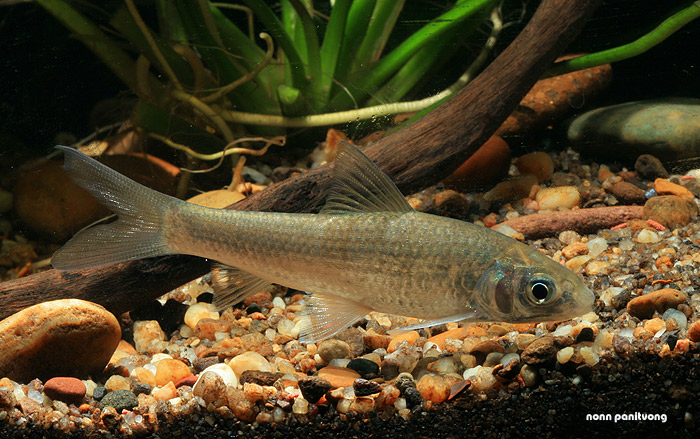
Henicorhynchus caudimaculatus is a riverine cyprinid from the middle to lower Mekong basin and the Chao Phraya, in China, Laos, Thailand and Cambodia. It is most often collected in mid-to-large channels, although in the Mekong basin it also enters smaller tributaries and inundated fields. It has a pair of small maxillary barbels and 5-6 faint, thin stripes along each flank, and has also been placed in Cirrhinus, Bangana, Labeo and Gymnostomus in the last few decades.
Etymology
Editcaudimaculatus: from the Latin cauda, meaning 'tail', and maculatus, meaning 'spotted'.
Distribution
EditRecorded from the middle to lower Mekong River basin in southern China (Yunnan province), Laos, Thailand, and Cambodia, plus the Chao Phraya watershed in central Thailand.
Type locality is 'Thailand: Lam Ton Lang, a tributary of Menam Sak [Mae Nam Pa Sak; Ban Lam Thong Lang, village northwest of Pakjong'.
Habitat
Write a noteEditA riverine species most often collected in mid-to-large sized channels, although in the Mekong basin it is also known to enter smaller tributaries and inundated fields.
Notes
EditH. caudimaculatus can be distinguished from congeners by the following combination of characters: presence of a pair of small maxillary barbels, rostral barbels absent; 5-6 faint, thin, lateral stripes along each flank; body depth fits 3.5-3.8 times in SL; 34-35 lateral line scales.
Species currently included in Gymnostomus have previously been placed in a variety of genera including Henicorhynchus, Cirrhinus, Bangana, and Labeo in the last few decades alone. However, Gymnostomus is a senior subjective synonym of Henicorhynchus, thus rendering the latter invalid, while Gymnostomus is easily distinguished from Cirrhinus by possession of 8-9 (vs. 10-15) branched dorsal-fin rays.
Some confusion remains, however, since a recent phylogenetic study (Yang et al., 2012) considered Henicorhynchus to be valid, and members were not recovered in the same evolutionary lineage as Indian Gymnostomus species, suggesting that they are not closely related. It is unclear whether further taxonomic changes will be required in the future in order to reflect this disparity, but here on SF we currently follow Kottelat (2013) since it was published more recently and has been widely accepted, thus Henicorhynchus is a synonym of Gymnostomus.
Gymnostomus species are considered members of the tribe Labeonini within the putative cyprinid subfamily Cyprininae or simply the subfamily Labeoninae (name varies with author). According to the most recent phylogenetic research, this grouping is further divided into four subtribes; Labeoina, Garraina, Osteochilina, and Semilabeoina (Yang et al., 2012). Among these, Gymnostomus is included in the Labeoina alongside Labeo, Bangana sensu stricto (which includes the genus Nukta), Cirrhinus sensu stricto, Cirrhinus microlepis (which is of a different genetic lineage to other Cirrhinus species), and Incisilabeo. As noted above, however, this refers only to the Indian species of Gymnostomus, with the Southeast Asian species placed in the Osteochilina assemblage.
Some Gymnostomus species are common in mainstream rivers at certain times of year and extremely important in local fisheries during these periods.
References
- Smith, H. M. (1945). The Fresh-Water Fishes of Siam, Or Thailand. Bulletin of the United States National Museum 188, i-xi + 1-622
- Kottelat, M. (1998). Fishes of the Nam Theun and Xe Bangfai basins, Laos, with diagnoses of twenty-two new species (Teleostei: Cyprinidae, Balitoridae, Cobitidae, Coiidae and Odontobutidae). Ichthyological Exploration of Freshwaters 9(1), 1-128
- Kottelat, M. (2013). The fishes of the inland waters of southeast Asia: a catalogue and core bibiography of the fishes known to occur in freshwaters, mangroves and estuaries. The Raffles Bulletin of Zoology Supplement 27, 1-663
- Kottelat, M. (2003). Nomenclatural status of Crossocheilus burmanicus, C. horai and C. multirastellatus (Osteichthyes: Cyprinidae). Raffles Bulletin of Zoology 51(2), 399-401
- Roberts, T. R. (1997). Systematic revision of the tropical Asian labeoin cyprinid fish genus Cirrhinus, with descriptions of new species and biological observations on C. lobatus. Natural History Bulletin of the Siam Society 45(2), 171-203
- Yang, L., M. Arunachalam, T. Sado, B. A. Levin, A. S. Golubtsov, J. Freyhof, J. P. Friel, W-J. Chen, M. V. Hirt, R. Manickam, M. K. Agnew, A. M. Simons, K. Saitoh, M. Miya, R. L. Mayden, and S. He (2012). Molecular phylogeny of the cyprinid tribe Labeonini (Teleostei: Cypriniformes). Molecular Phylogenetics and Evolution 65(2), 362-379
Species images · 1
These photographs are used with each photographer's permission.
Send a photographHow the name has changed
Moved from Gymnostomus lineatus to Henicorhynchus caudimaculatus.
Distribution
Profile completeness12 of 24
Community
Questions about Henicorhynchus caudimaculatus?
Ask on Discord