Ompok bimaculatus
Butter Catfish
On this page11 sections
Quick facts
Difficulty4 of 8 measures
Rated moderate because it needs a very large tank.
More bars, more demanding. Hardiness is not averaged with the rest.
- Space
- very large tank
- Water
- tap water
- Temp
- unfussy
- Diet
- unknown
- Temperament
- peaceful
- Social
- unknown
- Compatibility
- unknown
Hardiness on its own can raise the rating, whatever the measures above say.
- Hardiness
- unknown
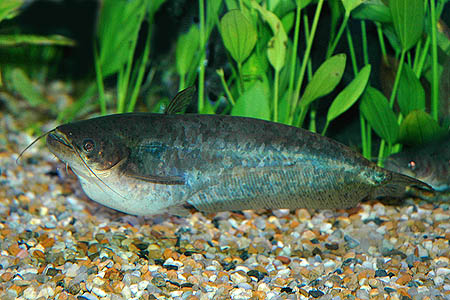
The butter catfish, Ompok bimaculatus, is a widespread silurid catfish recorded from Afghanistan and Pakistan east to China and Indonesia. Also known as the two spot glass catfish, it very likely contains a number of separate species, given the clear morphological differences between populations. It grows to 45 cm, needs a very large tank and will eat any smaller fish it can fit in its mouth.
Distribution
A widespread species having been recorded in Afghanistan, India, Pakistan, Nepal, Bangladesh, Sri Lanka, China, Myanmar, Thailand, Cambodia, Laos, Vietnam and Indonesia.
Habitat
Aquarium size
72" X 24" X 24" 180 ∗ 60 ∗ 60 cm72 ∗ 24 ∗ 24 in - ~648 litres~171 US gal.
Maintenance
This species requires a lot of open swimming space, along with some suitably-sized hiding places. Lengths of thick plastic piping should be adequate for this, as it is doubtful that any aquatic plants could withstand the movements of a fish this size. Filtration should be powerful and efficient, as this fish is a messy eater and produces a lot of waste. It is also sensitive to deteriorating water conditions and regular water changes must be strictly observed. Some degree of current is also preferred.
Water conditions
Temperature: 20 – 26 °C68 – 79 °F
pH: 6.0-8.0
Hardness: 4-28°H
These recommendations come from this profile’s own figures. They contain affiliate links, so we may earn a commission.
Diet
Relatively unfussy and will take most live, frozen and dried foods. Offer larger specimens earthworms, pieces of prawn and mussel and dried pellets.
Behaviour and compatibility
Fairly peaceful and shy for its size, although it will eat any smaller fish it can fit in its mouth. It has a mouth full of razor sharp teeth to reinforce this point. Good tankmates include medium to large sized cyprinids, characins, similarly-sized Asian or South American catfish and larger cichlids.
Sexual dimorphism
Males have a serrated edge to the pectoral spine, which females lack. Mature females are thicker-bodied than males.
Reproduction
Thus far only achieved through the use of hormone injections in captivity.
Notes
This infrequently seen (in the trade) species is also known as the two spot glass catfish, for fairly obvious reasons. It is more than likely that a number of separate species are currently considered within this one, as there are clear morphological differences between populations. Pending a taxonomic revision, these currently all remain classified as O.bimaculatus. This would also seem to explain the apparent toleration of the fish to wildly different water chemistry. Xanthic and albino forms are also occasionally available in the hobby, although these seem to be confined to the Southeast Asian 'species'. Taxonomy aside, it's considered a fine food fish in many of its native countries in both fresh and smoked forms.
Species images · 3
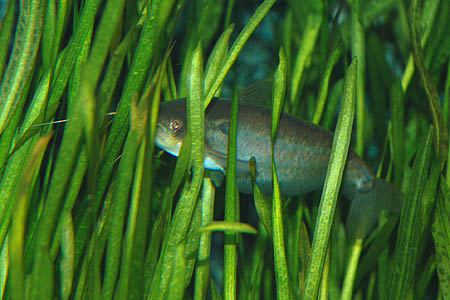
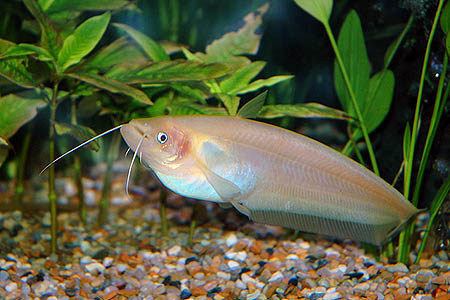
Used with the photographer’s permission. Not licensed for reuse.
Profile completeness18 of 24
75% complete
Also missing: a recorded distribution, taxonomic authority, etymology.
Community
Questions about Ompok bimaculatus?
Ask on Discord