Platydoras armatulus
Humbug Catfish
Last revised 2026Edit this page
On this page12 sections
Quick factsEdit
Difficulty5 of 8 measures
- Space
- large tank
- Water
- flexible
- Temp
- flexible
- Diet
- unknown
- Temperament
- eats smaller fish
- Social
- unknown
- Compatibility
- unknown
Other demands
Each of these can raise the rating on its own, whatever the measures above say.
- Hardiness
- hardy
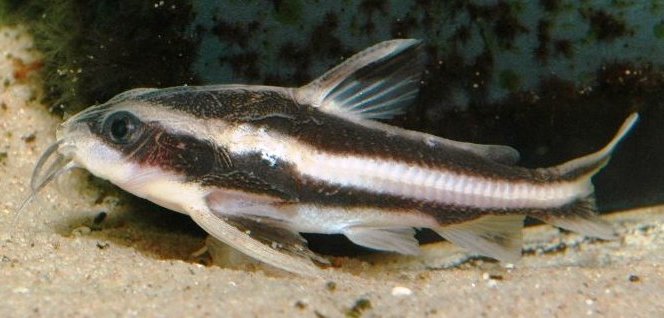
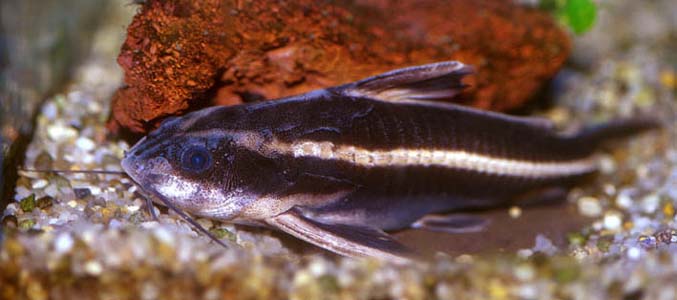
The humbug catfish, Platydoras armatulus, is a doradid catfish from the Paraná and Paraguay basins in Argentina, Bolivia, Brazil and Paraguay. Most fish in the trade come from the Amazon and Orinoco, and those are now treated as P. costatus or P. hancockii, so a fish sold under this name may be one of those. Also sold as the striped dora, striped raphael or striped talking catfish, it is hardy, but its secretive nature, adult size and habit of eating smaller tankmates suit it only to communities of larger fish. It produces audible sounds by grinding its pectoral spines in their sockets or by resonating the swimbladder.
Distribution
EditFound in the Paraná and Paraguay basins in Argentina, Bolivia, Brazil and Paraguay, and the Catalog of Fishes also lists Uruguay. Ota et al. (2018) treat it as introduced in the upper Paraná above the Itaipu dam.[2] Piorski et al. (2008) also included fish from the lower Orinoco and the Amazon in P. armatulus, but the Catalog of Fishes now places those under P. costatus and P. hancockii. Most fish in the trade come from the Amazon and Orinoco, so a fish sold as P. armatulus may be either of those. Fish from the Parnaíba and the neighbouring coastal rivers of northeastern Brazil are P. brachylecis (Piorski et al., 2008).[1]
Habitat
Write a noteEditSlow-moving and standing waters including tributaries, creeks and swamps. It's usually found sheltering among roots or submerged vegetation.
Aquarium size
Write a noteEditIt's not very active but due to its potential size will still need a tank measuring at least 120 ∗ 30 ∗ 30 cm48 ∗ 12 ∗ 12 in - ~108 litres~29 US gal.
Maintenance
Write a noteEditIt's a shy, nocturnal species so it's best to keep the tank dimly lit. Provide plenty of hiding places in the form of clay flowerpots, lengths of plastic piping, tangles of driftwood etc. Plants aren't essential but are useful in cutting out the amount of light hitting the bottom of the tank and providing extra cover.
If you buy one of these for your community tank you'll probably find it will head straight for an area of cover and remain there during the hours of daylight. If you want to see it more often, consider installing a red light above the tank. It can't see red lightwaves, so if you switch this on at night you should be able to observe it foraging for food. It usually becomes much bolder as it grows, and adult specimens will often cruise the tank whether the lights are on or not.
Water conditions
EditTemperature: 24 – 30 °C75 – 86 °F
pH: 5.8 to 7.5
Hardness: 2 to 20°H
These recommendations come from this profile’s own figures. They contain affiliate links, so we may earn a commission.
Diet
Write a noteEditOmnivorous and easy to feed. Use a good quality sinking pellet or tablet as the staple diet. Supplement this with live and frozen foods such as bloodworm, small earthworms and similar. It's best to add food after lights out to ensure it gets its share.
Behaviour and compatibility
Write a noteEditTotally unaggressive but it will eat smaller fish so isn't really suitable for the general community. It can be kept with most peaceable species that are too big too be considered food, including medium-sized characins, cyprinids, anabantoids, livebearers, cichlids and other non-territorial catfish.
It's tolerant of conspecifics and a group can usually be kept without any problems. If several are present they'll often share the same refuge during the day. While some jostling for position might occur, no physical damage is usually done.
Sexual dimorphism
Write a noteEditUnknown.
Reproduction
Write a noteEditThere are no reports of breeding in the hobby. Apparently in nature it spawns amongst surface vegetation.
Notes
EditThis popular species is also sold as the striped dora, striped raphael or striped talking catfish. It's often seen as an ideal beginner's cat, being hardy and tolerant of a wide range of water conditions. However its secretive nature, adult size and tendency to snack on smaller tankmates mean it should only be considered for communities of larger fish.
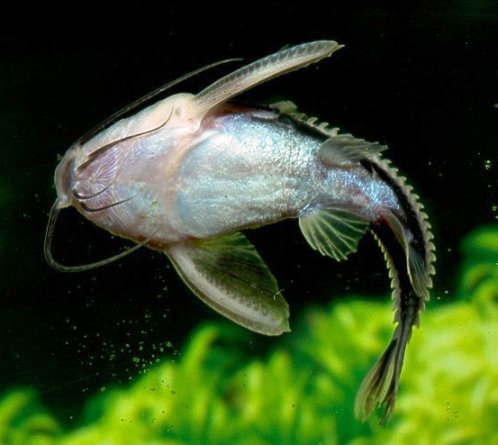
The 'talking catfish' moniker is derived from the fish's ability to produce sounds when communicating with conspecifics or when threatened. It can produce these sounds in two ways. The first involves partially locking the pectoral fins into their sockets. The fish can then grind the spines on the pectorals against the socket, producing a 'buzzing' sound. The second is by rapidly contracting and relaxing a muscle that is attached to the back of the skull at one end and the front of the swim bladder at the other. This causes the swimbladder to resonate and produces a slightly deeper sound. The noises are clearly audible and can sometimes be heard through the aquarium glass, or when the fish is netted. Do take care when netting these cats, as the spines on the body and fins can easily become entangled in the mesh of aquarium nets. The sharp pectoral spines can also cause an eye-watering wound if you happen to be impaled by them.
Carvalho et al. (2003) watched juvenile Platydoras cleaning a wolf fish, Hoplias cf. malabaricus, in a stream of the rio Araguaia drainage, picking parasites and dead scales off its body as some marine cleaner fish do.[3] They identified the catfish as P. costatus, and the Catalog of Fishes does not include the Araguaia in the range of P. armatulus.
References
- Piorski, Nivaldo M.; Garavello, Julio C.; Arce H., M.; Sabaj Pérez, M. H. (2008). Platydoras brachylecis, a new species of thorny catfish (Siluriformes: Doradidae) from northeastern Brazil Neotropical Ichthyology 6(3), 481-494doi.org/10.1590/s1679-62252008000300021
- Ota, Renata Rúbia; Deprá, Gabriel de Carvalho; Graça, Weferson Júnio da; Pavanelli, Carla Simone (2018). Peixes da planície de inundação do alto rio Paraná e áreas adjacentes: revised, annotated and updated Neotropical Ichthyology 16(2)doi.org/10.1590/1982-0224-20170094
- Carvalho, Lucélia Nobre; Arruda, Rafael; Zuanon, Jansen (2003). Record of cleaning behavior by Platydoras costatus (Siluriformes: Doradidae) in the Amazon Basin, Brazil Neotropical Ichthyology 1(2), 137-139doi.org/10.1590/s1679-62252003000200009
Species images · 3
These photographs are used with each photographer's permission.
Send a photographDistribution
Profile completeness21 of 24
Community
Questions about Platydoras armatulus?
Ask on Discord