Puntigrus anchisporus
Formerly Barbus anchisporus Vaillant, 1902 · Systomus anchisporus Vaillant, 1902 · Puntius anchisporus Vaillant, 1902
Last revised 2026Edit this page
On this page13 sections
Quick factsEdit
Difficulty5 of 8 measures
- Space
- medium tank
- Water
- flexible
- Temp
- flexible
- Diet
- unknown
- Temperament
- unknown
- Social
- needs to be in a group
- Compatibility
- fine with others
Other demands
Each of these can raise the rating on its own, whatever the measures above say.
- Hardiness
- unknown
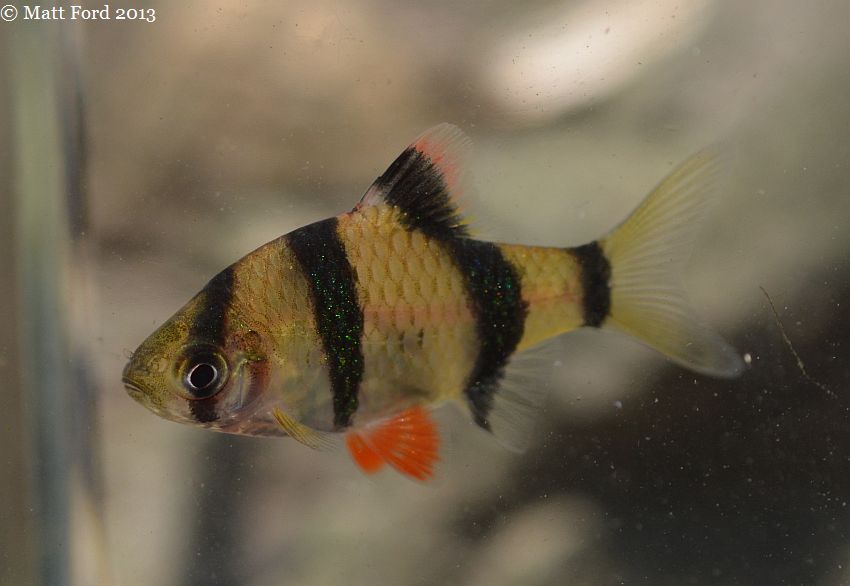
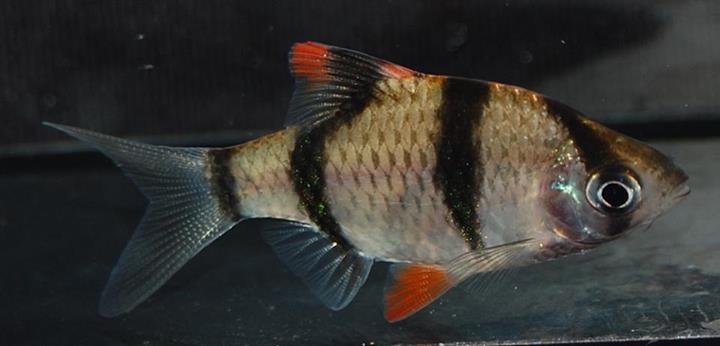
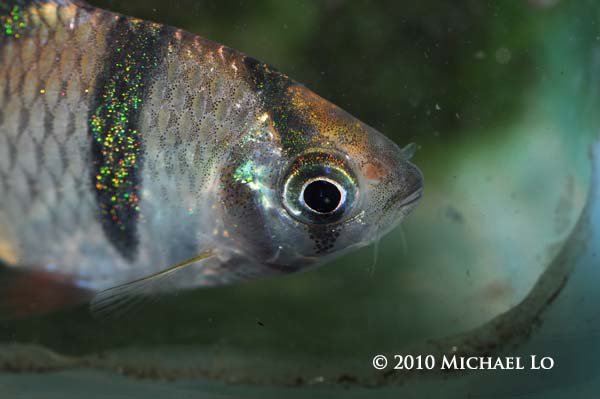
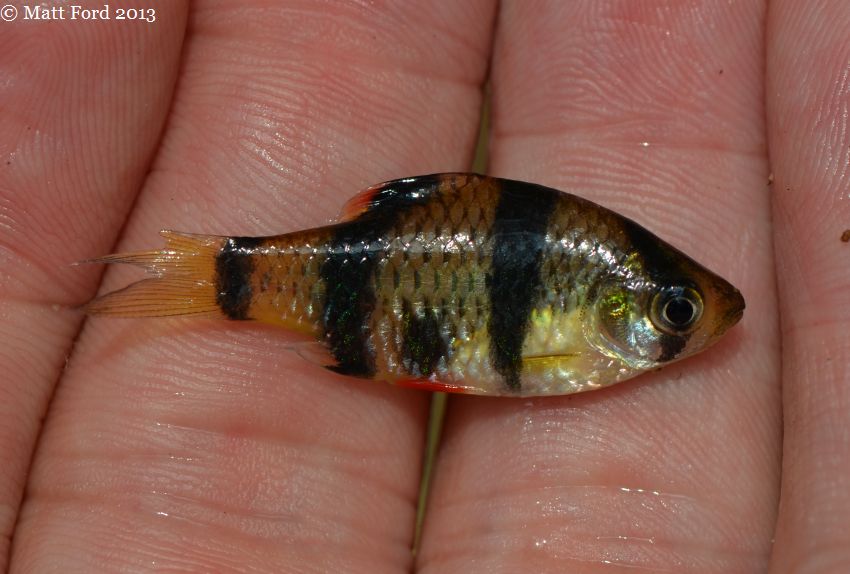
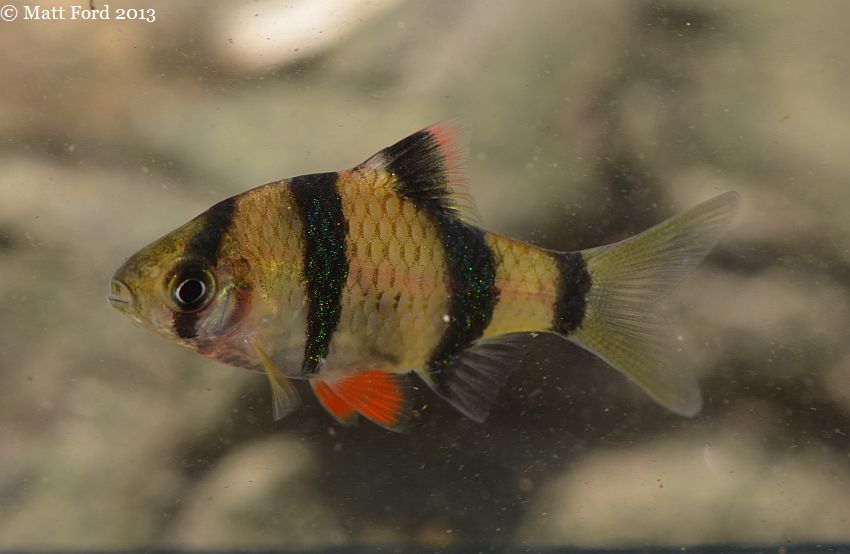
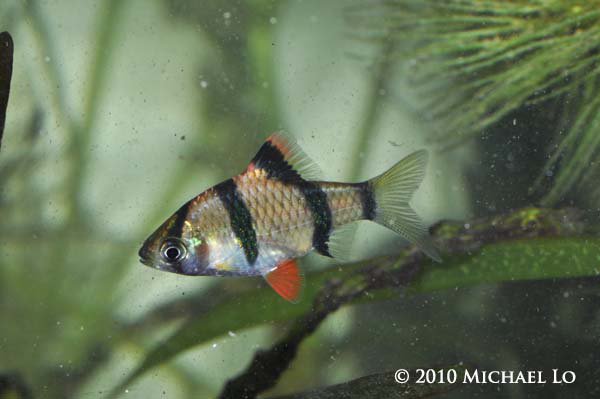
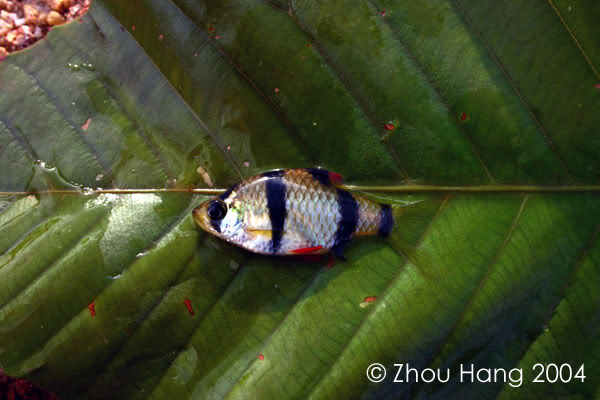
Puntigrus anchisporus is a small cyprinid endemic to Borneo, recorded from Kalimantan in Indonesia and much of Sarawak in Malaysia. One of the four-barred species once called the 'Puntius tetrazona group', it has a complete lateral line, a black dorsal fin with a red outer band and red pelvic fins. It occasionally appears in the hobby, but the trade relies largely on commercially-produced 'tiger barbs' of questionable origin.
Etymology
EditPuntigrus: formed from part of the generic name Puntius and tigrus, a word created to sound like the Latin word tigris, meaning 'tiger', in allusion to the barred colour pattern and the common name 'tiger barb' used for some members.
anchisporus: Vaillant did not specify the precise derivation, but probably from the Ancient Greek ἄγχῐ (akchi), meaning 'near', and σπόρος (spóros), meaning 'offspring', in reference to this species' resemblance to certain other small cyprinids.
Distribution
EditEndemic to Borneo, with Indonesian records from the Kapuas and Mempawah rivers in Kalimantan Barat (West Kalimantan) province, Maruwei, Pembuang, Teweh, and Kahayan watersheds in Kalimantan Tengah (Central Kalimantan), plus the Negara and Jorong drainages in Kalimantan Selatan (South Kalimantan).
It also occurs throughout much of Sarawak state in the Malaysian part of the island, although official records are lacking (M. Lo, pers. comm.; pers. obv.).
Type locality is 'Kapuas River, Borneo, Indonesia'.
Habitat
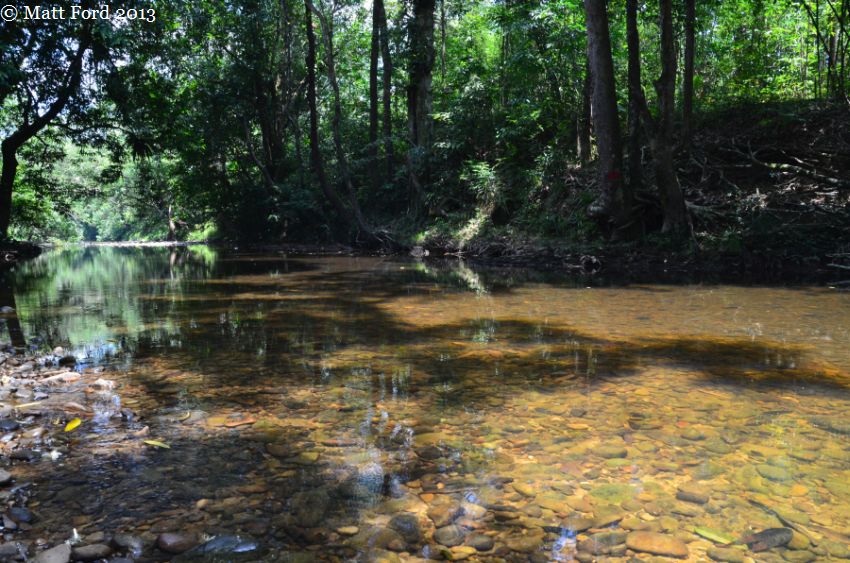
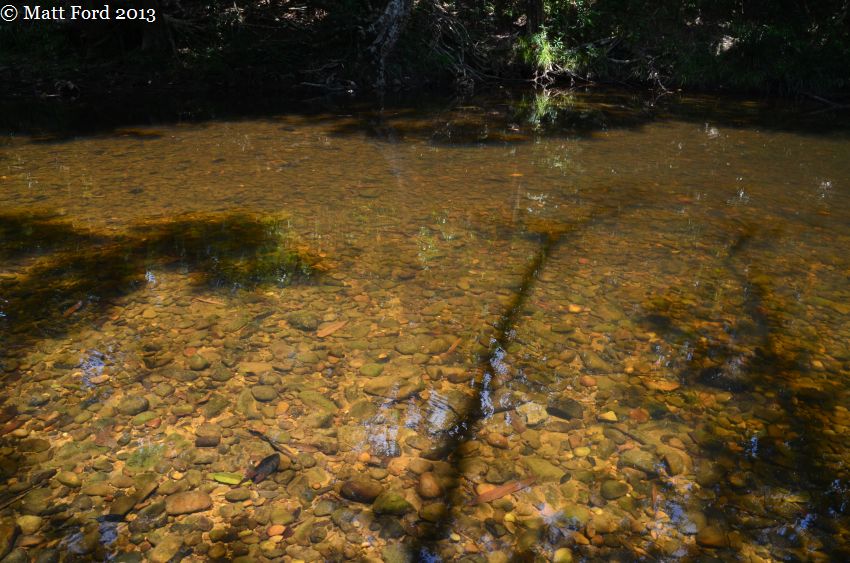
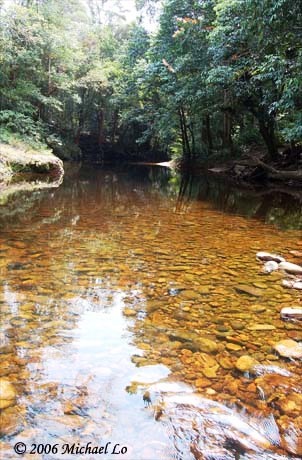
Write a noteEditOccurs in forest streams and tributaries containing relatively clear water and sandy to rocky substrates. Marginal vegetation tends to grow thickly and the water may be stained yellowish with tannins and other organic substances.
Beds of aquatic plants from genera such as Cryptocoryne or Barcalaya and patches of submerged leaf litter can be found in some habitats.
Sympatric species include members of Desmopuntius, Eirmotus, Rasbora, Gastromyzon, Nemacheilus, Pangio, and Paracrossocheilus.
Aquarium size
Write a noteEditAn aquarium measuring at least 80 ∗ 30 ∗ 30 cm31 ∗ 12 ∗ 12 in is required.
Maintenance
Write a noteEditChoice of décor is not especially critical though it should display better colouration in a well-decorated set-up. The addition of floating or overhanging vegetation and driftwood roots or branches also seems to be appreciated by members of this genus.
Water conditions
EditThese recommendations come from this profile’s own figures. They contain affiliate links, so we may earn a commission.
Diet
Write a noteEditProbably an omnivore feeding primarily on insect larvae and zooplankton, but also known to browse plant material and organic detritus (pers. obv.).
In the aquarium offer regular meals of small live and frozen foods such as chironomid larvae (bloodworm), Daphnia, and Artemia alongside good quality dried products.
Behaviour and compatibility
Write a noteEditLimited aquarium observations suggest this species to be peaceful when provided with a sufficiently large aquarium and well-chosen tankmates.
It is a gregarious species forming loose hierarchies, with rival males continually battling with each other for female attention and hierarchical position within the group. A group of at least 8-10 specimens should therefore be considered the minimum purchase.
Sexual dimorphism
Write a noteEditAdult males tend to be slightly smaller, slimmer, and possess a more intense colour pattern than females.
Reproduction
Write a noteEditUnrecorded.
Notes
EditThis species occasionally appears in the aquarium hobby, but the trade is largely reliant on commercially-produced 'tiger barbs' of questionable origin.
It is distinguished from congeners by the following combination of characters: lateral line complete; 14 circumpeduncular scales; 21-23+2 scales in the lateral row; dorsal-fin black with red outer band; pelvic fins red.
The genus Puntigrus was raised by Kottelat (2013) in order to accommodate a group of species formerly referred to as the 'Puntius tetrazona group'. Other members are P. tetrazona, P. navjotsodhii, P. pulcher, and P. partipentazona, of which the first three are native to western, central, and eastern Borneo, respectively, and the latter to Indochina.
This assemblage is diagnosed by possession of a unique colour pattern comprising 4 black bars on a pale body, and black pigmentation on at least the basal half of the dorsal-fin. The anteriormost body bar passes through the eye, the second is anterior to the pelvic-fin base, the third is above the anal-fin and continues onto it, and the posteriormost is at the caudal-fin base.
The following combination of characters also aid in identification, although individually they are not unique to the genus: body rhomboid, deep; last simple dorsal-fin ray serrated posteriorly; rostral barbels absent; maxillary barbels present; lips smooth and thin, postlabial groove interrupted medially; lateral line complete or incomplete; 18–23 lateral line scales; 9½–10½ [5½/1/3–4½] scale rows between dorsal-fin origin and ventral midline anterior to pelvic-fin base; 12–14 circumpeduncular scale rows; 8–9 rakers on first gill arch.
The genus Puntius was previously viewed as a polyphyletic catch-all containing over 100 species, but this situation has been largely resolved since the turn of the century.
References
- Kottelat, M. (1992). The identity of Barbus johorensis Duncker, 1904 (Teleostei: Cyprinidae). Raffles Bulletin of Zoology 40(2), 187-192
- Alfred, E. R. (1963). Some Colourful Fishes of the Genus Puntius Hamilton. Bulletin of the National Museum of Singapore 32, 135-142
- Pethiyagoda, R., M. Meegaskumbura, and K. Maduwage (2012). A synopsis of the South Asian fishes referred to Puntius (Pisces: Cyprinidae). Ichthyological Exploration of Freshwaters 23(1), 69-95
- Collins R. A., K. F. Armstrong, R. Meier, Y. Yi, S. D. J. Brown, R. H. Cruickshank, S. Keeling, and C. Johnston (2012). Barcoding and border biosecurity: identifying cyprinid fishes in the aquarium trade. PLoS ONE 7(1), e28381
- Kottelat, M. and H-H Tan (2011). Systomus xouthos, a new cyprinid fish from Borneo, and revalidation of Puntius pulcher (Teleostei: Cyprinidae). Ichthyological Exploration of Freshwaters 22(3), 209-214
- Tan, H-H. (2012). Systomus navjotsodhii, a New Cyprinid Fish from Central Kalimantan, Borneo. Raffles Bulletin of Zoology Supplement 25, 285-289
- Roberts, T. R. (1989). The freshwater fishes of western Borneo (Kalimantan Barat, Indonesia). Memoirs of the California Academy of Sciences 14, 1-210
- Kottelat, M. and E. Widjanarti (2005). The fishes of Danau Sentarum National Park and the Kapuas Lakes area, Kalimantan Barat, Indonesia. Raffles Bulletin of Zoology Supplement 13, 139-173
- Vaillant, L. L. (1902). Résultats zoologiques de l'expédition scientifique Néerlandaise au Bornéo central. Notes from the Leyden Museum 24 (note 1), 1-166, Pls. 1-2
- Pethiyagoda, R. (2013). Haludaria, a replacement generic name for Dravidia (Teleostei: Cyprinidae). Zootaxa 3646(2), 199
- Kottelat, M. (2013). The fishes of the inland waters of southeast Asia: a catalogue and core bibiography of the fishes known to occur in freshwaters, mangroves and estuaries. The Raffles Bulletin of Zoology Supplement 27, 1-663
Species images · 10
These photographs are used with each photographer's permission.
Send a photographDistribution
Profile completeness21 of 24
Community
Questions about Puntigrus anchisporus?
Ask on Discord