Trichopodus pectoralis
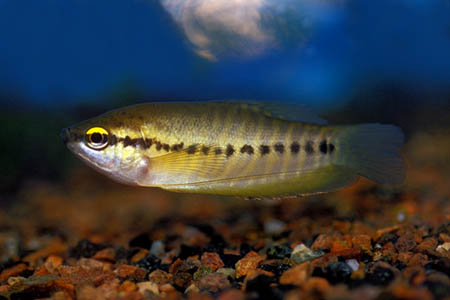
Snakeskin Gourami
Last revised 2026Edit this page
On this page11 sections
Quick factsEdit
Difficulty4 of 8 measures
- Space
- large tank
- Water
- flexible
- Temp
- flexible
- Diet
- unknown
- Temperament
- peaceful
- Social
- unknown
- Compatibility
- unknown
Other demands
Each of these can raise the rating on its own, whatever the measures above say.
- Hardiness
- unknown
The snakeskin gourami, Trichopodus pectoralis, is a large labyrinth fish from the Mekong and Chao Phraya drainages of Indochina and Myanmar. Growing to 30 cm, it is farmed as a food fish, and feral populations are established in several countries as a result. A very peaceful species for the larger community tank, it can produce 'cracking' noises during breeding or territorial exchanges.
Distribution
EditOccurs naturally in both the Mekong and Chao Phraya drainages in Vietnam, Laos, Cambodia, Thailand and Myanmar. It's a popular food fish and is farmed for the purpose in some countries. As a result feral populations are established in Malaysia, Philippines, Singapore, Indonesia, Papua New Guinea, Sri Lanka, New Caledonia and Colombia.
Habitat
Write a noteEditIt's an adaptable species that can survive in a wide range of biotopes. However it tends to thrive best in slow-moving or still waters where marginal and submerged vegetation grows densely. In the lower Mekong it's known to move into areas of flooded forest or grassland during the wet season, returning to permanent bodies of water when the water level begins to drop.
Aquarium size
Write a noteEdit120 ∗ 30 ∗ 30 cm48 ∗ 12 ∗ 12 in.
Maintenance
Write a noteEditA planted aquarium with floating vegetation and hiding places, as well as open water for swimming is ideal for this species.
Water conditions
EditTemperature: 22 – 30 °C72 – 86 °F
pH: 5.8-8.5
Hardness: 2-30 dH
These recommendations come from this profile’s own figures. They contain affiliate links, so we may earn a commission.
Diet
Write a noteEditOmnivorous in nature, feeding mostly on plant matter, algae and other phytoplankton. It also preys on both terrestrial and aquatic invertebrates including insect larvae, slugs and spiders.
Behaviour and compatibility
Write a noteEditA very peaceful gourami that can be kept with other peaceful fish that won't be intimidated by it's eventual size. Males are relatively non-territorial compared to other gourami species. May eat smaller fish. Good tankmates include barbs, loaches, corydoras, loricariids, larger danios and rasboras and angelfish.
Sexual dimorphism
Write a noteEditMales develop pointed dorsal and anal fins and their ventral fins are orange or red. Females are plumper.
Reproduction
Write a noteEditEasy. Bubblenester. The breeding tank should contain water of no more than 6-8" in depth with lots of floating plants. Filtration should be gentle and air-powered filters are ideal. Condition the fish with live food. When the female becomes plump with eggs the male will construct a large bubblenest of up to 10" diameter amongst the floating plants. He will then begin to display to the female. As the female approaches the nest the fish can be seen touching each other with their modified ventral fins. Spawning occurs under the nest in the typical anabantoid embrace. The eggs float upwards and the male shepherds them into the nest. Several more spawnings occur and up to 5000 eggs may be produced. When there are no more eggs the female is chased away. It is best to remove her at this point or she may be seriously harmed. The male then tends to the nest until the eggs hatch, usually in around 20-30 hours. The fry become free swimming in another 4-5 days, at which point the male should also be removed. They should be fed infusoria or liquid fry food for the first week, after which they are large enough to accept brine shrimp nauplii, microworm and powdered flake. The fry grow very slowly and care must be exercised when doing water changes as they are very susceptible to changes in water temperature for the first 3 months or so.
Notes
EditThis species is not often seen for sale but is a very good addition to the larger community tank. It is cultured commercially for food in it's native countries, and is used to make a particularly tasty fish soup! The snakeskin gourami can also produce 'cracking' noises, especially during breeding or territorial exchanges.
Species images · 2
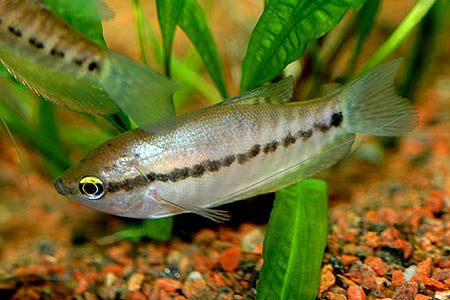
These photographs are used with each photographer's permission.
Send a photographDistribution
Profile completeness19 of 24
79% complete
Also missing: taxonomic authority, etymology.
Community
Questions about Trichopodus pectoralis?
Ask on Discord