Synodontis membranaceus
Moustache Catfish
Formerly Hemisynodontis membranaceus
Last revised 2026Edit this page
On this page11 sections
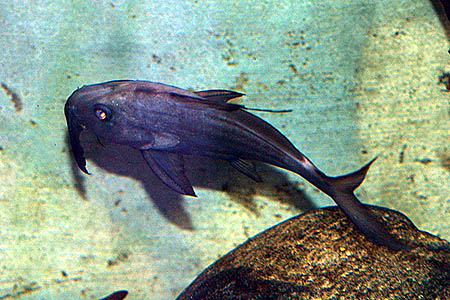
Quick factsEdit
Difficulty4 of 8 measures
- Space
- large tank
- Water
- needs a steady pH
- Temp
- needs a steady temperature
- Diet
- unknown
- Temperament
- territorial
- Social
- unknown
- Compatibility
- unknown
Other demands
Each of these can raise the rating on its own, whatever the measures above say.
- Hardiness
- unknown
The moustache catfish, Synodontis membranaceus, is a large mochokid widespread in Africa, from Egypt and Sudan to Senegal and Nigeria. Its 'moustache' is a membrane along the maxillary barbels. It feeds mainly on plankton, filtered through its many gill rakers, and often feeds at the surface upside down. Often sold as a spotted juvenile, it can reach 50 cm and becomes territorial with conspecifics as it matures.
Distribution
EditHabitat
Write a noteEditInhabits deep shorelines of rivers and streams.
Aquarium size
Write a noteEdit120 ∗ 60 ∗ 60 cm48 ∗ 24 ∗ 24 in - ~432 litres~114 US gal.
Maintenance
Write a noteEditAn aquarium with a soft substrate and rocks, pieces of driftwood and twisted roots arranged to form hiding places suits this species. Broad-leaved plants such as Anubias or Echinodorus and floating vegetation are also recommended as it likes to roost under these. Dim lighting will encourage the fish to be seen more often.
Water conditions
EditTemperature: 22 – 26 °C72 – 79 °F
pH: 6.5-7.5
Hardness: 5-15°H
These recommendations come from this profile’s own figures. They contain affiliate links, so we may earn a commission.
Diet
Write a noteEditAn omnivorous species. Frozen, live and dried foods are all accepted. It also relishes vegetable matter in the form of shelled peas, cucumber etc. You will often see it feeding from the surface in its typical inverted style. It will not generally accept larger meaty items such as prawn or mussel, preferring smaller foods. This is probably related to its natural filter feeding habits.
Behaviour and compatibility
Write a noteEditS. membranaceus can be kept in groups when juvenile but it becomes territorial with conspecifics as it matures. Otherwise it's peaceful for its size, although the sheer bulk of an adult specimen will frighten shy species. It may also eat very small fish. Larger Central and South American or African cichlids make good tankmates.
Sexual dimorphism
Write a noteEditThe female is plumper than the male when adult. It can also be sexed by examining the genital papillae. This is not for the amateur however. If you're brave enough start by holding the fish ventral side up in the palm of your hand. Secure the dorsal fin between your middle and ring fingers in order to avoid being pierced by the sharp rays. The genital area you're looking for is concealed beneath the pelvic fins. Expose it by pulling (gently) on the caudal fin. A male fish will exhibit an extended papillae which should be pointed and ridged. The spermatoduct can be seen on the caudal side. Females also have a clearly visible papillae but this is more rounded and the oviduct is on the opposite side to the male's spermatoduct. Bear in mind that the species can take 2 years or more to reach sexual maturity.
Reproduction
Write a noteEditUnrecorded in aquaria.
Notes
EditThere is some confusion as to where this species should be placed taxonomically. It is currently the only species in the genus Hemisynodontis but it has been regularly moved between Synodontis, Hemisynodontis and Brachysynodontis. The main morphological differences that set it apart are the presence of additional gill rakers in this species and the fact it has relatively few mandibular teeth compared to Synodontis species. It also possesses the chracteristic "moustache", which is in fact a membrane running along the maxillary barbels, giving the fish a somewhat comical appearance! It also has much smaller membranes on its mandibular barbels.
The high number of gill rakers and small number of teeth compared to Synodontis highlight the natural diet of this fish. While small invertebrates and crustaceans are eaten, S. membranaceus feeds mainly on plankton, and uses the gill rakers as a filter. It often feeds at the surface in an inverted position and the maxillary barbels are used to sweep food towards the mouth.
It is often seen for sale in its spotted juvenile form, but this patterning fades as the fish mature. However it remains an ideal community catfish for the larger aquarium.
Species images · 3
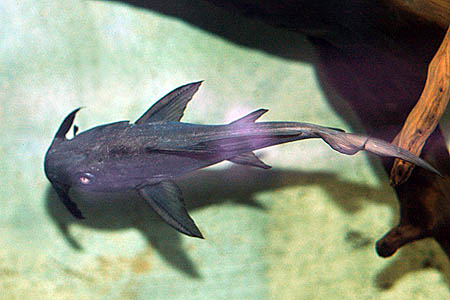
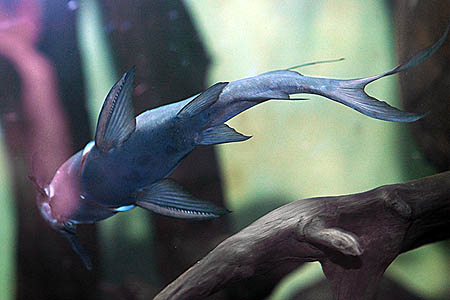
These photographs are used with each photographer's permission.
Send a photographHow the name has changed
Moved from Hemisynodontis membranaceus to Synodontis membranaceus.
2013Continental Diversification of an African Catfish Radiation (Mochokidae: Synodontis)
Distribution
Profile completeness20 of 24
83% complete
Also missing: etymology.
Community
Questions about Synodontis membranaceus?
Ask on Discord