Hobbyist group · Cypriniformes
Loaches
Loaches spans 7 families.
- Species
- 213
- Families
- 7
- Genera
- 52
- Photographed
- 213 of 213
- Difficulty rated
- 212 of 213
Families
Where they come fromnative records only
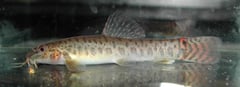
Acanthocobitis sinuata
Nemacheilidae · Day, 1870
Acanthocobitis sinuata is a nemacheilid loach from peninsular India, described from Wayanad district in Kerala. It appears widespread in drainages south of the Krishna. Most authorities treat it as a synonym of A. mooreh, but the two differ in distribution, dorsal-fin ray count and colour pattern, and they are apparently being revalidated. Both have a reduced lateral line ending around the dorsal fin, which in the similar A. botia is complete or ends above the anal fin.
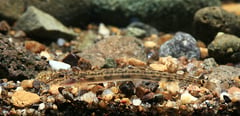
Acanthopsoides molobrion
Cobitidae · Siebert, 1991
Acanthopsoides molobrion is a dwarf horse-faced loach from Borneo, Peninsular Malaysia and southern Thailand. Like others in the genus it lives in flowing, clear-water river channels over sand, fine gravel or mud, and needs a soft, sandy substrate because it spends some of its time completely buried. Several Acanthopsoides in the trade have proven very tricky to identify. This one has 10 to 15 mid-dorsal markings and three bands in the caudal fin.
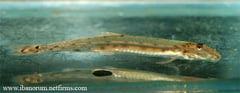
Acanthopsoides robertsi
Cobitidae · Siebert, 1991
Acanthopsoides robertsi is a dwarf horse-face loach from the Kapuas River basin in West Kalimantan, Indonesian Borneo. Unlike most of its congeners it is quite easily identified, being the only species with a dark, triangular marking in the caudal fin. Very similar fish have been collected further north in the Kayan and Sambas basins. Highly gregarious, it needs soft sand to bury in and is best kept in a group of six or more.
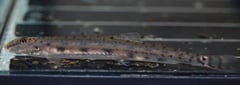
Acanthopsoides sp. 'A01'
Cobitidae · authority not recorded
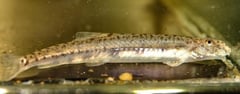
Acanthopsoides sp. 'A01' is an unidentified dwarf horse-face loach of unknown origin, likely to be collected in Thailand or Peninsular Malaysia. Like several of its congeners in the trade it has proven very tricky to identify. It spends some of its time completely buried, so it needs a soft, sandy substrate, and it is best kept in a group of six or more. SF member Mark Duffill has recovered fry from an adult pair kept on their own in a small tank.
Acanthopsoides sp. 'A02'
Cobitidae · authority not recorded
Acanthopsoides sp. 'A02' is an unidentified dwarf horse-face loach of unknown origin, likely to be collected in Thailand or Peninsular Malaysia. Like several of its congeners in the trade it has proven very tricky to identify. A soft, sandy substrate is essential because it spends some of its time completely buried, and it is highly gregarious and best kept in a group of six or more.
Lepidocephalichthys berdmorei
Cobitidae · Blyth, 1860
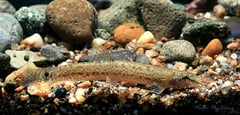
Lepidocephalichthys berdmorei is a cobitid loach found across Myanmar, Thailand, Laos, north-eastern India and Bangladesh. One of the most frequently-traded members of the genus, it is an excellent choice for those new to keeping loaches. Unlike most congeners it shows a preference for headwaters and streams with clear, flowing water, and its larger adult size separates it from the similar L. thermalis.
Lepidocephalichthys goalparensis
Cobitidae · Pillai & Yazdani, 1976
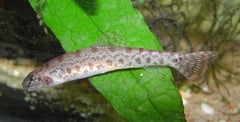
Lepidocephalichthys goalparensis is a cobitid loach from the Brahmaputra, Ganges and upper Irrawaddy basins in India, Nepal, Bangladesh and Myanmar. Rarely seen in the hobby, it was imported into the UK in late 2011 as bycatch among mastacembelid eels from northern India, and the identification was confirmed by Justin Havird. The forked caudal fin normally carries four or five broad, dark V-shaped bars.
Lepidocephalichthys guntea
Cobitidae · Hamilton, 1822
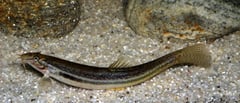
Lepidocephalichthys guntea is a cobitid loach from the Ganges and Brahmaputra systems of northern India, Nepal and Bangladesh, and much of Myanmar. One of the most frequently-traded members of the group, it is an excellent choice for those new to keeping loaches. Males carry a solid, dark lateral stripe and females spotted flanks, and patterning varies with origin. It is also used as a food fish, eaten fresh and dried.
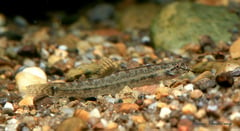
Lepidocephalichthys hasselti
Cobitidae · Valenciennes, 1846
Lepidocephalichthys hasselti is a cobitid loach described from Java and recorded from Myanmar to Vietnam, Peninsular Malaysia, Sumatra and Borneo. Its wide distribution makes it relatively common in the aquarium hobby. Colour and pattern vary with locality and have led to problems with identification, and the flanks usually show a row of dark blotches or a solid stripe with a light, unpigmented stripe above.
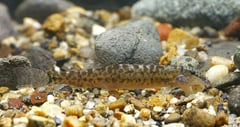
Lepidocephalichthys kranos
Cobitidae · Havird & Page, 2010
Lepidocephalichthys kranos is a cobitid loach from the Chao Phraya system in Thailand and the Mekong in Thailand, Laos and Vietnam. Some private collectors have kept it. Its colour pattern tends to form a mosaic, unlike the irregular spotting of most congeners, and the body deepens steeply behind the snout to give a 'hunched' appearance. It can often be found living with L. hasselti.
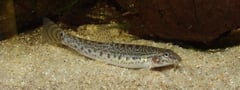
Lepidocephalichthys thermalis
Cobitidae · Valenciennes, 1846
Lepidocephalichthys thermalis is a cobitid loach from Sri Lanka and Peninsular India, described from the hot waters of Cania, Sri Lanka. Available sporadically, it makes an excellent choice for those new to keeping loaches. Unlike most of the genus it shows a preference for headwaters and clear, flowing streams. It was for a number of years included in Lepidocephalus until Havird and Page (2010) placed it in Lepidocephalichthys.
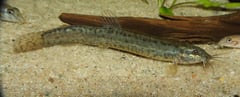
Misgurnus dabryanusLarge-scaled Loach
Cobitidae · Dabry de Thiersant, 1872
The large-scaled loach, Misgurnus dabryanus, is a 'true' loach from the Yangtze and Pearl rivers in China, plus Taiwan and the Amur in Russia. It is sold regularly in the hobby but almost always labelled as or mixed in with M. anguillicaudatus, from which it differs in its high adipose crests on the caudal peduncle and the lack of a dark spot at the caudal-fin base. It spends some of its time completely buried, so it needs a soft, sandy substrate.
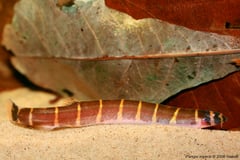
Pangio myersiGiant Kuhli Loach
Cobitidae · Harry, 1949
The giant kuhli loach, Pangio myersi, is a barred cobitid loach from the lower Mekong basin in Laos, Cambodia, Vietnam and Thailand. Traded regularly and also known as 'Myer's loach', it has 8-11 very broad dark bars on an orange body. A submarginal dark bar or row of spots on the caudal-fin separates young or undernourished imports from P. kuhlii and P. semicincta. Albino and leucistic forms are also available, though it is unclear whether these occur naturally.
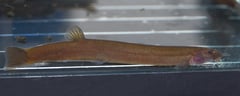
Pangio oblongaBlack Kuhli Loach
Cobitidae · Valenciennes, 1846
The black kuhli loach, Pangio oblonga, is a plain-bodied cobitid from Java, Sumatra, Borneo, Peninsular Malaysia and Thailand. Among the more readily available Pangio in the hobby, it is also traded as 'Java loach', 'cinnamon loach' and 'chocolate kuhli loach'. The species will probably turn out to be a complex of closely-related taxa, with at least four genetic lineages identified.
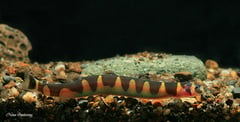
Pangio semicincta'Kuhli' Loach
Cobitidae · Fraser-Brunner, 1940
Usually sold as the 'kuhli' loach, Pangio semicincta is a cobitid loach from Peninsular Malaysia, Sumatra and Borneo. It lives in shallow forest streams and swamps, often in black water, and is typically abundant in leaf litter. P. kuhlii itself is currently considered endemic to Java and has possibly never been seen in aquaria, so the common aquarium 'kuhli' is more likely to be this species or an unidentified relative.
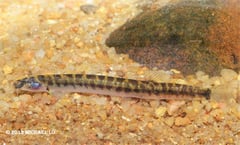
Pangio shelfordii
Cobitidae · Popta, 1903
Pangio shelfordii is a variably patterned kuhli loach from Peninsular Malaysia, Singapore, Sumatra and Borneo. Its patterning varies within and between populations, and as currently understood the species represents an assemblage containing a number of unidentified taxa. Some Sumatran and Bornean populations resemble P. piperata, which often occurs alongside it. It is exported occasionally, often as bycatch among shipments of congeners.
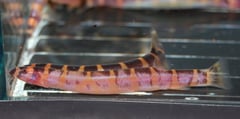
Pangio sp. 'PAN01'
Cobitidae · authority not recorded
Pangio sp. 'PAN01' is an unidentified kuhli loach, possibly from Borneo, assigned to the P. kuhlii-oblonga group with a degree of certainty. The imported fish shown in the profile do not correspond to any described Pangio. Some carry a pinkish to purplish pigmentation that has also been reported in P. superba and appears to be shared by some Bornean Pangio populations.
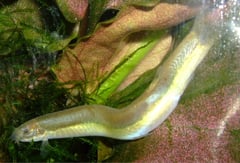
Pangio sp. 'PAN02'
Cobitidae · authority not recorded
Pangio sp. 'PAN02' is an unidentified kuhli loach of unknown origin that can be assigned to the P. kuhlii-oblonga group with a degree of certainty. It is apparently exported as a contaminant among shipments of a uniformly brown fish, and unpublished genetic analyses suggest the two might be variants of the same species. Its dark upper and white lower body suggest it may be related to P. alcoides.
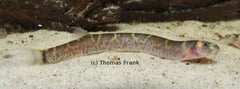
Pangio sp. 'PAN03'
Cobitidae · authority not recorded
Pangio sp. 'PAN03' is an unidentified kuhli loach that appears to be native to the Barito River basin in Indonesian Borneo. It belongs to the P. kuhlii-oblonga group and has been misidentified and traded as P. alternans, a different-looking species. Like its congeners it needs a soft, sandy substrate, since it digs and spends some of its time buried.
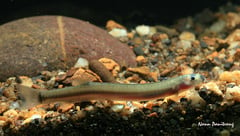
Pangio sp. 'PAN04'Panda Loach
Cobitidae · authority not recorded
The panda loach, Pangio sp. 'PAN04', is an unidentified kuhli loach apparently native to the Thai portion of the Mekong River basin. Traded since the mid-00s, it comes in two similar forms. One has a darker body, dark pectoral fins and barbels and a blue sheen on the head, while the other is paler with better-defined head markings, hyaline pectoral fins and colourless barbels.
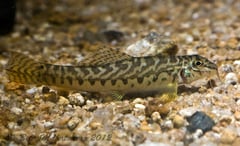
Paracanthocobitis botiaZipper Loach
Nemacheilidae · Hamilton, 1822
The zipper loach, Paracanthocobitis botia, is a nemacheilid loach from the Brahmaputra River in Assam, northeastern India. It was long thought to range from Pakistan to western Thailand, and several populations once included under the name are now treated as separate species. Relatively hardy and peaceful, it is one of the better choices for those new to nemacheilids, and its dark, eye-like ocellus at the top of the caudal peduncle is normally more intense in younger fish.
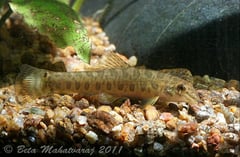
Paracanthocobitis mooreh
Nemacheilidae · Sykes, 1839
Paracanthocobitis mooreh is a nemacheilid loach known only from the Godavari, Krishna and Kaveri (Cauvery) systems in western and southern India. An incomplete lateral line ending near the pelvic-fin origin, with small, mostly vertical blotches along it connected to the dorsal saddles, separates it from congeners. It favours stretches of streams and small rivers where leaf litter collects over sand, cobbles and boulders, and is generally non-aggressive.
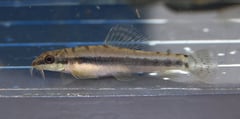
Paracanthocobitis zonalternans
Nemacheilidae · Blyth, 1860
Paracanthocobitis zonalternans is a nemacheilid loach ranging from Manipur in India through Myanmar into western and peninsular Thailand. Several species are thought to be confused under the name, and Singer and Page (2015) consider it likely to be a species complex. Among the more peaceful members of the genus, it does best in a mixed-sex group of at least half a dozen, and it has been bred in aquaria, first by UK aquarist Mick Wright.
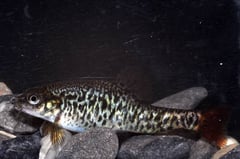
Petruichthys brevisInle Loach
Nemacheilidae · Boulenger, 1893
The Inle loach, Petruichthys brevis, is a small nemacheilid loach known only from Lake Inlé and its watershed in Shan state, eastern Myanmar. Sometimes traded as 'Lake Inle red-tailed loach', it is listed as 'Vulnerable' on the IUCN Red List due to deterioration of the lake. Unlike most loaches it spends a lot of time in the open, often hovering in midwater, and it is highly gregarious, needing a group of at least 8-10.
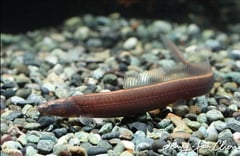
Vaillantella maassiFork-tailed Loach
Vaillantellidae · Weber & de Beaufort, 1912
The fork-tailed loach, Vaillantella maassi, is a loach from Sumatra, Borneo, Peninsular Malaysia and southern Thailand. Traded as 'chocolate scissor-tailed loach' and 'dragon loach' among other names, it has a bluish-brown body with an orange to yellow dorsal stripe. Rarely traded in numbers, it is among the more reclusive loaches and can be aggressive with its own kind and other fishes.
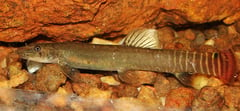
Aborichthys elongatusRed-Tailed Squirrel Loach
Nemacheilidae · Hora, 1921
The red-tailed squirrel loach, Aborichthys elongatus, is a nemacheilid loach from Darjeeling District, West Bengal, in north-east India. It lives among rocks and cobbles in shallow, swift streams running down from the Sivalik Hills into the Teesta and Brahmaputra drainage. The species is quite rare in the trade, and most fish sold under the name are collected at lower altitudes in Jalpaiguri District and probably represent different species.
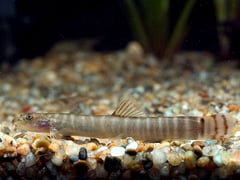
Aborichthys sp. 'AR01'
Nemacheilidae · authority not recorded
Aborichthys sp. 'AR01' is a nemacheilid loach, apparently undescribed, known only from the Raidak I River basin in West Bengal, India. It is usually traded as A. elongatus, but that species appears endemic to higher-altitude waters in Darjeeling District, and the colour and patterning of the two are clearly different. It inhabits shallow, swiftly-flowing water over gravel and small rocks.
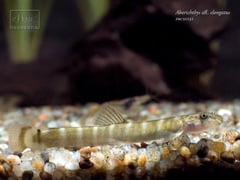
Aborichthys sp. 'AR02'
Nemacheilidae · authority not recorded
Aborichthys sp. 'AR02' is a small nemacheilid loach, apparently undescribed, known only from the Raidak I River basin in West Bengal, India. It occasionally turns up as a contaminant in shipments of A. sp. 'AR01'. Its small adult size, which seems to be 30 to 35 mm SL, and its relatively wide dark vertical bars along the body and single reddish bar in the caudal fin set it apart from others in the genus.
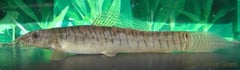
Acanthocobitis pavonaceaPeacock Loach
Nemacheilidae · McClelland, 1839
The peacock loach, Acanthocobitis pavonacea, is a large nemacheilid loach from the Brahmaputra River drainage in Assam, northeastern India. At 120 to 156 mm SL it is one of the largest nemacheilids, and Singer and Page (2015) treat it as the only member of Acanthocobitis. It isn't common in the trade, but occasional specimens turn up among wild-caught shipments from northeast India, sometimes sold as 'panther' or 'puma' loach.
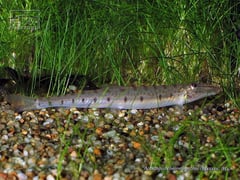
Acantopsis dialuzonaHorseface Loach
Cobitidae · van Hasselt, 1823
The horseface loach, Acantopsis dialuzona, is a cobitid loach from Sumatra, Borneo, Java and Peninsular Malaysia, and possibly Thailand. Most literature lists it as A. choirorhynchos, which Kottelat treats as a junior synonym, and few if any fish in the trade come from near the type locality, so they may represent an unidentified species. Juveniles are exported in large numbers but adults are uncommon in the hobby, and it needs soft sand to bury in.
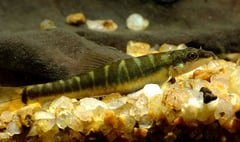
Acoura savonaHalf-banded Loach
Nemacheilidae · (Hamilton, 1822)
The half-banded loach, Acoura savona, is a nemacheilid loach from Ganges tributaries draining the eastern Himalayas in India, Nepal and Bangladesh. The species is seen in the trade fairly often and is sometimes sold as 'bicolor loach' in the United States. Its colour pattern of 9-10 thin, yellowish bars on a dark upper body, with plain whitish lower parts, separates it from similar loaches, and it is among the less aggressive of them.
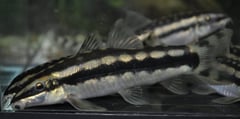
Ambastaia nigrolineataBlack-Lined Loach
Botiidae · Kottelat & Chu, 1987
The black-lined loach, Ambastaia nigrolineata, is a botiid loach from the Mekong drainage in southern China and Laos, and the Nan River in Thailand. It resembles its only congener A. sidthimunki but has a solid dark lateral stripe and another along the dorsal mid-line, with the vertical bars between them much less prominent. In Thailand it is considered endangered and appears in the national Red Book of threatened species.
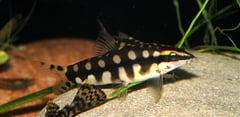
Ambastaia sidthimunkiDwarf Chain Loach
Botiidae · Klausewitz, 1959
The dwarf chain loach, Ambastaia sidthimunki, is a small botiid loach from the Mae Klong basin in western Thailand and the Ataran drainage in Myanmar. Older records from the Yom River, Laos and Cambodia refer to A. nigrolineata. Gregarious, it should be kept in a group of at least five or six and preferably ten or more, and reports conflict on whether it stays peaceful with sedentary or long-finned fishes.
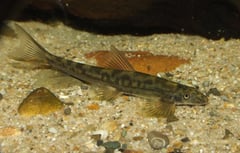
Annamia cf. thuathienensis
Gastromyzontidae · Nguyen, 2005
Annamia cf. thuathienensis is a hillstream loach described from the Bô River in Thua Thien-Hue Province, central Vietnam. Its description was published in Vietnamese and very little is known about it: some major resources do not list it as valid, and Kottelat (2012) considers it a 'species inquirenda'. Its ecology should be similar to that of A. normani, which lives in riffles and rapids over rocky substrates.
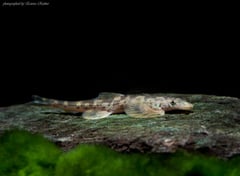
Annamia normaniVietnamese Giraffe Loach
Gastromyzontidae · Hora, 1931
The Vietnamese giraffe loach, Annamia normani, is a hillstream loach from Mekong tributaries in Vietnam, Laos and Cambodia and from coastal Vietnam. An obligate resident of riffles and rapids, it has been traded as the 'Vietnamese lizard loach' and 'Vietnamese Homaloptera'. Adults studied in the Duc My River were specialised grazers of cyanobacteria. Many of its known habitats are threatened by planned hydroelectric projects.
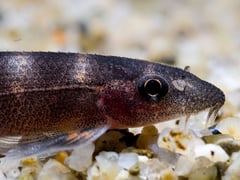
Balitoropsis zollingeri
Balitoridae · Bleeker, 1853
Balitoropsis zollingeri is a balitorid loach described from Java and recorded from Sumatra, Borneo, Peninsular Malaysia, Thailand, Laos and Cambodia. An obligate dweller of swiftly flowing streams and headwaters, it lives on riffles and runs over gravel, rocks and bedrock carpeted with biofilm. It needs clean, well-oxygenated water with strong turnover in the aquarium. It lives in aggregations in nature and is less bold when kept singly or in small numbers, so a group of six or more is best.
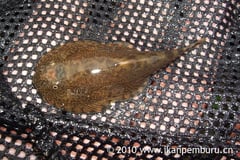
Beaufortia cyclica
Gastromyzontidae · Chen, 1980
Beaufortia cyclica is a hillstream loach known from a handful of localities in the Xi River drainage and the Tuoniang river system in southern China. Its flattened head and body and horizontal paired fins form a sucking cup that lets it cling to rocks in shallow, fast-flowing, highly-oxygenated headwaters. Kottelat (2012) states that B. cyclica may be a synonym of B. elongata.
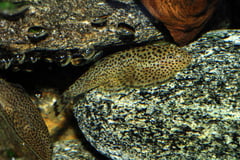
Beaufortia kweichowensisButterfly Loach
Gastromyzontidae · Fang, 1931
The butterfly loach, Beaufortia kweichowensis, is a hillstream loach from the Xi Jiang (West River) system in southern China. In many countries it is the most common gastromyzontid in the shops, one of several loaches traded as 'butterfly loach', 'Hong Kong plec' or 'Chinese hillstream loach' regardless of species. The name B. leveretti is often applied to it. It needs clean, well-oxygenated, fast-flowing water, and 16 to 24 °C is recommended.
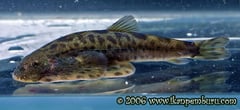
Beaufortia szechuanensis
Gastromyzontidae · Fang, 1930
Beaufortia szechuanensis is a hillstream loach from the upper Yangtze River basin in Sichuan province, southwestern China. It has been recorded from several tributary systems including the Qing, Wu and Da Ning He. Its flattened head and body and horizontal paired fins form a sucking cup that lets it cling to rocks in shallow, fast-flowing, highly-oxygenated headwaters.
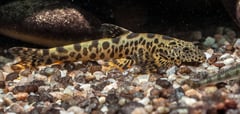
Bhavania australis
Balitoridae · Jerdon, 1849
Bhavania australis is a balitorid loach endemic to the Western Ghats mountains of southern India, recorded from Kerala, Tamil Nadu and Karnataka. An obligate dweller of shallow, fast-flowing, highly-oxygenated headwaters and minor tributaries, it has a flattened head and body and horizontally extended paired fins that form a powerful sucking cup for clinging to rocks. It is very rarely seen in the international aquarium trade but is maintained by a number of Indian aquarists.
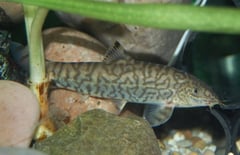
Botia almorhaeYo-Yo Loach
Botiidae · Gray, 1831
The yo-yo loach, Botia almorhae, is a botiid loach from parts of the Ganges River drainage in northern India and possibly Nepal. It is often called the 'Pakistani' loach, but that name is a misnomer. B. almorhae sensu stricto appears to belong to a group of closely-related species and has possibly never been seen in the aquarium trade, where the most commonly available members seem to be B. lohachata, B. sp. 'Kosi' and B. sp. 'Teesta', plus assorted hybrids.
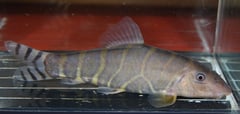
Botia darioBengal Loach
Botiidae · Hamilton, 1822
The Bengal loach, Botia dario, is a botiid loach from the middle to lower Ganges and Brahmaputra drainages in northern India, Bangladesh and Bhutan. Its yellow to golden body carries 7-9 dark bars with thinner, lighter bars between, and its particularly curved head makes it among the most easily recognisable in the genus. Botia macrolineata, described from aquarium fish shipped via Bombay, represents the same species. It is among the botiids produced commercially using hormones.
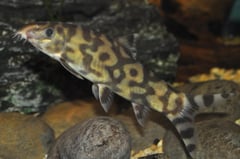
Botia histrionica
Botiidae · Blyth, 1860
Known in the trade as the 'Burmese loach', Botia histrionica is a botiid loach from Myanmar, Manipur in India and Yunnan, China. Young fish all carry five solid dark bars on each flank and are often confused with B. kubotai, but in B. histrionica the bars stay solid for longer and the central bar usually forms a 'y' shape. Adult patterning varies considerably between the Ayeyarwady, Salween, Manipur and Ataran forms, and there has been speculation that some represent distinct species.
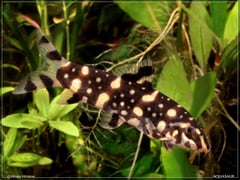
Botia kubotaiPolka-Dot Loach
Botiidae · Kottelat, 2004
The polka-dot loach, Botia kubotai, is a botiid loach that appears to be endemic to headwaters of the Salween basin in Myanmar and Thailand. It was traded before it was described and is still sold as 'angelicus', 'Burmese border loach' and 'marbled loach', among other names. Juveniles are often confused with B. histrionica, but the dark bars in B. kubotai split at a young age.
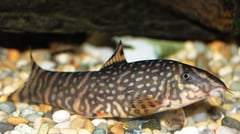
Botia rostrata
Botiidae · Günther, 1868
Botia rostrata is a botiid loach from the lower Ganges and middle to lower Brahmaputra basins in northern India and Bangladesh. Traded as the 'Gangetic loach', 'twin-banded loach' or 'ladder loach', almost all fish sold under the name are B. sp. 'upper Brahmaputra', and B. rostrata sensu stricto is rarely, if ever, available. Juveniles carry 9-10 dark body bars, usually in pairs, which break up to differing extents as the fish grow.
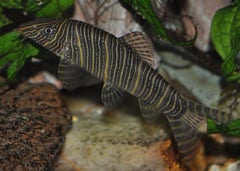
Botia striataZebra Loach
Botiidae · Narayan Rao, 1920
The zebra loach, Botia striata, is a botiid loach from the Krishna River system in southern India, described from the Tunga River in Karnataka. Its yellow to golden body with blue, green, grey or black bars and typically red mouthparts make it one of the most easily recognised in the genus, although the bars break up entirely in some specimens. Given its adult size and peaceable nature it is perhaps the best choice of Botia for the general community.
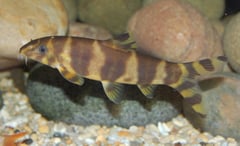
Botia udomritthirujiEmperor Botia
Botiidae · Ng, 2007
The emperor botia, Botia udomritthiruji, is a botiid loach known only from the Tanintharyi River drainage in southern Myanmar. Known since 1993, it was occasionally traded as B. sp. 'Tenasserim' before it was described. At first glance it is most easily confused with B. histrionica but keeps its wider vertical bars at all ages, while in B. histrionica the bars become irregular or break up completely as the fish mature.
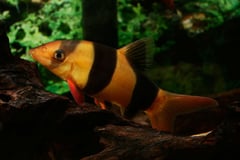
Chromobotia macracanthusClown Loach
Botiidae · Bleeker, 1852
The clown loach, Chromobotia macracanthus, is a large botiid loach native to river systems of Borneo and Sumatra in Indonesia. Widely sold, it is wholly unsuitable for smaller aquaria: a group needs a tank of at least 180 x 60 cm, and a properly kept fish can live for more than twenty years. Bornean and Sumatran populations differ slightly in pattern, and in the Batang Hari, Sumatra, drifting larvae are now collected and grown on for the trade.
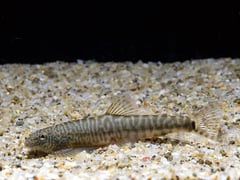
Erromyzon sinensis
Gastromyzontidae · Chen, 1980
Erromyzon sinensis is a gastromyzontid loach from the Xi Jiang (West River) system in southern China, mostly in Guangxi. It is extremely rare to nonexistent in the aquarium trade, although its name has been widely misapplied to congeners such as the unidentified E. sp. 'ER02'. An obligate bottom-dweller, it lives in shallow, fast-flowing, highly-oxygenated headwaters and minor tributaries, clinging to rocks with its flattened body and horizontally-orientated paired fins.
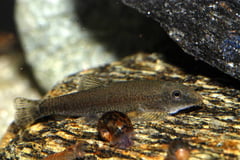
Erromyzon sp. 'ER01'
Gastromyzontidae · authority not recorded
Erromyzon sp. 'ER01' is an unidentified gastromyzontid loach, probably native to the Xi Jiang (West River) system in southern China. Its range is unconfirmed: the fish pictured arrived as a contaminant in a shipment of Beaufortia kweichowensis. It appears somewhat similar to Erromyzon yangi. Like its congeners it needs the clean, well-oxygenated, fast-flowing water of shallow headwaters and minor tributaries.
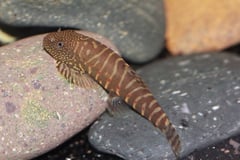
Erromyzon sp. 'ER02'
Gastromyzontidae · authority not recorded
Erromyzon sp. 'ER02' is an unidentified gastromyzontid loach from southern China, traded as Erromyzon sp. 'red spots'. Other trade names include 'Strawberry Spot Sucker Loach', and it has also been sold as a Gastromyzon or Pseudogastromyzon species. No other Erromyzon is known with a dark base colour, thin paler vertical bars on the body and similar spots on the head, and older fish develop red spots along the lateral line.
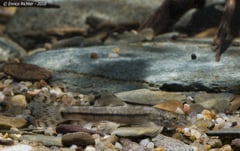
Formosania lacustrisTasseled-mouth Loach
Gastromyzontidae · Steindachner, 1908
The tasseled-mouth loach, Formosania lacustris, is a gastromyzontid from Taiwan and some coastal drainages of Fujian Province, mainland China. An obligate dweller of swiftly-flowing streams and headwaters, it clings to rocks in riffles and runs using its flattened head and body and horizontal paired fins. The genus was formerly Crossostoma, and colour and pattern vary with locality and age.
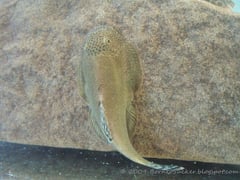
Gastromyzon aeroides
Gastromyzontidae · Tan & Sulaiman, 2006
Gastromyzon aeroides is a hillstream loach endemic to northern Borneo, recorded from western Sabah in Malaysia and the Temburong basin in Brunei. The dorsal, caudal and anal fins are blue in life, and the plain brown body separates it from the other two species in the G. punctulatus group. Like its congeners it needs swift, clean, well-oxygenated water.
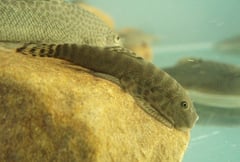
Gastromyzon cornusaccus
Gastromyzontidae · Tan, 2006
Gastromyzon cornusaccus is a small hillstream loach known only from the Sungai Kinarom, a river draining Mount Kinabalu in Sabah, Malaysian Borneo. Before its description it was often misidentified as G. danumensis because of its small adult size and secondary rostrum. Juveniles have thick cream bars and blotches, while adults are uniformly coloured. Like its congeners it needs swift, clean, well-oxygenated water.
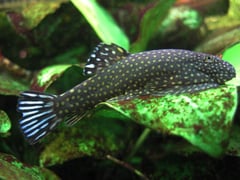
Gastromyzon ctenocephalus
Gastromyzontidae · Roberts, 1982
Gastromyzon ctenocephalus is a hillstream loach from western Borneo, known only from headwaters of the Sarawak and Sambas rivers. One of the more commonly traded members of the genus, it turns up in mixed shipments labelled 'Borneo sucker', 'Hong Kong pleco' or 'butterfly loach'. It is sometimes misidentified as G. punctulatus, which has yellow fins and a lighter, less intensely spotted body.
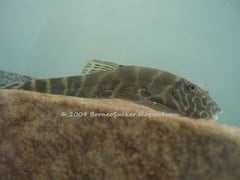
Gastromyzon extrorsus
Gastromyzontidae · Tan, 2006
Gastromyzon extrorsus is a hillstream loach from the Kimanis and Petagas basins, draining the western Crocker Range in Sabah, Malaysian Borneo. The brown body carries up to nine thin gold stripes and the head a gold reticulate pattern. Growing to around 80 mm SL, it lives in swift, shallow streams with clear, oxygen-saturated water, and in aquaria needs clean, well-oxygenated water with strong turnover.
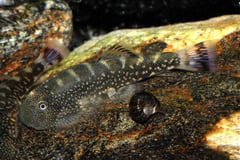
Gastromyzon farragus
Gastromyzontidae · Tan & Leh, 2006
Gastromyzon farragus is a small gastromyzontid loach from swift hill streams in the Sadong River basin of southern Sarawak, Malaysian Borneo. It is dark brown with thin cream bars across the back and a red caudal fin, and is very close to G. ocellatus. One of the more commonly traded members of the genus, it often arrives in mixed shipments labelled 'Borneo sucker' or 'Hong Kong pleco', and needs clean, well-oxygenated water with strong flow.
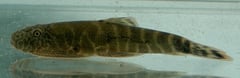
Gastromyzon introrsus
Gastromyzontidae · Tan, 2006
Gastromyzon introrsus is a hillstream loach known only from the Padas and Labuk basins, draining the eastern Crocker Range in Sabah, Malaysian Borneo. The brown body has up to 12 cream vertical bars, and it grows to around 95 mm SL. It lives in swift, shallow streams with clear, oxygen-saturated water, and in aquaria needs clean, well-oxygenated water with strong turnover.
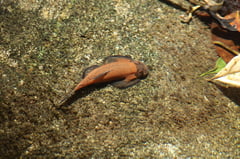
Gastromyzon lepidogaster
Gastromyzontidae · Roberts, 1982
Gastromyzon lepidogaster is a hillstream loach from northern Borneo and the most widely-distributed member of the genus. It occurs in Sabah, Brunei and East Kalimantan. Colour is variable: large adults may be bright green, orange or barred, and can apparently change from barred to plain in a few seconds. It is occasionally available in the trade, where the orange form is particularly sought after.
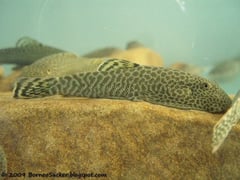
Gastromyzon monticola
Gastromyzontidae · Vaillant, 1889
Gastromyzon monticola is a hillstream loach from streams draining Mount Kinabalu into Marudu Bay, and the Wariu basin, in Sabah, Malaysian Borneo. It has a spotted back with wavy bars on the flanks and grows to around 85 mm SL. German aquarist Philipp Dickmann attempted to spawn it and published his observations in 2001. Like its congeners it needs swift, clean, well-oxygenated water.
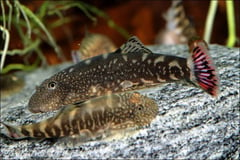
Gastromyzon ocellatus
Gastromyzontidae · Tan & Ng, 2004
Gastromyzon ocellatus is a small hillstream loach known only from the Sarawak River drainage in southern Sarawak, Malaysian Borneo. One of the more commonly traded members of the genus, it turns up in mixed shipments labelled 'Borneo sucker', 'Hong Kong pleco' or 'butterfly loach'. The dark brown body has cream bars that break up into an ocellus pattern on the flanks, and the caudal fin is red in life.
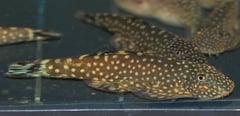
Gastromyzon scitulus
Gastromyzontidae · Tan & Leh, 2006
Gastromyzon scitulus is a hillstream loach endemic to tributaries of the Sungai Sadong basin in southern Sarawak, Malaysian Borneo. One of the more commonly-traded members of the genus, it usually arrives in mixed shipments labelled 'Borneo sucker' or 'Hong Kong pleco' regardless of species. It forms a pair of cryptospecies with the very similar G. ctenocephalus, and intermediate forms of both mean identification can sometimes be tricky.
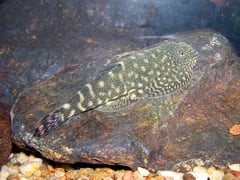
Gastromyzon sp. 'SK01'
Gastromyzontidae · authority not recorded
Gastromyzon sp. 'SK01' is an undescribed hillstream loach known only from the Sungai Jorong in South Kalimantan, Indonesian Borneo. The Jorong is part of the upper Barito drainage. The 'SK' code refers to South Kalimantan, home to several unidentified members of the genus. Based on colour pattern it appears similar to members of the G. ridens group. It has occasionally been maintained by private collectors, and like its congeners it lives in swift, shallow streams with clear, oxygen-saturated water.
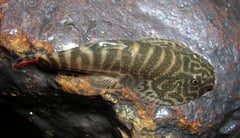
Gastromyzon sp. 'SK02'
Gastromyzontidae · authority not recorded
Gastromyzon sp. 'SK02' is an undescribed hillstream loach from the Sungai Amandit headwaters in South Kalimantan, Indonesian Borneo. The Amandit is a tributary of the Barito basin in the Meratus mountain range. Based on colour pattern this species appears similar to members of the G. ridens group, and it has occasionally been maintained by private collectors. Like its congeners it needs clean, well-oxygenated water with strong flow.
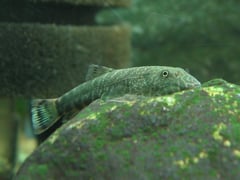
Gastromyzon sp. 'SK03'
Gastromyzontidae · authority not recorded
Gastromyzon sp. 'SK03' is an undescribed hillstream loach from a tributary of the Sungai Riam Kiwa in South Kalimantan, Indonesian Borneo. The Riam Kiwa feeds the Martapura, a major tributary of the Barito. The 'SK' code refers to South Kalimantan, home to several unidentified members of the genus. Based on colour pattern it appears similar to members of the G. ridens group, and it has occasionally been maintained by private collectors.
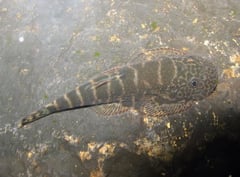
Gastromyzon sp. 'SK04'
Gastromyzontidae · authority not recorded
Gastromyzon sp. 'SK04' is an undescribed hillstream loach from South Kalimantan province, Indonesian Borneo. Based on colour pattern it appears similar to members of the G. lepidogaster group, which also includes G. psiloetron. It has occasionally been maintained by private collectors, and like its congeners it needs clean, well-oxygenated water with strong flow.
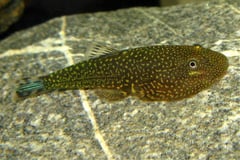
Gastromyzon stellatus
Gastromyzontidae · Tan, 2006
Gastromyzon stellatus is a hillstream loach from the Sarawak, Sadong and Lupar River drainages in southern Sarawak, Malaysian Borneo. Its dark brown head and body carry many small yellow spots. It forms a pair of cryptospecies with G. zebrinus and is often confused with it, since both show intermediate colour patterns. One of the more commonly-traded members of the genus, it usually arrives in mixed shipments labelled 'Borneo sucker' or 'Hong Kong pleco'.
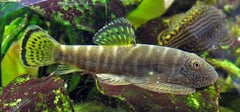
Gastromyzon viriosus
Gastromyzontidae · Tan, 2006
Gastromyzon viriosus is a hillstream loach known only from the Tatau River drainage in central Sarawak, Malaysian Borneo. A dark brown body with 8-10 complete vertical cream bars and a thin, cream, reticulated pattern on the head identify it. It is occasionally seen in the trade, most often in mixed shipments labelled 'Borneo sucker', 'Hong Kong pleco' or 'butterfly loach' regardless of species.
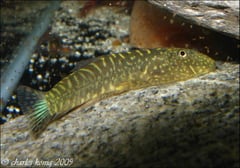
Gastromyzon zebrinus
Gastromyzontidae · Tan, 2006
Gastromyzon zebrinus is a hillstream loach known only from the upper Sambas River in West Kalimantan, Indonesian Borneo. Its black body carries 11-13 thin cream bars on the dorsal surface. It forms a pair of cryptospecies with G. stellatus, separated from it by an outcrop of the Müller range, and intermediate colour patterns mean the two are often confused. It is one of the more commonly-traded members of the genus.
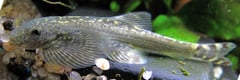
Hemimyzon formosanus
Balitoridae · Boulenger, 1894
Hemimyzon formosanus is a balitorid loach endemic to Taiwan, most abundant in rivers draining the western slopes of the Central Mountain Range. Current knowledge suggests it is the most widely distributed of the three Hemimyzon species endemic to the island. It lives in shallow, fast-flowing, highly oxygenated headwaters and needs clean, well-oxygenated water, a biologically mature tank with plenty of biofilm, and a tight cover since it can climb glass.
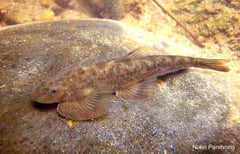
Hemimyzon nanensis
Balitoridae · Doi & Kottelat, 1998
Hemimyzon nanensis is a balitorid loach known only from the upper Mae Nam Nan river basin, part of the Chao Phraya system in northern Thailand. It was the first member of the genus recorded outside China and Taiwan. At the type locality it was collected in shallow riffles over algae-covered stones, and in the aquarium it needs clean, well-oxygenated water and a biologically mature set-up.
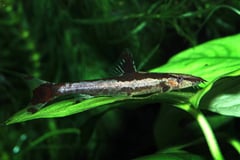
Homaloptera bilineata
Balitoridae · Blyth, 1860
Homaloptera bilineata is a 'lizard' loach from the Sittaung and Salween basins of Myanmar and tributaries of the Mae Klong in western Thailand. Uniquely in the genus, the dark markings running back from the snout form two distinct stripes meeting at the dorsal fin and do not form saddles. An obligate dweller of swift, oxygen-saturated streams, it needs clean, well-oxygenated water and is best kept in a group of six or more.
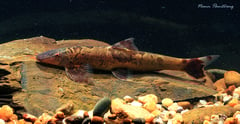
Homaloptera confuzona
Balitoridae · Kottelat, 2000
Homaloptera confuzona is a 'lizard' loach mostly recorded from the Mekong basin in Laos and Cambodia, and from smaller drainages in southern Thailand. It appears in the trade from time to time, though not always identified correctly. It resembles H. orthogoniata and H. parclitella, but its saddle-shaped markings are more irregular, up to four in number, and often restricted to the upper half of the body.
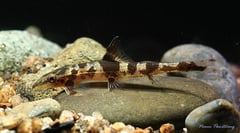
Homaloptera ogilviei
Balitoridae · Alfred, 1967
Homaloptera ogilviei is a small 'lizard' loach recorded through much of the Malay Peninsula in both Malaysia and southern Thailand. Quite rare in the trade, it is sometimes imported as bycatch and sold as 'lizard' or 'gecko' loach. Its paired fins are orientated vertically, unlike those of other members of the genus, and in aquaria it perches on the tips of its fins at rest. It favours slower stretches among plants, roots or leaf litter.
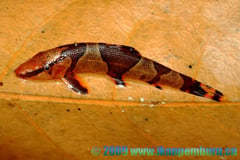
Homaloptera orthogoniataSaddle-back Loach
Balitoridae · Vaillant, 1902
The saddle-back loach, Homaloptera orthogoniata, is a 'lizard' loach endemic to Borneo, known from rivers in Sarawak and Kalimantan. It was historically said to occur across much of Indochina. It is rare in the hobby, and most images online and in the literature show H. confuzona or H. parclitella. It always has three large, saddle-shaped markings on the back, the third between the dorsal and caudal fins.
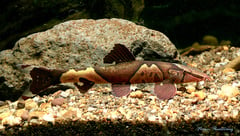
Homaloptera parclitella
Balitoridae · Tan & Ng, 2005
Homaloptera parclitella is a 'lizard' loach from Peninsular Malaysia and the Sai Buri, Bang Nara and Kolok river systems of southern Thailand. It was previously considered a form of H. orthogoniata and may be seen identified as such online and in print. It always has two large, saddle-shaped markings on the back, where H. orthogoniata has three, and it lives in swift, clear, oxygen-saturated streams.
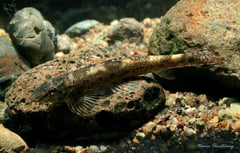
Homalopteroides modestus
Balitoridae · Vinciguerra, 1890
Homalopteroides modestus is a small hillstream loach from the Salween, Mae Klong and Tenasserim rivers of southern Myanmar and western Thailand. Randall and Page (2012) redescribed it from Mae Klong specimens that had previously been identified as the congener H. smithi. A specialised micropredator of swift, clear, oxygen-saturated streams, it needs clean, well-oxygenated water and regular meals of live or frozen food.
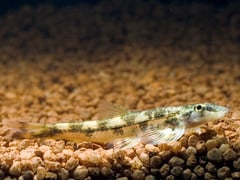
Homalopteroides nebulosus
Balitoridae · Alfred, 1969
Homalopteroides nebulosus is a small hillstream loach described from the Sok River in northern Peninsular Malaysia and since recorded from Borneo. Poorly known in the aquarium hobby, it may never have been exported for the ornamental trade. Its eyes sit in a comparatively raised position on the head, as in H. tweediei, but it has more lateral line scales. Little is known of its habitat, which is presumed to be swiftly-flowing streams and headwaters.
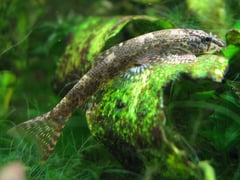
Homalopteroides smithi
Balitoridae · Hora, 1932
Homalopteroides smithi is a hillstream loach from Thailand, Peninsular Malaysia and parts of the Mekong basin in Laos, Cambodia and Vietnam. Perhaps the best-known member of the genus, it is relatively common in the aquarium hobby, and Rainboth (1996) considered it 'probably the commonest member of the genus in the Mekong'. An obligate dweller of swiftly-flowing streams and headwaters, it needs clean, well-oxygenated water.
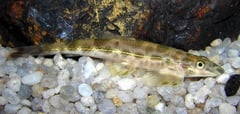
Homalopteroides stephensoni
Balitoridae · Hora, 1932
Homalopteroides stephensoni is a hillstream loach from Borneo, recorded from Kalimantan in Indonesia and from Sabah and Sarawak in Malaysia. Poorly known in the aquarium hobby, it may never have been exported for the ornamental trade. Originally described in Homaloptera, it was placed in Balitoropsis by Kottelat (2012), who subsequently followed Randall and Page (2012) in treating it as a Homalopteroides. Like its congeners it inhabits swiftly-flowing, clear, oxygen-saturated streams.
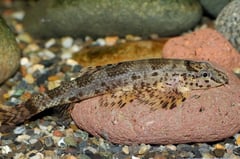
Homalopteroides tweediei
Balitoridae · Herre, 1940
Homalopteroides tweediei is a small hillstream loach from Peninsular Malaysia, the Mekong system and West Kalimantan in Indonesian Borneo. It is often confused with the congener H. smithi. Rainboth (1996) found it less likely to occur in riffles or runs than other members of the genus, and it shows a preference for moderately-flowing stretches of clear, oxygen-rich streams among patches of live or dead vegetation.
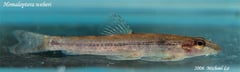
Homalopteroides weberi
Balitoridae · Hora, 1932
Homalopteroides weberi is a hillstream loach from Sarawak in Malaysian Borneo, described from the Akar River and possibly endemic to the state. Poorly known in the aquarium hobby, it was questioned as a possible synonym of Balitoropsis stephensoni by Kottelat (2012), but Randall and Page consider it distinct. It inhabits swiftly-flowing streams and headwaters with clear, oxygen-saturated water.
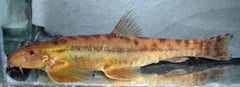
Homalopterula gymnogaster
Balitoridae · Bleeker, 1853
Homalopterula gymnogaster is a hillstream loach from Sumatra, Indonesia, described from Lake Maninjau and recorded from Jambi province northwards. Tan and Kottelat (2009) describe it as a relatively common highland species of riffles and 'quiet waters'. That makes it unusual, since Homaloptera species are not normally associated with standing water, though it remains unclear whether the fish come from the lakes themselves or their outflowing rivers.
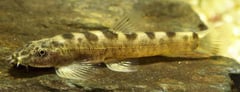
Homalopterula ripleyi
Balitoridae · Fowler, 1940
Homalopterula ripleyi is a hillstream loach known only from a small area of northern Sumatra, Indonesia, on the eastern slopes of the Barisan range. Fowler (1940) described it from a single specimen as the only member of his new genus Homalopterula. Gerhard Ott and Dirk Dettmers collected it in 2003 for the first time in over 60 years, from small, clear forest streams over bedrock, boulders, rocks and gravel.
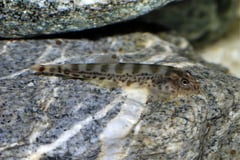
Hypergastromyzon humilis
Gastromyzontidae · Roberts, 1989
Hypergastromyzon humilis is a small hillstream loach known only from the Melawi basin of the Kapuas system in West Kalimantan, Indonesian Borneo. Not traded specifically, it sometimes turns up as bycatch among shipments of wild-collected Gastromyzon. It is told from those by its small mouth without papillae, and from H. eubranchus, the only other species in the genus, by its 7-8 cream-coloured dorsal bars.
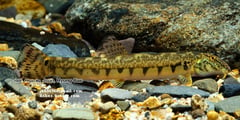
Iksookimia hugowolfeldi
Cobitidae · Nalbant, 1993
Iksookimia hugowolfeldi is a cobitid loach endemic to Korea, known from the Yeongsan and Tamjin river systems in the province of Jeollanam-do. It is most similar to I. longicorpus, of which it was first considered a geographical variant, and has narrow dark bars below the lateral line with densely arranged small spots above. It apparently prefers small, shallow rivers and streams with moderate to fast currents, and needs clean, well-oxygenated water.
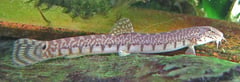
Iksookimia koreensis
Cobitidae · Kim, 1975
Iksookimia koreensis is a cobitid loach endemic to Korea, relatively common in river drainages of northern and western South Korea. It is most similar to I. pumila, formerly treated as a subspecies, but has 10 or more dark bars on each flank, saddle-like markings along the back and irregular spots over the upper body. It apparently prefers small, shallow rivers and streams with moderate to fast currents, and needs clean, well-oxygenated water.
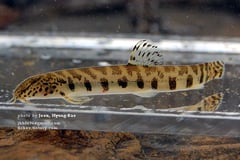
Iksookimia pumila
Cobitidae · Kim & Lee, 1987
Iksookimia pumila is a small cobitid loach endemic to Korea, known only from the Baek River drainage in the south-west of the country. A dam built in the middle reaches of the river in the late 1990s has undermined its presence at some localities. It is most similar to I. koreensis, of which it was formerly considered a subspecies, but has fewer than 10 bars on each flank and only a few larger, vertically orientated blotches on the upper body.
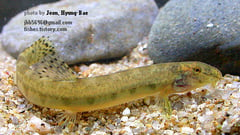
Iksookimia yongdokensis
Cobitidae · Kim & Park, 1997
Iksookimia yongdokensis is a cobitid loach endemic to Korea, known from four river drainages in the eastern province of Gyeongsangbuk-do. Most similar to I. longicorpus and I. hugowolfeldi, it has 9 to 13 dark vertical bars on the flanks, a small dark spot at the base of the upper caudal-fin lobe and a much smaller lamina circularis in males. It is most often seen in sluggish, shallow habitats with sand or pebble substrates in the mid-to-upper sections of rivers.
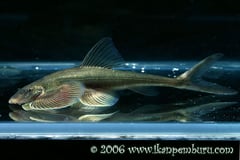
Jinshaia sinensis
Balitoridae · Sauvage & Dabry de Thiersant, 1874
Jinshaia sinensis is a balitorid loach known only from the Jinsha river basin, the westernmost headwater tributary of the Yangtze in China. Like other balitorids it has a flattened head and body and horizontally extended paired fins that form a powerful sucking cup. It lives only in riffles, runs and cascades of swift, clear, oxygen-saturated water, and the aquarium must be set up to resemble such a habitat.
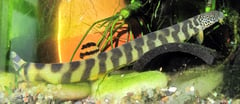
Kichulchoia multifasciata
Cobitidae · Wakiya & Mori, 1929
Kichulchoia multifasciata is a cobitid loach known only from river basins of southwestern Korea. It is restricted to shallow, fast-flowing, highly-oxygenated headwaters with riffles and runs, and needs clean, well-oxygenated water in the aquarium. It is most easily told from K. brevifasciata, its only congener, by its body patterning, wrinkled lips and short barbels.
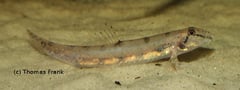
Kottelatlimia hipporhynchos
Cobitidae · Kottelat & Tan, 2008
Kottelatlimia hipporhynchos is a small cobitid loach known only from Central Kalimantan in Indonesian Borneo. It lives in slow-moving forest streams with clear, tannin-stained water over white sand, where it rests on the substrate or dives into it, so it must be given a soft sandy substrate. The largest member of the genus, it differs from its congeners in having papillae covering the lips, barbels and lobes of the mouth.
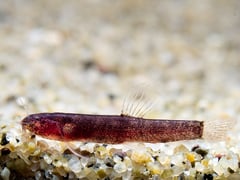
Kottelatlimia katik
Cobitidae · Kottelat & Lim, 1992
Kottelatlimia katik is a miniature cobitid loach from Johor in Peninsular Malaysia and the Batang Hari drainage of Sumatra, reaching 13.5 mm SL. It is considered paedomorphic, keeping juvenile features such as long fins and long nasal barbels into adulthood. It lives in small forest streams associated with blackwater peat swamps, often in leaf litter, and needs a soft sandy substrate and spotless water.
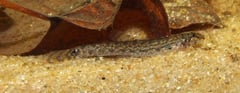
Kottelatlimia pristes
Cobitidae · Roberts, 1989
Kottelatlimia pristes is a small cobitid loach from Peninsular Malaysia, Sumatra and Borneo, the most widely-distributed member of its genus. It inhabits small, slow-moving forest streams and peat swamps with tannin-stained water, often in piles of leaf litter. It turns up occasionally in the trade, sometimes as bycatch among other species and under names such as 'Sumatran mini royal loach' or Cobitis cf. sumatranus.
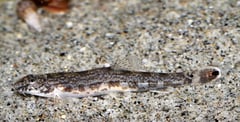
Lepidocephalichthys annandalei
Cobitidae · Chaudhuri, 1912
Lepidocephalichthys annandalei is a cobitid loach from the mid-to-lower Ganges and Brahmaputra systems in Nepal, Bangladesh and north-east India. Rarely traded, it has been sold as L. sp. 'peacock', presumably for its caudal-fin pattern of two dark v-shaped markings, unique within the genus. Fish in the trade differ slightly from the original description, in particular lacking a notched caudal fin.
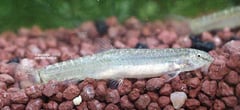
Lepidocephalichthys cf. irrorataLoktak Loach
Cobitidae · Hora, 1921
The Loktak loach, Lepidocephalichthys irrorata, is a small cobitid from north-eastern India and Bangladesh. Hora described it as widely distributed in lakes and streams of the Manipur Valley, and some of his specimens came from Loktak Lake. It grows to only 29 mm SL, has large, exposed scales on top of the head, and is occasionally exported as bycatch among other species.
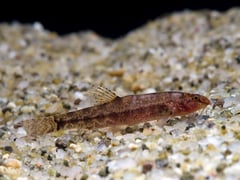
Lepidocephalichthys furcatus
Cobitidae · de Beaufort, 1933
Lepidocephalichthys furcatus is a small cobitid loach from Peninsular Malaysia, southern Thailand and North Sumatra, Indonesia. Not traded often, it turns up occasionally as bycatch among shipments of other species. It is told apart from congeners most easily by the prominent, roughly semi-circular lamina circularis in males, a feature unique within the genus, and it has a forked caudal fin.
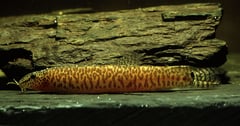
Lepidocephalichthys jonklaasi
Cobitidae · Deraniyagala, 1956
Lepidocephalichthys jonklaasi is a cobitid loach endemic to the 'wet zone' of south-western Sri Lanka, known from at least five localities. Records exist from the Gin, Kalu, Nilwala and Bentota river basins plus a small blackwater creek near the Kottawa Forest Reserve. Its conservation status perhaps precludes its suitability for the hobby. Broad dark bars on the caudal fin and large, vertically elongated black spots on the flanks identify it.
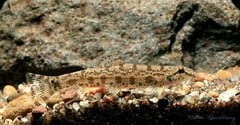
Lepidocephalichthys micropogon
Cobitidae · Blyth, 1860
Lepidocephalichthys micropogon is a cobitid loach from Myanmar, western Thailand, Bangladesh and Assam, India. Known from the Salween, Sittaung, Irrawaddy and Brahmaputra drainages and occasionally exported as bycatch, it grows to 55 mm SL and has a strongly forked caudal fin with broad, dark V-shaped bars. Kottelat (2012) treats L. manipurensis as a synonym, though Havird and Page (2010) list the two separately.
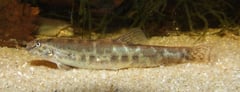
Lepidocephalichthys sp. 'LE1'Vietnamese Marbled Hog-faced Loach
Cobitidae · authority not recorded
The Vietnamese marbled hog-faced loach, Lepidocephalichthys sp. 'LE1', is a cobitid loach from central Vietnam. Unconfirmed reports suggest it is collected in the coastal province of D'Nang. It has been traded only a handful of times and referred to as Lepidocephalichthys cf. hasselti and Lepidocephalus cf. thermalis, but appears to be an undescribed member of the former genus.
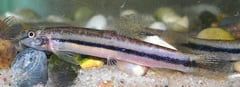
Lepidocephalichthys sp. 'LE2'
Cobitidae · authority not recorded
Lepidocephalichthys sp. 'LE2' is a cobitid loach from northern West Bengal, India, and most likely an undescribed species. It was apparently collected in the Buxa Tiger Reserve alongside the dwarf snakehead traded as Channa sp. 'Assam' or 'Lal Cheng'. It shows characters of both L. alkaia and L. guntea, has been referred to as L. cf. guntea, and the specimens pictured reached the UK in 2007.
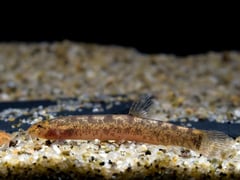
Lepidocephalichthys tomaculum
Cobitidae · Kottelat & Lim, 1992
Lepidocephalichthys tomaculum is a small cobitid loach from Peninsular Malaysia, with a single tentative record from Lampung Province, Sumatra. It inhabits shallow, slow-moving streams, swamps, oxbows and backwaters over mud, silt or peat. Occasionally available as bycatch, it has a reddish brown body with thin dark bars across the back, and where it lives with L. hasselti identification can be difficult.
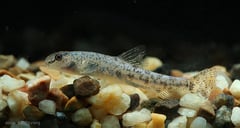
Lepidocephalichthys zeppelini
Cobitidae · Havird & Tangjitjaroen, 2010
Lepidocephalichthys zeppelini is a tiny cobitid loach from the Mekong system in Thailand and Vietnam and the Chao Phraya drainage in central Thailand. Adults reach only 25.8 mm SL, and the lamina circularis of mature males forms a large, finely serrated flange. Many adults at the type locality were collected from remnant ephemeral pools in otherwise dry agricultural land.
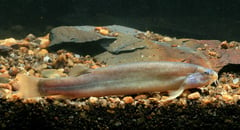
Lepidocephalus macrochir
Cobitidae · Bleeker, 1854
Lepidocephalus macrochir is a cobitid loach described from Sumatra and since recorded from Thailand, Peninsular Malaysia, Java and Borneo. It is traded sporadically as the 'pinky loach', 'deep water kuhli loach' and 'Borneo high body cave loach'. Although sometimes said to be a cave loach, Thai collectors report it from deep water, and in aquaria it spends a lot of time buried in soft substrates.
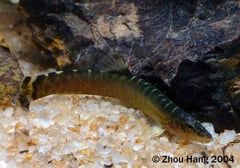
Leptobotia guilinensis
Botiidae · Chen, 1980
Leptobotia guilinensis is a botiid loach from southern China, described from Guangxi Province and also recorded from neighbouring Hunan. The species is rarely exported for the aquarium hobby, and fish labelled as such are usually Sinibotia pulchra or other related species. In the formal description Chen states that it is closely related to the fish now called Sinibotia zebra but lacks stripes on the head. Its habitat is unconfirmed but presumably clear, well-oxygenated running water over rocks and gravel.
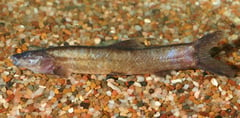
Leptobotia microphthalma
Botiidae · Fu & Ye, 1983
Leptobotia microphthalma is a botiid loach from the upper Yangtze basin in southwestern China, known from the Min and Jialing rivers. Its near-vestigial eyes and the variable hypopigmentation seen in many individuals suggest a deep water or even subterranean existence. Poorly known in the hobby, it is superficially similar to L. tientainensis and differs in a more deeply forked caudal-fin and a smaller eye, although eye size varies considerably between individuals.
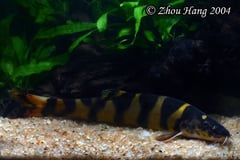
Leptobotia pellegrini
Botiidae · Fang, 1936
Leptobotia pellegrini is a botiid loach from southern China, described from Sichuan province and also known from the Pearl River (Zhu Jiang) basin. Often traded as 'royal clown loach', a name also applied to L. elongata, it differs from that species chiefly in adult size, reaching around 200 mm SL against 500 mm. It is also more slender with a darker head, and its relatively wide distribution probably explains why it is commoner in the hobby.
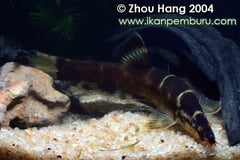
Leptobotia rubrilabris
Botiidae · Dabry de Thiersant, 1872
Leptobotia rubrilabris is a riverine botiid loach native to the middle and upper Yangtze River in China, with most records from Sichuan and Hunan. Fish labelled as this species in the trade are typically Sinibotia pulchra or other related species. In nature it favours clear, well-oxygenated running water over rocks and gravel, from boulder-filled headwater streams to larger, turbid river channels, and much of the Yangtze has been degraded by dam construction and pollution.
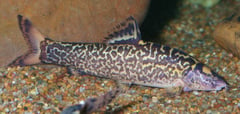
Leptobotia taeniops
Botiidae · Sauvage, 1878
Leptobotia taeniops is a botiid loach native to the middle and upper Yangtze River in China, recorded mostly from Hunan including Dongting Lake. Poorly known in the hobby, it is available occasionally and normally traded as 'honeycomb loach'. It exists in a number of colour forms from plain to reticulated and brown to pink, with reticulated populations towards the eastern end of its range, and it was previously included in the related genus Parabotia.
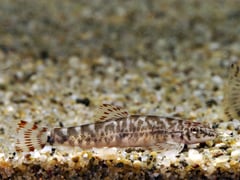
Liniparhomaloptera disparisBroken-band Hillstream Loach
Gastromyzontidae · Lin, 1934
The broken-band hillstream loach, Liniparhomaloptera disparis, is a gastromyzontid from the Pearl River system of southern China and from Hong Kong. It is restricted to shallow, fast-flowing, highly oxygenated headwaters with riffles and runs. Sometimes available as bycatch among shipments of Rhinogobius duospilus, it also appears on trade lists under the fictitious name 'Homaloptera hoffmani'. It has been bred in aquaria and buries its eggs within the substrate.
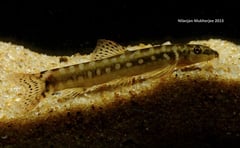
Mesonoemacheilus guentheri
Nemacheilidae · Day, 1867
Mesonoemacheilus guentheri is a loach from the Western Ghats of southern India, described from the Nilgiri Hills and since recorded in Kerala. Outside India it is most often seen as bycatch among shipments of M. triangularis. It is often confused with M. herrei, since both have rows of yellowish, dark-edged spots, but its spots are rounded where those of M. herrei are 'Y' or 'V' shaped. Some aquarists report it as peaceful and others as territorial and aggressive.
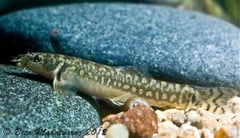
Mesonoemacheilus herrei
Nemacheilidae · Nalbant & Bãnãrescu, 1982
Mesonoemacheilus herrei is a loach from the Anaimalai Hills of the Western Ghats in Tamil Nadu, southern India. It is unclear if it has ever been exported outside India, though the odd specimen may turn up among shipments of M. guentheri or M. triangularis. It was earlier considered synonymous with M. guentheri and shares its rows of yellowish, dark-edged spots, which in this species are 'Y' or 'V' shaped.
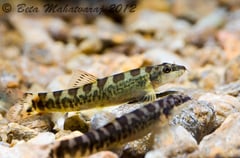
Mesonoemacheilus petrubanarescui
Nemacheilidae · Menon, 1984
Mesonoemacheilus petrubanarescui is a loach from the Netravati and Kabini river basins in the Western Ghats of southern India. It may be endemic to these two drainages. The dorsal surface carries 7-8 dark, saddle-shaped markings and the flanks a varying number of broken bars. It is unclear if it has been traded outside India, but it may turn up among shipments of M. guentheri or M. triangularis.
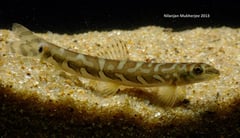
Mesonoemacheilus triangularisZodiac Loach
Nemacheilidae · Day, 1865
The zodiac loach, Mesonoemacheilus triangularis, is a loach from the Western Ghats of Kerala and Tamil Nadu in southern India. Also called the 'Batik loach', it is relatively common in the aquarium trade. Pale, black-edged saddles along the back and a similar set of bars from the belly set it apart from its congeners. Aquarists differ on its temperament, some finding it peaceful and others territorial and aggressive.
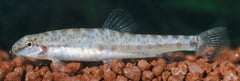
Microcobitis misgurnoides
Cobitidae · Rendahl, 1944
Microcobitis misgurnoides is a small cobitid loach from central Vietnam and the Mekong system in eastern Laos, growing to 41 mm SL. It was described in Cobitis and stayed there for over 60 years until Bohlen and Harant (2011) moved it to the new genus Microcobitis. It apparently lives in groups, and a soft, sandy substrate probably suits it best.
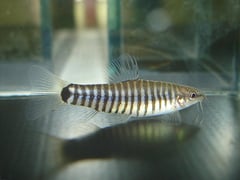
Micronemacheilus cruciatus
Nemacheilidae · Rendahl, 1944
Micronemacheilus cruciatus is a small nemacheilid loach that appears to be endemic to the coastal rivers of Vietnam. It is traded under names including 'Vietnamese multi-banded zebra loach' and 'hovering zebra loach', and its colour pattern is a dark lateral stripe with numerous vertical cross-bars. It can be susceptible to swings in water chemistry and should not go into a biologically immature aquarium.
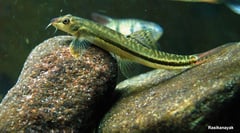
'Nemacheilus' anguilla
Nemacheilidae · Annandale, 1919
Nemacheilus anguilla is a loach endemic to the Western Ghats of southwestern India, recorded from rivers in Maharashtra, Karnataka and Kerala. Dark flank markings merged into a lateral stripe separate it from other Indian congeners, and its generic placement requires further study. It inhabits well-oxygenated, moderate to fast-flowing rivers over gravel and boulders, and is peaceful with its own kind, best kept in a group of four or more.
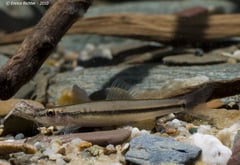
Nemacheilus binotatus
Nemacheilidae · Smith, 1933
Nemacheilus binotatus is a loach known only from the Mae Klong and Chao Phraya river systems of western and central Thailand. Its colour pattern is simply two dark stripes, one along the back and one from the snout through the eye along the flank, which separates it from N. longistriatus and N. ornatus. It lives in shallow, flowing stretches of streams over sand, gravel and leaf litter.
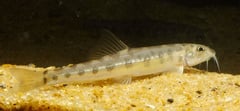
'Nemacheilus' corica
Nemacheilidae · Hamilton, 1822
Nemacheilus corica is a loach from Himalayan foothill rivers of the Ganges and Brahmaputra systems in Nepal, northern India and Bangladesh. Usually referred to Schistura in the hobby, it has been placed in Nemacheilus by most authors since the late 1970s, though its generic placement requires further study. A row of variably sized dark spots runs along the back and another along each flank, both ending in a dark blotch at the caudal-fin base.
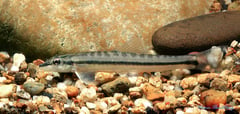
Nemacheilus longistriatusLaos Blackline Torpedo Loach
Nemacheilidae · Kottelat, 1990
The Laos blackline torpedo loach, Nemacheilus longistriatus, is a nemacheilid loach from the Mekong in Thailand and Laos. It has been collected from the main river channel and from backwaters over bedrock or sand. It is occasionally exported for the aquarium hobby and is told apart from the similar N. binotatus by the dark saddles along its back. A naturally reclusive loach, it becomes more confident alongside schools of peaceful, open water-dwelling cyprinids.
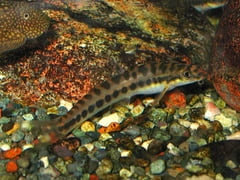
Nemacheilus masyaeArrow Loach
Nemacheilidae · Smith, 1933
Nemacheilus masyae is a nemacheilid loach from Thailand and Peninsular Malaysia. Its flanks carry 14-18 short dark bars and its back 12-17 saddles. It occurs in both small blackwater forest streams and turbid main river channels. It is very similar to N. pallidus but has a more slender body, and its dark bars and saddles are wider than the light interspaces between them.
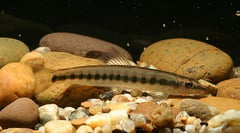
Nemacheilus ornatus
Nemacheilidae · Kottelat, 1990
Nemacheilus ornatus is a small nemacheilid loach known only from the Tapi river drainage in Surat Thani province, southern Thailand. It is said to occur in shallow riffles with clear, moderately-flowing water over small pebbles. Its colour pattern is a black lateral stripe with 9-16 vertical blotches extending above and below it, and the first of these blotches is ringed with lighter pigment to form an ocellus.

Nemacheilus pallidus
Nemacheilidae · Kottelat, 1990
Nemacheilus pallidus is a nemacheilid loach from the Mae Klong, Chao Phraya and Mekong systems in Thailand, Laos, Cambodia and Vietnam. It inhabits streams and small rivers with clear to turbid water and substrates of mud, sand or small rocks. The similar-looking N. masyae is sometimes traded under this name, but N. pallidus has a deeper body and dark bars and saddles thinner than the light interspaces between them.
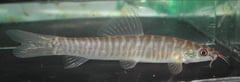
Nemacheilus platiceps
Nemacheilidae · Kottelat, 1990
Nemacheilus platiceps is a nemacheilid loach native to the Mekong basin in Laos, Thailand, Cambodia and Vietnam, and the Dong Nai system. It has been collected from shallow, slow-moving hill stream pools where leaf litter collects, and from faster-flowing stretches over gravel. It is only occasionally available in the aquarium trade and has 12-16 dark, irregular body bars, usually split vertically.
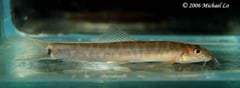
Nemacheilus saravacensis
Nemacheilidae · Boulenger, 1894
Nemacheilus saravacensis is a nemacheilid loach from Borneo, recorded from drainages in Sarawak (Malaysia) and West Kalimantan (Indonesia). It inhabits clear, tea-coloured forest streams with low mineral hardness and pH. Rare in the aquarium hobby, it may only have appeared as bycatch, and it carries 13-17 irregular dark blotches along the lateral line with a similar number of saddles across the back.
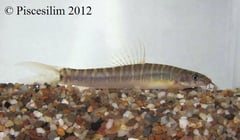
Nemacheilus selangoricus
Nemacheilidae · Duncker, 1904
Nemacheilus selangoricus is a nemacheilid loach ranging from southern Thailand through Peninsular Malaysia and Singapore to western Borneo and Sumatra. It is most common in shallow, flowing forest streams over sand, gravel and detritus. It belongs to the N. selangoricus group and is most similar to N. spiniferus, from which it differs in its 8-12 very regular dark bars on the flanks.
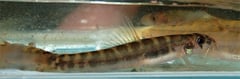
Nemacheilus spiniferus
Nemacheilidae · Kottelat, 1984
Nemacheilus spiniferus is a nemacheilid loach from Borneo, recorded from Sarawak, Brunei and Kalimantan, plus the Natuna and Anambas islands. It is most common in shallow, flowing forest streams with clear to slightly tannin-stained water. A member of the N. selangoricus group, it is rare in the aquarium hobby and differs from N. selangoricus in its 10-13 irregularly-shaped dark bars.
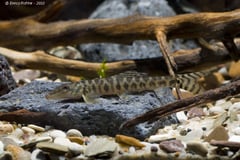
Nemachilichthys rueppelli
Nemacheilidae · Sykes, 1839
Nemachilichthys rueppelli is a nemacheilid loach from the upper Krishna River system in the Western Ghats, India. It inhabits moderate to fast-flowing streams and rivers, usually on the bed among aquatic vegetation and submerged roots. N. shimogensis was long treated as a separate species, but Keskar et al. (2015) examined topotypes of both and concluded they are conspecific.
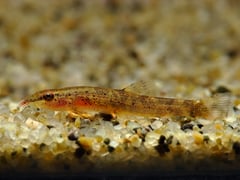
Neohomaloptera johorensis
Balitoridae · Herre, 1944
Neohomaloptera johorensis is a tiny balitorid loach from Peninsular Malaysia, found mainly in peat swamps and associated blackwater streams. Its small adult size and orange to reddish-brown colour make it difficult to confuse with any other balitorid. The water in its habitat is stained brown, with negligible mineral content and pH as low as 3.0 or 4.0. It needs well-oxygenated water free of organic pollutants.
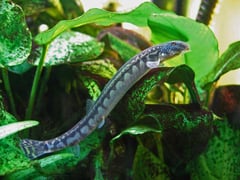
Niwaëlla delicataAjime Loach
Cobitidae · Niwa, 1937
The ajime loach, Niwaella delicata, is a 'true' loach that appears restricted to river drainages of central Honshu, Japan. It lives in shallow, fast-flowing, highly-oxygenated headwaters and minor tributaries, and retreats to streams or underflows to remain dormant between October and April. In Japan it is a prized food fish. A dark stripe or row of blotches along the lateral line separates it from its congeners.
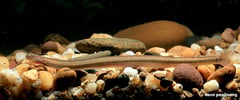
Pangio anguillaris
Cobitidae · Vaillant, 1902
Traded as 'eel loach', Pangio anguillaris is a cobitid loach from Borneo, Sumatra, Peninsular Malaysia and the Chao Phraya and Mekong basins. It has an extremely elongated, worm-like body with 69-71 vertebrae and no nasal barbels, and is most commonly available as bycatch among shipments of other fishes. The species as currently recognised appears to represent a complex of closely-related taxa.
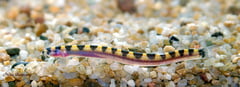
Pangio cuneovirgata
Cobitidae · Raut, 1957
Pangio cuneovirgata is a small kuhli loach from southern Thailand, Peninsular Malaysia, Sumatra and western Java, found in forest streams and swamps. It has 7-13 dark saddles on the upper half of the body and looks most like P. malayana, but has nasal barbels and a truncate caudal-fin. It is infrequently encountered in the trade, most often as bycatch among shipments of similar-looking congeners.
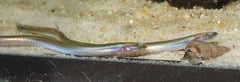
Pangio doriae
Cobitidae · Perugia, 1892
Traded as 'eel loach', Pangio doriae is a worm-like cobitid loach from Sarawak in Borneo and from Peninsular Malaysia. Some authors have suggested it is synonymous with P. anguillaris, but it can be told apart by a pair of prominent nasal barbels. The Sumatran population once identified as this species was described as P. bitaimac in 2009. It is most commonly available as bycatch among shipments of other fishes.
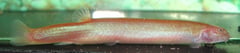
Pangio filinaris
Cobitidae · Kottelat & Lim, 1993
Pangio filinaris is a plain-bodied kuhli loach known only from Pahang and Terengganu states in Peninsular Malaysia. It has been confused with P. mariarum, which shares its plain patterning and nasal barbels, and has also been referred to by the invented name P. 'mariae'. It is sometimes exported for the aquarium trade, normally as by-catch among shipments of other species.
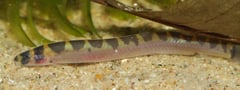
Pangio malayana
Cobitidae · Tweedie, 1956
Pangio malayana is a barred kuhli loach from Peninsular Malaysia, the Batang Hari drainage in Sumatra and the Kapuas system in Indonesian Borneo. It has 10-16 dark saddles on the upper half of the body and a black bar at the base of the caudal-fin, and looks most similar to P. cuneovirgata, which has a truncate caudal-fin. It is most often encountered as bycatch among shipments of similar-looking congeners.
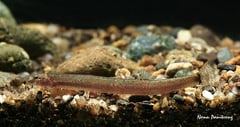
Pangio piperata
Cobitidae · Kottelat & Lim, 1993
Pangio piperata is a slender kuhli loach from Peninsular Malaysia, Riau Province in Sumatra and the Rajang river drainage in Sarawak. Its yellowish-brown body is peppered with small dark spots forming a rough stripe along the lateral line. Some populations of the variable P. shelfordii look similar and the two often occur together, but P. piperata is generally plainer and has fewer vertebrae. It is exported occasionally, most often as bycatch among congeners.
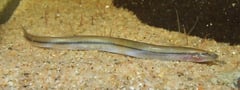
Pangio sp. 'PAN05'
Cobitidae · authority not recorded
Pangio sp. 'PAN05' appears to be an undescribed eel loach in the P. anguillaris group, and where it comes from is unclear. It is regularly imported and traded as 'eel loach', usually alongside P. anguillaris, and like other members of the group has a worm-like, usually patternless, greyish body and a high vertebral count.
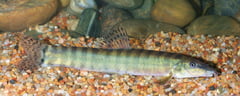
Parabotia bimaculata
Botiidae · Chen, 1980
Parabotia bimaculata is a riverine botiid loach from the upper Yangtze basin in Sichuan, southwest China, described from the Laixi River at Luxian. It looks similar to P. fasciata but has two dark markings at the caudal-fin base (vs. one) and 12-15 dark bars on the body. Like other Parabotia it favours clear, well-oxygenated running water over rocks and gravel, and needs spotless water in the aquarium.
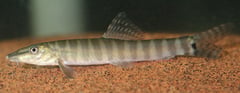
Parabotia fasciata
Botiidae · Dabry de Thiersant, 1872
Parabotia fasciata is a botiid loach from China, described from the Yangtze and also recorded from much of the Pearl River watershed. It is rarely seen in the trade and usually arrives only as bycatch among shipments of Sinibotia, particularly S. robusta. A single dark spot at the caudal-fin base separates it from the similar P. bimaculata, and numerous species from several genera are considered synonymous with it.
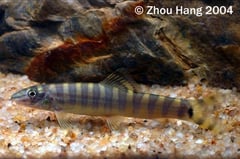
Parabotia lijiangensis
Botiidae · Chen, 1980
Parabotia lijiangensis is a botiid loach described from the Li River drainage near Guilin, in the Pearl River system of southern China. It has 10-13 dark vertical bars on the body and a dark, ocellated spot in the centre of the caudal-fin base. It probably inhabits clear, well-oxygenated running water, and the occasional specimen may turn up among shipments of similar-looking Sinibotia.
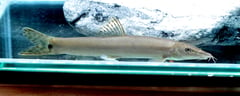
Parabotia sp. 'PB01'
Botiidae · authority not recorded
Parabotia sp. 'PB01' is an unidentified botiid loach imported into Singapore in 2012 from Sichuan province, southwestern China. Its name is unclear, and identification is harder still because diagnoses for several members of the genus do not appear to exist in English. It is not common in the aquarium trade and presumably needs clear, well-oxygenated running water like its congeners.
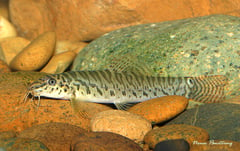
Paracanthocobitis pictilisCherry-fin Loach
Nemacheilidae · Kottelat, 2012
The cherry-fin loach, Paracanthocobitis pictilis, is a nemacheilid loach from the Ataran River, a Salween tributary on the Thailand-Myanmar border. Before its description it was traded as P. rubidipinnis, a species apparently endemic to the lower Irrawaddy. Bolder and less peaceful than other members of the genus, it inhabits shady, fast-flowing riffles, and some males become aggressive unless kept in a mixed-sex group of at least six.
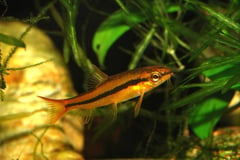
Petruichthys sp. 'rosy'Rosy Loach
Nemacheilidae · authority not recorded
The rosy loach, Petruichthys sp. 'rosy', is a small nemacheilid loach from eastern Myanmar, collected alongside Danio margaritatus. In the trade it also goes by the fictitious name 'Tuberoschistura arakensis', as an undescribed Yunnanilus, or as Y. sp. 'orange' or 'Burmese pink loach', and it appears to belong to Petruichthys as per Kottelat (2012). Peaceful and highly gregarious, it reaches 25-30 mm and should be kept in a group of at least 8-10. Often only the colourful males are exported.
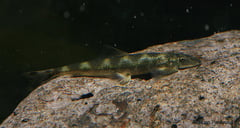
Pseudohomaloptera leonardi
Balitoridae · Hora, 1941
Pseudohomaloptera leonardi is a 'lizard' loach ranging through Peninsular Malaysia and north into Thailand as far as the Tapi river drainage. Seriously Fish referred to it as Homaloptera sp. 'H01' before its identity was established. It is very similar to P. sexmaculata, and both are sometimes misidentified as H. yunnanensis. Naturally reclusive, it needs clean, fast-flowing, well-oxygenated water and a group of four or more.
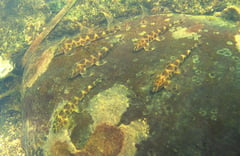
Pseudohomaloptera sexmaculata
Balitoridae · Fowler, 1934
Pseudohomaloptera sexmaculata is a hillstream loach from central and western Thailand, known only from the Chao Phraya and Mae Klong watersheds. An obligate dweller of swiftly-flowing streams and headwaters, it needs clean, well-oxygenated water. It closely resembles P. leonardi, and both are sometimes misidentified as P. yunnanensis. Members of the group mostly turn up as contaminants among shipments of other species and are usually sold as 'gecko' loaches.
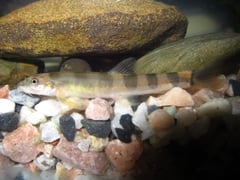
Schistura aizawlensis
Nemacheilidae · Lalramliana, 2012
Schistura aizawlensis is a nemacheilid loach known only from the Muthi River, a tributary of the Tuirial in Mizoram state, India. It has been collected for the aquarium hobby under an unknown trade name. Adults have 5-7 broad vertical bars on the flanks and an orange patch before the caudal-fin base. The type series came from a moderate to strongly-flowing stream with a substrate of gravel and rocks.
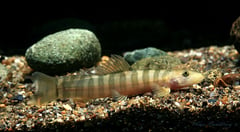
Schistura alticrista
Nemacheilidae · Kottelat, 1990
Schistura alticrista is a nemacheilid loach from the Nam Mae Yuan basin in Mae Hong Son Province, northwest Thailand, part of the Salween drainage. Very rare in the aquarium trade but available on occasion, it has conspicuous adipose crests on both the upper and lower midlines of the caudal peduncle and 8-9 dark brown bars about as wide as the paler interspaces. Its closest relatives appear to be S. disparizona and S. callidora.
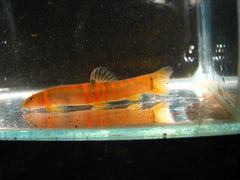
Schistura aurantiaca
Nemacheilidae · Plongsesthee, Page & Beamish, 2011
Schistura aurantiaca is a small nemacheilid loach known only from the Mae Khlong basin in Kanchanaburi Province, western Thailand. It is told apart from congeners solely by its colour pattern of 3-9 vertical orange bars on each flank. It inhabits riffles in clear, well-oxygenated headwater streams shaded by forest, and is possibly exported alongside similar-looking species such as S. cf. balteata.
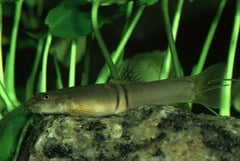
Schistura balteataSumo Loach
Nemacheilidae · Rendahl, 1948
The sumo loach, Schistura balteata, is a nemacheilid loach from the Tanintharyi river system in southern Myanmar, also recorded in western Thailand. Quite uncommon in the hobby, its name is sometimes used for the similar-looking, apparently undescribed S. cf. balteata, and both are traded as 'sumo loach'. The real S. balteata has two dark vertical bars below the dorsal-fin and no black bar at the caudal-fin base.
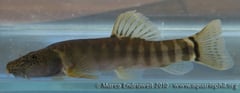
Schistura callichroma
Nemacheilidae · Zhu & Wang, 1985
Schistura callichromus is a nemacheilid loach recorded only from the Babianjiang River in the Red River basin, Yunnan Province, China. It is expected to occur in Vietnamese waters as well, and Kottelat (2012) amended the spelling of its name to 'callichroma'. Wild specimens have been observed living in social aggregations of up to six in clear, well-oxygenated headwater streams.
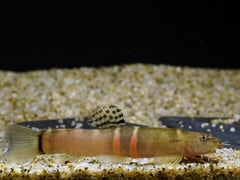
Schistura cf. balteataSumo Loach II
Nemacheilidae · authority not recorded
The sumo loach II, Schistura cf. balteata, is an apparently undescribed nemacheilid loach from the Ataran River drainage in Myanmar and Thailand. Both it and the real S. balteata have been traded as 'sumo loach', but this fish has brighter colouration, a smaller adult size and seems more peaceful. The colour pattern is highly variable, with the rear half of the body bright pink in some specimens and yellow in others.
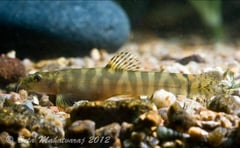
Schistura denisonii
Nemacheilidae · Day, 1867
Schistura denisonii is a nemacheilid loach from the Western Ghats of southern India, described from the Bhavani River in the Cauvery system. Widely referred to Nemacheilus, it matches the diagnostic characters of Schistura. The number and arrangement of its vertical body bars vary greatly, and whether it represents a complex of species or a single taxon remains unclear. Feisty, it is largely unsuitable for the general community aquarium.
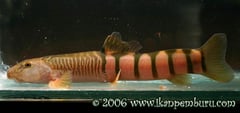
Schistura disparizona
Nemacheilidae · Zhou & Kottelat, 2005
Schistura disparizona is a nemacheilid loach known only from its type locality on the Nangun River, a Salween tributary in Yunnan Province, China. Its colour pattern of 8-11 closely-set, narrow dark bars at the front of the body and 5 wider bars behind separates it from congeners, and it has prominent adipose crests on the caudal peduncle. It inhabits shallow, narrow branches of streams over gravel or stone.
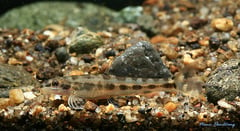
Schistura geisleri
Nemacheilidae · Kottelat, 1990
Schistura geisleri is a small nemacheilid loach widespread in the Chao Phraya river system of western Thailand. It differs from most congeners in its small adult size, sociable behaviour and tendency to bury itself in the substrate when threatened. Peaceful with conspecifics, it is best kept in a group of four or more. It is available in the trade from time to time but is by no means common.
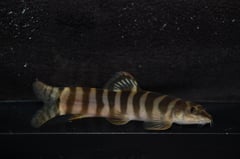
Schistura hypsiuraSuper Convict Loach
Nemacheilidae · Bohlen, Ŝlechtová & Udomritthiruj, 2014
The super convict loach, Schistura hypsiura, is a nemacheilid loach known only from a short coastal river in southern Rakhine State, western Myanmar. Traded as S. sp. 'super convict', it has a deep caudal peduncle, a deeply forked caudal-fin and 6-8 very regular bars along the flank. Not among the more aggressive members of the genus, it can be kept in a community aquarium provided tankmates are selected with care.
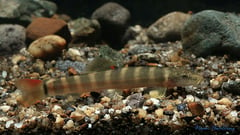
Schistura kengtungensis
Nemacheilidae · Fowler, 1936
Schistura kengtungensis is a nemacheilid loach from the middle Mekong basin in Thailand, Myanmar, Laos and Yunnan Province, southern China. It has 9-13 vertical bars as wide as or wider than the interspaces, and specimens from China differ from those in Thailand and Myanmar in several morphological characters. It inhabits shallow, narrow branches of streams over gravel or stone.
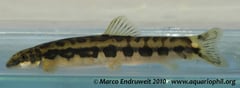
Schistura kloetzliae
Nemacheilidae · Kottelat, 2000
Schistura kloetzliae is a nemacheilid loach known only from the Mengla River system in Yunnan, China, and Luang Namtha province, northern Laos. It appears restricted to highly-oxygenated, fast-flowing riffles of small to medium streams with clear water and no aquatic plants. A series of large black blotches along the lateral line, each connected with blotches on the dorsal midline, separates it from congeners.
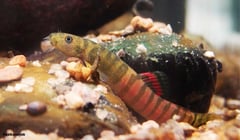
Schistura kodaguensis
Nemacheilidae · Menon, 1987
Schistura kodaguensis is a small nemacheilid loach from the Western Ghats of Karnataka, India, confirmed only from a tributary of the Cauvery. It is not a well-known aquarium fish but is maintained by a number of Indian enthusiasts. The very similar S. nilgiriensis, also from the Western Ghats, has a black spot at the base of the dorsal-fin and lacks the rows of spots on the caudal-fin.
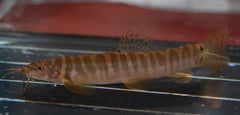
Schistura kohchangensisOrnate Tiger Sand Loach
Nemacheilidae · Smith, 1933
The ornate tiger sand loach, Schistura kohchangensis, is a nemacheilid loach from southeastern Thailand and southwestern Cambodia. Described from a waterfall stream on Koh Chang island, it appears in the trade from time to time but is not well known in the hobby. It has 10-12 dark brown vertical bars, usually split vertically, and inhabits shallow, often high-gradient streams with moderate to fast flow, surviving the dry months in isolated pools at some localities.
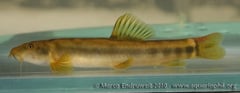
Schistura laterivittata
Nemacheilidae · Zhu & Wang, 1985
Schistura laterivittata is a nemacheilid loach recorded only from the Babianjiang River in the Red River basin, Yunnan Province, China. Most recent authors have treated it as a synonym of S. caudofurca, but this appears to be a case of misidentification: S. caudofurca has a deeply forked caudal-fin and no dark lateral body stripe. It is expected to occur in Vietnamese waters as well.
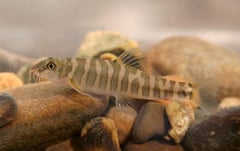
Schistura maepaiensis
Nemacheilidae · Kottelat, 1990
Schistura maepaiensis is a small nemacheilid loach from tributaries of the Salween basin in Mae Hong Son and Tak provinces, northwestern Thailand. It may also occur in the Salween system in Myanmar. Poorly known in the hobby, it can be told from congeners by its 10-13 irregular body bars with thin dark borders. The type locality was a shallow stream over rocks and boulders with moderate to swift flow.
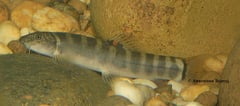
Schistura nicholsi
Nemacheilidae · Smith, 1933
Schistura nicholsi is a nemacheilid loach widespread in the Mekong basin in Laos and Thailand, and it may also occur in Cambodia. It is sometimes traded for aquaria, but its name also appears to have been widely misapplied to other fishes. It has 8-10 quite regular dark bars wider than the light interspaces. It has been bred in an aquarium, although the adults seem to consume both eggs and fry.
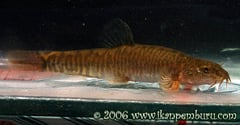
Schistura polytaenia
Nemacheilidae · Zhu, 1982
Schistura polytaenia is a nemacheilid loach known only from its type locality, an Irrawaddy tributary in Tengchong County, Yunnan, China. It appears never to have been exported for the aquarium hobby. Normally listed in Nemacheilus, it appears under Schistura in Kottelat (2012), and the specimens shown on the profile were identified on the basis of collection locality.
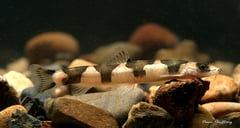
Schistura pridiiMini Dragon Loach
Nemacheilidae · Vidthayanon, 2003
The mini dragon loach, Schistura pridii, is a small nemacheilid loach endemic to tributary streams of the upper Chao Phraya in northern Thailand. Only a handful of populations are known, most inside the Doi Chiang Dao Wildlife Sanctuary, in swift, shallow forest hill streams at around 950-1250 m. Despite its endangered status it is available in the trade sporadically. Four black bars on a yellow base, usually forming saddles, identify it.
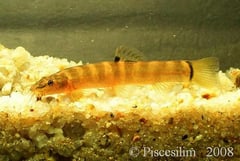
Schistura robertsi
Nemacheilidae · Kottelat, 1990
Schistura robertsi is a small nemacheilid loach from the western slope of the Malay Peninsula in southern Thailand and Malaysia. It inhabits shallow, narrow branches of streams over sand, gravel or stone, and adults carry 8-10 regular dark body bars wider than the pale interspaces. It may have been exported alongside similar-looking relatives such as S. cf. balteata, and like many fishes from running water it is intolerant of organic pollutants.
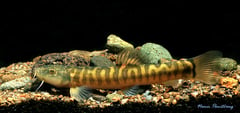
Schistura schultzi
Nemacheilidae · Smith, 1945
Schistura schultzi is a nemacheilid loach from Mekong tributaries in northern Thailand, and probably also Bokeo province in Laos. The full extent of its range is unclear. It grows to at least 93 mm and has 13-18 relatively thin dark body bars. Its aquarium behaviour is unknown, but slow-moving, long-finned or very placid tankmates are not recommended.
Schistura sp. 2Laos Redtail Loach
Nemacheilidae · authority not recorded
The Laos redtail loach, Schistura sp. 2, is a nemacheilid loach supposedly exported from Laos. Its identity is unclear, and it has been traded as S. sp. 'Laos redtail'. Expect it to reach at least 40-45 mm.
Schistura sp. 3
Nemacheilidae · authority not recorded
Schistura sp. 3 is an unidentified nemacheilid loach thought to have been exported from northern India. It has been traded as Schistura scaturigina but does not appear to be that species, since it has 9 regular vertical bars extending the full depth of the body and a dark marking at the anterior dorsal-fin base. Several vertically-barred Schistura from northern India have confused identities.
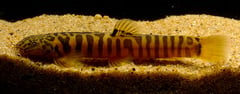
Schistura sp. 4Grizzled Loach
Nemacheilidae · authority not recorded
The grizzled loach, Schistura sp. 4, is a nemacheilid loach from a hill stream in the Siwalik hills around Darjeeling, West Bengal, northern India. Its identity is unclear, and though collected close to the type locality of S. multifasciata it does not match the description of that species. The stream is small, shallow and clear, well over 1000 m AMSL, and the fish is likely to attain 90-100 mm.
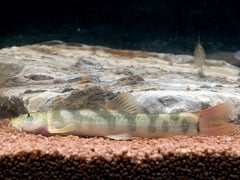
Schistura spilota
Nemacheilidae · Fowler, 1934
Schistura spilota is a nemacheilid loach known only from tributaries of the upper Ping River basin in Chiang Mai Province, northern Thailand. The species turns up sporadically in shipments of wild fishes from Thailand. Its body bars tend to form roundish blotches along the flanks, and the caudal-fin is reddish with two vertical rows of dark spots. Feisty and reaching 90-100 mm, it is largely unsuitable for the general community aquarium.
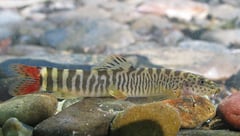
Schistura vinciguerrae
Nemacheilidae · Hora, 1935
Schistura vinciguerrae is a nemacheilid loach from the Irrawaddy, Salween and Chindwin river basins in Myanmar and northeastern India. Traded fairly regularly, it belongs to the Schistura multifasciata group, in which the anterior flank bars are divided and thinner than those behind. Males lack a suborbital flap, and this separates it from S. bella, S. mahnerti, S. reticulata and S. udomritthiruji. It inhabits clear, well-oxygenated forest streams over coarse sand, gravel, rocks and boulders.
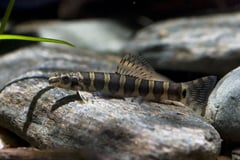
Serpenticobitis octozona
Serpenticobitidae · Roberts, 1997
Serpenticobitis octozona is a small loach apparently endemic to the Sekong River basin in southern Laos, part of the lower Mekong system. Sometimes sold as 'serpent loach', it shows a degree of social interaction and can cling to vertical or overhanging surfaces. The type species of its genus, it has 7-8 dark bars on each flank, much wider than the pale interspaces. It lives in shallow, fast-flowing, highly-oxygenated headwaters and minor tributaries.
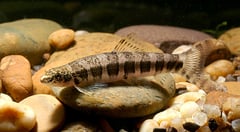
Serpenticobitis zonata
Serpenticobitidae · Kottelat, 1998
Serpenticobitis zonata is a small loach from the Xe Bangfai and Xe Bang Hiang drainages in Laos, and Chanthaburi province in south-eastern Thailand. Fish sold under this name are sporadically available, but the majority appear to be the congener S. octozona. S. zonata has a pale body with 7-8 regular dark vertical bars, sometimes with thin dark bars on the interspaces. It inhabits shallow, fast-flowing, highly-oxygenated headwaters and minor tributaries.
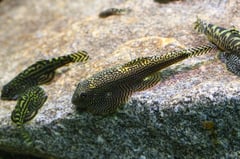
Sewellia albisuera
Gastromyzontidae · Freyhof, 2003
Sewellia albisuera is a hillstream loach known only from a handful of localities in the Thu Bon river system, Quang Nam province, central Vietnam. It is very rarely traded but resembles S. sp. 'SEW01', from which it differs in its network of irregular dark reticulations (many small light spots in SEW01). It inhabits shallow, fast-flowing, highly-oxygenated headwaters and tributaries, and the type locality is apparently suffering from pollution.
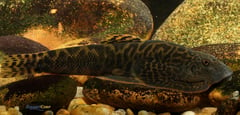
Sewellia elongata
Gastromyzontidae · Roberts, 1998
Sewellia elongata is a hillstream loach from the Bolovens plateau in southern Laos, also recorded in the upper Se Kong drainage in central Vietnam. The largest described Sewellia, growing to at least 73 mm SL, it is most similar to S. diardi but has a relatively slender, elongate body. It appeared in the aquarium trade during 2010 and inhabits shallow, fast-flowing, highly-oxygenated headwaters with riffles and runs.
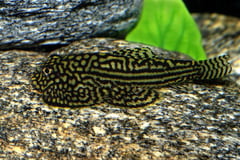
Sewellia lineolataTiger Hillstream Loach
Gastromyzontidae · Valenciennes, 1846
The tiger hillstream loach, Sewellia lineolata, is a gastromyzontid loach from fast-flowing headwaters in Vietnam and on the Mekong in Laos. Three to five dark stripes on the body make it difficult to confuse with any other member of the genus. The water must be clean, fast-flowing and well-oxygenated, and Sewellia species are arguably the easiest of all loaches to breed in aquaria.
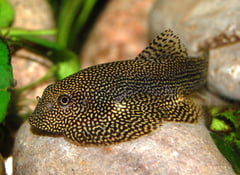
Sewellia sp. 'SEW01'Spotted Butterfly Loach
Gastromyzontidae · authority not recorded
The spotted butterfly loach, Sewellia sp. 'SEW01', is a hillstream loach from Quang Nam province in central Vietnam. One of the more readily available members of the genus, it is also called S. sp. 'spotted' or S. sp. 'special' and has many small, light spots on a dark background. It resembles S. albisuera, and it has been suggested the two are the same species, but this does not appear to be the case.
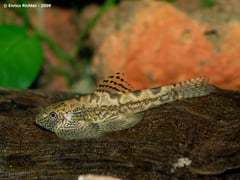
Sewellia sp. 'SEW02'
Gastromyzontidae · authority not recorded
Sewellia sp. 'SEW02' is an undescribed hillstream loach whose trade specimens are thought to originate in Hue province, central Vietnam. It first became available in early 2009 and was initially identified as S. breviventralis, but it does not fully match that species or S. elongata and remains in need of identification. It is sometimes sold as 'butterfly loach', a generic name used for several balitorids.
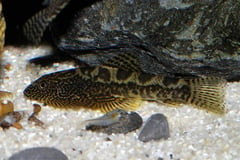
Sewellia sp. 'SEW03'
Gastromyzontidae · authority not recorded
Sewellia sp. 'SEW03' is an unidentified hillstream loach thought to originate in Hue province, central Vietnam. First available in early 2009 as S. breviventralis, it cannot be that species because there is no discernible gap between the pelvic and anal fins. It is often imported in mixed batches with S. sp. 'SEW02', which it resembles closely, and needs shallow, fast-flowing, highly-oxygenated water.
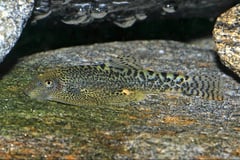
Sewellia sp. 'SEW04'
Gastromyzontidae · authority not recorded
Sewellia sp. 'SEW04' is a hillstream loach thought to originate in Hue province, central Vietnam, and may be undescribed. It has been imported among shipments of S. sp. 'SEW02' and S. sp. 'SEW03' and does not appear to correspond to any known member of the genus.
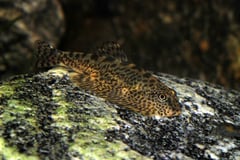
Sewellia speciosa
Gastromyzontidae · Roberts, 1998
Sewellia speciosa is a hillstream loach that appears endemic to the Xe Kong river drainage in central Vietnam and southern Laos. It first became available in early 2010 and sometimes appears on trade lists as 'Laos sucker' or 'Laos Sakura sucker'. The spotted body without stripes separates it from the morphologically similar S. lineolata, which is striped, and it inhabits shallow, fast-flowing, highly-oxygenated headwaters.
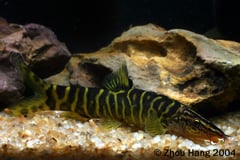
Sinibotia pulchraGolden Zebra Loach
Botiidae · Wu, 1939
The golden zebra loach, Sinibotia pulchra, is a botiid loach from the Zhu Jiang (Pearl River) system in southern China. It is also sold as the 'golden Chinese loach' or '12-banded Chinese loach' and, with S. robusta, is the most commonly traded Sinibotia, the two often imported in mixed batches. It is reclusive but very peaceful, and the gregarious nature of the genus means 3-4 should be the minimum purchase.
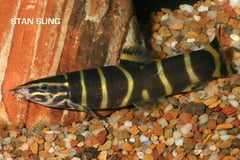
Sinibotia reevesae
Botiidae · Chang, 1944
Sinibotia reevesae is a botiid loach described from the middle Yangtze in Luxian County, Sichuan Province, and still known only from that area. It is apparently rare in nature and seldom seen in the trade, arriving occasionally as bycatch in shipments of S. pulchra or S. robusta. It has 7-8 dark vertical bars, and the head lacks the brown vermiform markings of S. pulchra.
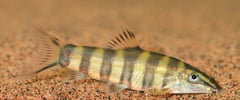
Sinibotia robustaKansu Loach
Botiidae · Wu, 1939
The Kansu loach, Sinibotia robusta, is a botiid loach from the Zhu Jiang (Pearl River) system in Guangxi, southern China. Its deeper, stockier body separates it from other Sinibotia. With S. pulchra it is the most commonly traded member of the genus, and the two are often imported in mixed batches. Young fish have around 6 dark bars that usually bifurcate as they mature.
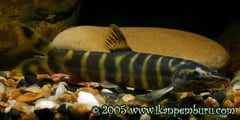
Sinibotia superciliaris
Botiidae · Günther, 1892
Sinibotia superciliaris is a botiid loach from the middle Yangtze River drainage in Sichuan and Guizhou provinces, western China. It is rarely seen in the trade, with exports sporadic. It looks very similar to S. pulchra but lacks the brownish markings and spots on the side of the head, and in the wild it was collected from swiftly-flowing stretches with rocky substrates.
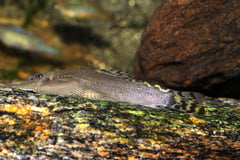
Sinogastromyzon puliensis
Balitoridae · Liang, 1974
Sinogastromyzon puliensis is a hillstream loach endemic to western river drainages of central and southern Taiwan. It is considered endangered across some of its range and has been protected by the Wildlife Conservation Act of Taiwan since 1989, and those in the trade appear to be collected and exported illegally. It lives in riffles and rapids with swift currents.
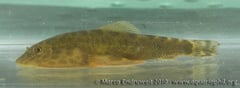
Sinogastromyzon tonkinensis
Balitoridae · Pellegrin & Chevey, 1935
Sinogastromyzon tonkinensis is a hillstream loach that appears endemic to the lower Red River drainage in southern China and northern Vietnam. It is poorly known in the hobby but appears to have been exported on a handful of occasions. It occurs alongside three congeners, which are most easily separated by the barbels and mouth width, and it dwells in swiftly-flowing streams and headwaters.
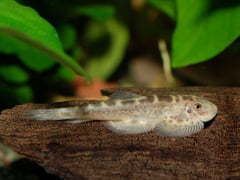
Sinogastromyzon wui
Balitoridae · Fang, 1930
Sinogastromyzon wui is a hillstream loach known only from parts of the Xi Jiang (West River) watershed in Guangxi and Guangdong, southern China. Probably the most common member of the genus in the aquarium trade, it is still not often exported in numbers and more often arrives in mixed shipments with Beaufortia or Pseudogastromyzon. It lives in shallow riffles and rapids with swift currents.
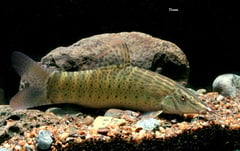
Syncrossus beaufortiChameleon Loach
Botiidae · Smith, 1931
The chameleon loach, Syncrossus beauforti, is a botiid loach from Thailand and southern Myanmar, including the Chao Phraya and the Ataran River. It has been widely mislabelled as S. berdmorei in older aquarium literature, but has 9-10 branched dorsal-fin rays and rows of small dark markings across the body and head even when young. Adults reach 160-180 mm, and wild populations appear to have declined by at least 20-29% since 1997.
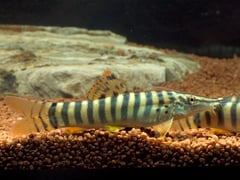
Syncrossus berdmoreiRedfin Tiger Loach
Botiidae · Blyth, 1860
The redfin tiger loach, Syncrossus berdmorei, is a botiid loach from the Irrawaddy, Sittaung and Salween systems in Myanmar and Manipur, India. It looks very similar to S. beauforti but has 11-14 branched dorsal-fin rays, and in young fish its larger dark markings appear first behind the opercle. Colour and pattern vary with locality and age, and some of these forms may turn out to be separate species.
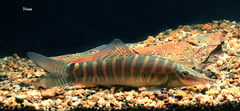
Syncrossus helodesBanded Tiger Loach
Botiidae · Sauvage, 1876
The banded tiger loach, Syncrossus helodes, is a botiid loach from the Mekong in Laos, Cambodia, Vietnam and Thailand, and the Chao Phraya. Reaching 250-300 mm, it lives in flowing waters from headwater streams to main channels and migrates into flooded areas in the wet season to feed and spawn. It is sometimes confused with S. hymenophysa but has small dark markings on the lower body, no dark spot in the dorsal fin and 10-12 bars without bluish borders.
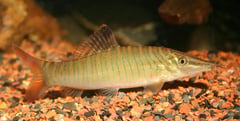
Syncrossus hymenophysaGreen Tiger Loach
Botiidae · Bleeker, 1852
The green tiger loach, Syncrossus hymenophysa, is a botiid loach from Sumatra and Borneo, and the Pahang and Perak systems of Peninsular Malaysia. It may already have disappeared from Peninsular Malaysia, where only one confirmed specimen has been documented since 1955. Often associated with submerged branches, roots and logs, it is sometimes confused with S. helodes but has a dark spot in the dorsal fin and 12-15 body bars with bluish borders.
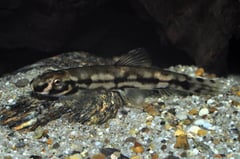
Yaoshania pachychilusPanda Loach
Balitoridae · Chen, 1980
The panda loach, Yaoshania pachychilus, is a balitorid loach from headwater streams draining the Dayao Mountain in Guangxi, southern China. The name comes from the black-and-white-striped juvenile pattern, which fades in older fish, so only young fish tend to be traded, sometimes labelled 'panda goby'. It needs clean, well-oxygenated, fast-flowing water, and though often marketed for them it is not suitable for tiny 'nano' aquaria.
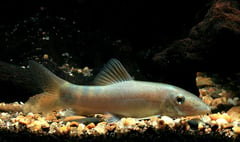
Yasuhikotakia caudipunctataSpeckle-tailed Loach
Botiidae · Taki & Doi, 1995
The speckle-tailed loach, Yasuhikotakia caudipunctata, is a botiid loach described from the Mekong drainage in Laos, near Pakse and Vientiane. Relatively rare in the aquarium trade and much sought after, it looks similar to Y. splendida but has numerous small blackish spots in the dorsal and caudal fins. SF members report it milder in temperament than some congeners, and it needs an aquarium with a base of at least 120 ∗ 30 cm.
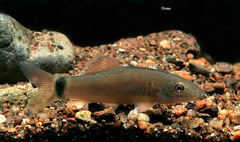
Yasuhikotakia eosSun Loach
Botiidae · Taki, 1972
The sun loach, Yasuhikotakia eos, is a botiid loach from the middle and lower Mekong in Laos, Cambodia and Thailand, and the Dong Nai in Vietnam. Its yellow to reddish brown body with a metallic sheen and a large dark marking on each side of the caudal peduncle make it difficult to confuse with any congener. It has a reputation for aggression and can be fiercely territorial where space or shelter is limited, so it suits only larger, well-structured aquaria with other sturdy fishes.
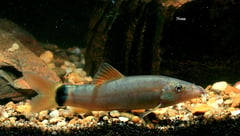
Yasuhikotakia leconteiSilver Loach
Botiidae · Fowler, 1937
The silver loach, Yasuhikotakia lecontei, is a botiid loach from the middle and lower Mekong and the Chao Phraya and Mae Klong drainages of Thailand. Sometimes confused with Y. modesta, it is a slimmer, more elongate fish, usually brownish with a gold/green sheen, and its roundish caudal peduncle markings do not meet on the ventral surface. It forages under cover of dusk and darkness, and SF members report it milder in temperament than Y. eos and Y. morleti.
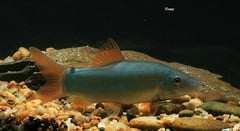
Yasuhikotakia modestaRedtail Loach
Botiidae · Bleeker, 1864
The redtail loach, Yasuhikotakia modesta, is a botiid loach from the middle and lower Mekong and the Chao Phraya and Mae Klong drainages of Thailand. One of the more commonly encountered botiids in the hobby, it is also sold as 'blue', 'orange-finned' or 'red-finned' botia. Some fish are dyed and sold as 'blueberry' or 'raspberry' loach, and their health is normally compromised by the process. Deeper-bodied than the similar Y. lecontei, it grows to 250 mm and needs an aquarium with a base of at least 150 ∗ 45 cm.
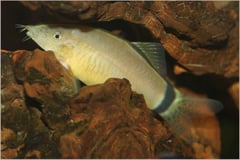
Yasuhikotakia morletiSkunk Loach
Botiidae · Tirant, 1855
The skunk loach, Yasuhikotakia morleti, is a botiid loach from the middle and lower Mekong and the Chao Phraya and Mae Klong drainages of Thailand. Common in the hobby, where most fish are farmed commercially, it is also sold as 'skunk botia' or 'Hora's loach'. The dark stripe over its dorsal surface separates it from the similar Y. longidorsalis. It can be combative, nipping fins and harassing tankmates, especially when kept in smaller groups.
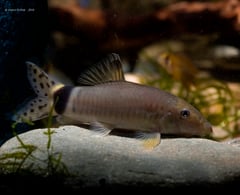
Yasuhikotakia splendida
Botiidae · Roberts, 1995
Sold as the 'jaguar loach' among other names, Yasuhikotakia splendida is a botiid loach from the Xe Pian river system in southern Laos. It is known from small, swiftly-running headwater streams draining the Bolaven Plateau, with clear water over rocks and cobbles. An unbroken dark ring around the caudal peduncle and large dark spots in the yellow caudal-fin separate it from the similar Y. caudipunctata, Y. longidorsalis and Y. morleti. SF members report it milder in temperament than some congeners.
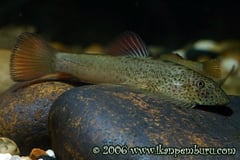
Pseudogastromyzon laticeps
Balitoridae · authority not recorded
Pseudogastromyzon laticeps is a balitorid loach from southeastern China, apparently endemic to the Longjin river drainage in Guangdong province. Like its congeners it has a flattened head and body with horizontally orientated paired fins, adapted to shallow, fast-flowing, highly-oxygenated streams. Based on the images available it appears to have reddish dorsal and caudal fins, and males develop tubercules on the head at sexual maturity.
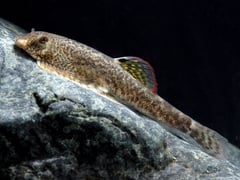
Pseudogastromyzon myersi
Balitoridae · authority not recorded
Traded as the 'Chinese hillstream loach', Pseudogastromyzon myersi is a balitorid from Hong Kong and neighbouring Guangdong province, China. The commonest member of the genus in the hobby, it has often been misidentified as P. cheni, which is not collected for the trade. Aquarium Pseudogastromyzon with a yellow-based dorsal fin and a red distal band should be considered P. myersi. It needs clean, well-oxygenated water and has been bred in aquaria on numerous occasions.
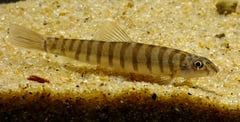
Schistura sp. 1Ring Loach
Nemacheilidae · authority not recorded
The ring loach, Schistura sp. 1, is a nemacheilid loach collected for the trade in the Torsa river, a Brahmaputra tributary in West Bengal, India. Its identity is unclear: it has been considered to represent S. beavani, S. montana and S. himachalensis, but its bar count and plain fins argue against each. Unlike many congeners it is peaceful with conspecifics, and it has a propensity to bury itself when startled.
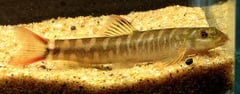
Schistura sp. 6
Nemacheilidae · authority not recorded
Schistura sp. 6 is an unidentified nemacheilid loach from the south Garo Hills in Meghalaya state, northeastern India. It was collected for the aquarium trade during 2012. The body apparently becomes suffused with red once the fish is settled, and its colour pattern recalls the Schistura multifasciata group, in which the anterior flank bars are divided.
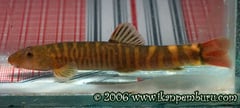
Schistura yingjiangensis
Nemacheilidae · Zhu, 1982
Schistura yingjiangensis is a nemacheilid loach known only from the Daying River, an Irrawaddy tributary in Yingjiang County, Yunnan, China. It appears never to have been exported for the aquarium hobby. Normally listed in Nemacheilus, it appears under Schistura in Kottelat (2012), as it does in Chen & Neely (2012) and Endruweit (2014).
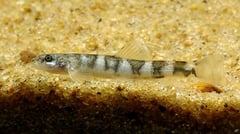
Schistura devdeviSaddleback Loach
Nemacheilidae · Hora, 1935
The saddleback loach, Schistura devdevi, is a nemacheilid loach from upland parts of Assam, Sikkim, Arunachal Pradesh and West Bengal, northern India. It has been collected for the aquarium trade in limited quantities and is sometimes called 'firefly loach'. Records from Nepal apparently require confirmation. It is unlikely to prove aggressive and should suit a community aquarium provided tankmates are selected with care.
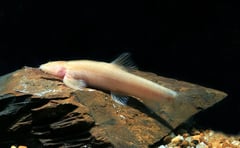
Nemacheilus troglocataractus
Nemacheilidae · Kottelat & Géry, 1989
Nemacheilus troglocataractus is a blind cave loach known only from the Tham Sai Yok Noi cave system in Kanchanaburi Province, Thailand. Most specimens have no externally visible eyes and all are entirely depigmented. It is protected by Thai law and illegal to remove from its habitat, so the profile includes it for interest only.
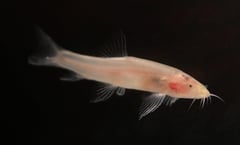
Schistura deansmarti
Nemacheilidae · Vidthayanon & Kottelat, 2003
Schistura deansmarti is a troglomorphic nemacheilid loach endemic to the Tham Phra Sai Ngam cave system in Phitsanulok Province, Thailand. All individuals are entirely depigmented, and some have no externally visible eyes. The species is protected by Thai national law and illegal to remove from its habitat, so it is included here for interest only and is not suitable as an aquarium fish.
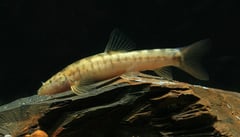
Schistura jarutanini
Nemacheilidae · Kottelat, 1990
Schistura jarutanini is a troglomorphic nemacheilid loach that appears to be endemic to the Ba Dan cave in Kanchanaburi Province, western Thailand. The eyes are reduced or absent but the body retains a degree of pigmentation, and it is found in deeper parts of the cave's subterranean stream. Protected by Thai national law and illegal to remove from its habitat, it is included here for interest only.
Schistura oedipus
Nemacheilidae · Kottelat, 1988
Schistura oedipus is a troglomorphic nemacheilid loach restricted to five caves in the Pang Mapha karst, Mae Hong Son province, northwest Thailand. The eyes are reduced to vestigial pits beneath the skin and the body is unpigmented. It inhabits flowing subterranean streams, often interrupted by cascades, that drain to the Salween system. Protected by Thai national law, it is included here for interest only.
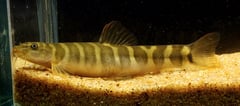
Schistura sp. 7
Nemacheilidae · authority not recorded
Schistura sp. 7 is an unidentified nemacheilid loach from the south Garo Hills in Meghalaya state, northeastern India. It was collected for the aquarium hobby during 2012 and may have been traded as 'green loach'.
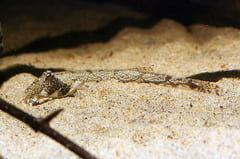
Canthophrys gongotaMoose-faced Loach
Cobitidae · Hamilton, 1822
The moose-faced loach, Canthophrys gongota, is a cobitid loach from the Ganges and Brahmaputra river systems in Nepal, northern India and Bangladesh. Often referred to as Somileptes gongota in aquarium literature, it is rarely seen in the trade, being notoriously delicate and difficult to ship. It mostly inhabits slow-moving, shallow tributaries and minor rivers over mud, sand or gravel.
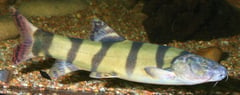
Leptobotia elongataImperial Flower Loach
Botiidae · Bleeker, 1870
The imperial flower loach, Leptobotia elongata, is a large botiid loach native to the middle and upper Yangtze River in China. Growing to 400 to 500 mm SL, it has declined drastically in the wild through damming, pollution and habitat degradation, and it is rare in the aquarium trade and prohibitively expensive when available. Also known as the 'royal clown' loach, a name since applied to the smaller L. pellegrini, it is a species for the specialist able to house it long term.
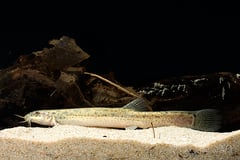
Misgurnus anguillicaudatusOriental Weather Loach
Cobitidae · authority not recorded
The oriental weather loach, Misgurnus anguillicaudatus, is a loach native to Siberia, Korea, Japan, China and northern Vietnam. Known in the United States as the 'dojo loach', it is one of the most ubiquitously available species in the hobby, and years of mass-production have made health and morphological issues common. Exceptionally hardy and adaptable, it is established as an alien species around the globe, and its adult size of up to 280 mm should be considered prohibitive.