River
Caroní
Only species with a profile on Seriously Fish are counted.
- Species
- 6
- Families
- 4
- Photographed
- 6 of 6
- Difficulty rated
- 6 of 6
Basin
Also in the Orinoco basinspecies recorded from both
Shares fishes with rivers elsewherespecies recorded from both
Runs through

Colomesus asellusAmazon Puffer
Tetraodontidae · (Müller & Troschel, 1849)
The Amazon puffer, Colomesus asellus, is a freshwater puffer found throughout much of the Amazon basin, with records north to Guyana and Venezuela. Also traded as the South American puffer or 'SAP', it is told from congeners by a transverse row of dermal flaps across the chin. It lives mostly in well-oxygenated river habitats, is intolerant of organic waste, and forms loose aggregations, so a group of 6 or more is best, away from the general community.
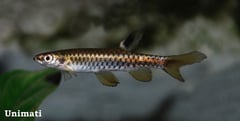
Copella eigenmanni
Lebiasinidae · (Regan, 1912)
Copella eigenmanni is a small lebiasinid from the Orinoco system in the llanos of Colombia and Venezuela, including the Meta, Caroní and Apure. It turns up in the trade from time to time among wild-caught fishes from the Orinoco basin. Colombian populations were formerly called C. metae until Zarske (2011) synonymised the two. A broad dark stripe runs from the snout to the eye, and the eggs are laid among vegetation and guarded by the male.

Geophagus dicrozoster
Cichlidae · López-Fernández & Taphorn, 2004
Geophagus dicrozoster is a cichlid from tributaries of the río Orinoco in Venezuela, extending to the Casiquiare and the headwaters of the Negro. Commonly traded but rarely under the correct name, it is usually sold as G. altifrons or G. surinamensis, and it is one of the few Geophagus bred commercially. Seven flank bars, the fourth and fifth meeting in a 'Y', and a relatively elongate profile identify it. It appears restricted to acidic blackwater.

Satanoperca mapiritensis
Cichlidae · (Fernández-Yépez, 1950)
Satanoperca mapiritensis is an eartheater cichlid native to the lower Río Orinoco basin in northern Venezuela, including the ríos Caura and Caroní. Uncommon in the aquarium trade, its name is frequently misapplied to S. leucosticta and similar, unidentified forms. Adults have white spots and vermiculations on the head, most intense on the operculum, and pale orange lips. Genetic research suggests it may turn out to be conspecific with S. jurupari and S. rhynchitis.
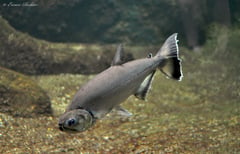
Hydrolycus armatusPayara
Cynodontidae · (Jardine, 1841)
The payara, Hydrolycus armatus, is a large, predatory dogtooth characin from the eastern Amazon, the Orinoco and the Essequibo in Guyana. Given its eventual size and natural behaviour it probably should not be considered a home aquarium subject at all, though juveniles are sometimes sold. It is regularly confused with the smaller H. scomberoides, and no other member of the genus has white margins to the anal and caudal fins.
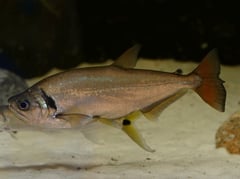
Hydrolycus tatauaia
Cynodontidae · Toledo-Piza, Menezes & Santos, 1999
Hydrolycus tatauaia is a large, predatory dogtooth characin from the lower and central Amazon, the upper Orinoco and coastal drainages of Guyana. A pelagic species of flowing main river channels, it performs long upstream migrations to spawn. Its adult size and natural behaviour mean only a handful of private aquarists have the facilities to house it long-term.