River
Pará
Only species with a profile on Seriously Fish are counted.
- Species
- 8
- Families
- 7
- Photographed
- 8 of 8
- Difficulty rated
- 8 of 8
Shares fishes withspecies recorded from both
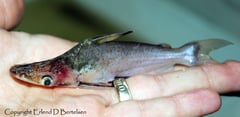
Ageneiosus ucayalensisDuck Catfish
Auchenipteridae · Castelnau, 1855
The duck catfish, Ageneiosus ucayalensis, is an auchenipterid catfish described from Peru and recorded across the Amazon, Orinoco and Guianas. Body patterning apparently varies with locality, and fish from black water habitats, particularly on the Guiana Shield, tend to be darker. Growing to around 290 mm SL and capable of taking large prey, it is safe only with similarly sized catfishes or large pelagic characins, mostly a combination for public aquaria.

Apistogramma agassiziiAgassiz's Dwarf Cichlid
Cichlidae · Steindachner, 1875
Apistogramma agassizii is a dwarf cichlid found through much of the Amazon/Solimões basin, from the Río Ucayali in Peru to the Capim River in Brazil. Colour and pattern vary considerably with locality, and numerous ornamental forms have been selectively bred for the trade. It inhabits slower-moving tributaries and creeks where leaf litter collects. Captive-raised fish suit the community aquarium, while wild fish are best kept alone or with small dither fishes.

Colomesus asellusAmazon Puffer
Tetraodontidae · Müller & Troschel, 1849
The Amazon puffer, Colomesus asellus, is a freshwater puffer found throughout much of the Amazon basin, with records north to Guyana and Venezuela. Also traded as the South American puffer or 'SAP', it is told from congeners by a transverse row of dermal flaps across the chin. It lives mostly in well-oxygenated river habitats, is intolerant of organic waste, and forms loose aggregations, so a group of 6 or more is best, away from the general community.
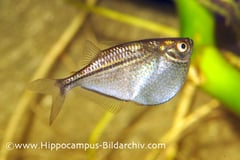
Gasteropelecus levisSilver Hatchetfish
Gasteropelecidae · Eigenmann, 1909
The silver hatchetfish (Gasteropelecus levis) is a freshwater hatchetfish found only in the lower Amazon basin in the state of Pará, Brazil. It spends almost all of its time at or just below the surface, and can leap from the water and glide for several metres to catch flying insects or escape predators. It lives in open water of larger igarapés, streams and floodplain lakes.
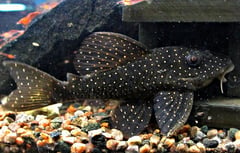
Hypancistrus sp.L004
Loricariidae · authority not recorded
L004, the angelicus pleco, is an undescribed Hypancistrus from tributaries of the lower Amazon near its mouth in Pará state, northern Brazil. It is sometimes traded under the false name 'Peckoltia angelicus', and the codes L004, L005, L028 and L073 represent distinct populations from the Tocantins, Guamá and Pará rivers. Peaceful but territorial towards its own kind, it has been bred in aquaria many times.
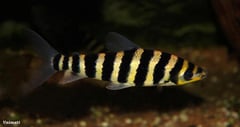
Leporinus fasciatusBanded Leporinus
Anostomidae · Bloch, 1794
The banded leporinus, Leporinus fasciatus, is an anostomid from the Amazon and Orinoco systems and coastal Guyana, Suriname and French Guiana. Young fish are often sold without warning of their size and requirements, and it is fairly ubiquitous in public aquarium displays. It is frequently confused with L. affinis, and its dark body bars multiply with age, from five in young fish to around ten in adults.
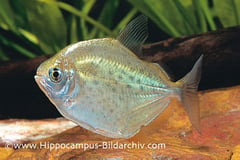
Metynnis lippincottianus
Serrasalmidae · Cope, 1870
Metynnis lippincottianus is a spotted silver dollar from Brazil and French Guiana, found in the lower and middle Amazon and the Oyapock system. It is occasionally seen for sale, sometimes as 'silver dollar', and its spotted pattern tells it apart from M. argenteus and M. hypsauchen. The spots are less pronounced than in M. maculatus, with which it shares a common name. The precise extent of its range is unclear.
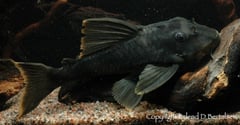
Peckoltia sp.L076
Loricariidae · authority not recorded
L076 is a Peckoltia species, a suckermouth catfish apparently collected from the rio do Pará near Portel in Pará state, northern Brazil. L076 and L099 appear to be the same species, the former showing a darker colour pattern by day, though both look similar at night. It spawns in caves and the male is responsible for brood care.