River
Iriri
Only species with a profile on Seriously Fish are counted.
- Species
- 7
- Families
- 5
- Photographed
- 7 of 7
- Difficulty rated
- 7 of 7
Basin
Also in the Amazon basinspecies recorded from both
Shares fishes with rivers elsewherespecies recorded from both
Runs through
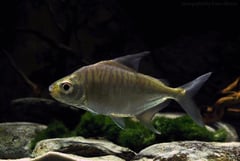
Acnodon normaniSheep Pacu
Serrasalmidae · Gosline, 1951
The sheep pacu, Acnodon normani, is a serrasalmid from Brazil, possibly restricted to the Xingu and Tocantins watersheds of the Amazon basin. Also known in the trade as 'tiger pacu', it is often said to be a frugivore or herbivore, but aquarium observations suggest it also feeds on the scales of other fishes. That makes it unsuitable for the community aquarium, although it does not seem to target much smaller species.
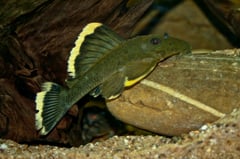
Baryancistrus chrysolomusMango Pleco
Loricariidae · Rapp Py-Daniel, Zuanon & Ribeiro de Oliveira, 2011
The mango pleco, Baryancistrus chrysolomus, traded as L047, is a loricariid endemic to the rio Xingu basin in Pará state, Brazil. A broad, usually yellowish band along the edges of the dorsal and caudal fins throughout life separates it from B. xanthellus, whose bands shrink to tips in adults. It grows to around 220 mm SL, and males in particular become highly intolerant of conspecifics as they age.
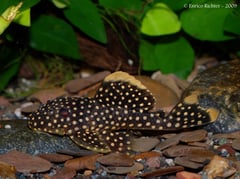
Baryancistrus xanthellusGold Nugget Pleco
Loricariidae · Rapp Py-Daniel, Zuanon & Ribeiro de Oliveira, 2011
The gold nugget pleco, Baryancistrus xanthellus, is a suckermouth catfish endemic to the rio Xingu basin in Pará state, Brazil. It lives in whitewater rapids in the Volta Grande do rio Xingu, between Belo Monte falls and the mouth of the rio Iriri. Before its description it was traded as L018, L085, L177 and LDA060, and L081 is the same fish. Males become highly intolerant of conspecifics as they age.

Geophagus argyrostictus
Cichlidae · Kullander, 1991
Geophagus argyrostictus is a cichlid known only from the rio Xingu system in Brazil, including its major tributary the rio Iriri. It belongs to the five species outside the G. surinamensis group, all with a complete infraorbital stripe, and fish over 70 to 80 mm SL develop silvery reflective scales on the anterior flanks. Markedly more aggressive than most congeners, it is a substrate-spawner and does best in a group of 5-8.

Hyphessobrycon heterorhabdusFlag Tetra
Characidae · (Ulrey, 1894)
The flag tetra, Hyphessobrycon heterorhabdus, is a characid from Pará and Maranhão states in eastern Brazil, also known as 'Belgian flag tetra'. Its name has been misapplied to similar fishes across much of the Amazon, the Orinoco and the Guianas, and the true species may reach no further upstream than the rio Tapajós. It lives almost exclusively in small, shaded forest streams called igarapés.

Iguanodectes spilurusGreen Line Lizard Tetra
Iguanodectidae · (Günther, 1864)
The green line lizard tetra, Iguanodectes spilurus, is a characin found throughout the Amazon, Orinoco, Essequibo and Tocantins river systems. The most widespread Iguanodectes species, it has also been called the 'slender', 'spindle' or 'iguana' tetra, and differs from its congeners in its translucent dorsal and anal fins, lack of a red lateral stripe and prominent dark caudal-fin marking. It is sensitive to poor water conditions.

Retroculus xinguensis
Cichlidae · Gosse, 1971
Retroculus xinguensis is a rheophilic cichlid from the rio Xingu basin in Brazil, with a handful of records from the Tapajós drainage. It occurs in rapids and fast-flowing stretches of clear water rivers, and differs from its congeners in having conspicuous dark bars on the caudal fin. It is available in the trade on a sporadic basis and needs a large set-up designed to resemble a flowing river, with water of 26 to 32 °C.