River
Jamanxim
5 profiles across 5 families name the Jamanxim as a locality.
- Species
- 5
- Families
- 5
- Photographed
- 5 of 5
- Difficulty rated
- 5 of 5
Basin
Also in the Amazon basinspecies recorded from both
Shares fishes with rivers elsewherespecies recorded from both
Runs through
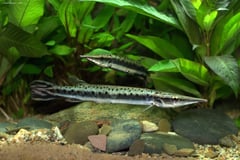
Boulengerella maculata
Ctenoluciidae · Valenciennes, 1850
Boulengerella maculata is a pelagic ctenoluciid found throughout much of the Amazon, Orinoco and Tocantins river systems. Colour pattern varies considerably, with some specimens much paler than others, and this may be correlated with water type. Random dark spots on the upper body, and a dark stripe only behind the eye when one is present, separate it from the similar B. lateristriga. It reaches 329 mm SL and needs an aquarium with base dimensions of 240 by 90 cm or more.

Colomesus asellusAmazon Puffer
Tetraodontidae · Müller & Troschel, 1849
The Amazon puffer, Colomesus asellus, is a freshwater puffer found throughout much of the Amazon basin, with records north to Guyana and Venezuela. Also traded as the South American puffer or 'SAP', it is told from congeners by a transverse row of dermal flaps across the chin. It lives mostly in well-oxygenated river habitats, is intolerant of organic waste, and forms loose aggregations, so a group of 6 or more is best, away from the general community.

Hyphessobrycon pulchripinnisLemon Tetra
Characidae · Ahl, 1937
The lemon tetra, Hyphessobrycon pulchripinnis, is a characid from central Brazil, mostly recorded from the rio Tapajós basin. It is bred commercially in several countries, but the origin of the aquarium strain is questionable. Fish identical to it have been photographed in the lower Xingu, while a related 'orange red' form from the Tapajós may not be the same species.

Retroculus xinguensis
Cichlidae · Gosse, 1971
Retroculus xinguensis is a rheophilic cichlid from the rio Xingu basin in Brazil, with a handful of records from the Tapajós drainage. It occurs in rapids and fast-flowing stretches of clear water rivers, and differs from its congeners in having conspicuous dark bars on the caudal fin. It is available in the trade on a sporadic basis and needs a large set-up designed to resemble a flowing river, with water of 26 to 32 °C.
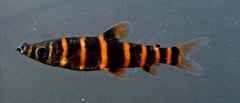
Synaptolaemus latofasciatus
Anostomidae · Steindachner, 1910
Synaptolaemus latofasciatus is a headstander from the upper Orinoco, the Casiquiare Canal and the middle-to-lower Amazon in Venezuela and Brazil. Described from a single specimen and placed in Leporinus until 2011, it was then recognised as the fish described as Synaptolaemus cingulatus. Alternating transverse bands of orange or yellow and dark brown or black run along the entire body, and snout shape and colour pattern vary with locality.