River
Tahuamanu
Only species with a profile on Seriously Fish are counted.
- Species
- 5
- Families
- 4
- Photographed
- 5 of 5
- Difficulty rated
- 5 of 5
Basin
Also in the Amazon basinspecies recorded from both
Shares fishes with rivers elsewherespecies recorded from both
Runs through
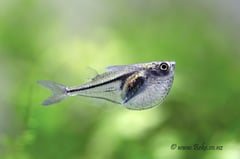
Carnegiella myersiPygmy Hatchetfish
Gasteropelecidae · Fernandez-Yepes, 1950
The pygmy hatchetfish, Carnegiella myersi, is a tiny freshwater hatchetfish from the Peruvian Amazon basin, with a second population in Bolivia. The smallest and most delicate of the nominal hatchetfishes, it has a shallower, rounded keel that gives it an elongate profile. It lives in small, shaded, shallow forest streams and must be kept in a group of at least six, away from active tankmates.
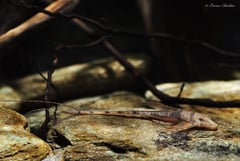
Lamontichthys filamentosusSturgeon Catfish
Loricariidae · La Monte, 1935
The sturgeon catfish, Lamontichthys filamentosus, is a loricariid from the central and western Amazon in Brazil, Peru, Ecuador and Bolivia. Above 60 mm SL the pectoral-fin spine extends into a filament that can be over four times the length of the first branched ray, and the dorsal-fin spine carries a similar extension. Relatively common in the hobby but not easy to maintain, it needs clean, well-oxygenated water and a mature aquarium with plenty of algae-covered surfaces.

Mikrogeophagus altispinosusBolivian Ram
Cichlidae · Haseman, 1911
The Bolivian ram, Mikrogeophagus altispinosus, is a cichlid endemic to the upper rio Madeira basin in Bolivia and Brazil. Also traded as 'hi-fin ram' and 'Bolivian butterfly', it is larger and less colourful than M. ramirezi and lacks its blue iridescent markings, and it is arguably a better choice for less-experienced aquarists. A soft, sandy substrate is essential, and it needs pristine water quality.
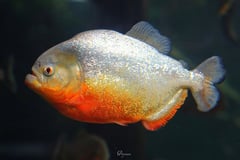
Pygocentrus nattereriRed Bellied Piranha
Serrasalmidae · Kner, 1858
The red bellied piranha, Pygocentrus nattereri, occurs through much of the Amazon basin and south into the Paraná and Uruguay river systems. Famed as a rapacious predator, it is among the most notorious freshwater fishes in the world. According to Herbert Axelrod (1976), the myth began with a feeding frenzy staged for Theodore Roosevelt in Brazil in 1913. Usually only juveniles form aggregations, and the species is relatively easy to breed in the aquarium.
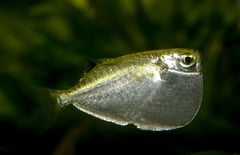
Thoracocharax stellatusSpotfin Hatchetfish
Gasteropelecidae · Kner, 1858
The spotfin hatchetfish, Thoracocharax stellatus, is the most widespread neotropical hatchetfish, recorded from much of South America. It is told from its only congener, T. securis, by a prominent dark spot in the dorsal fin, and is sometimes traded as 'platinum hatchetfish'. It feeds almost entirely on insects, and a tightly fitting cover is needed because it can clear several metres in one jump.