River
Takutu
Only species with a profile on Seriously Fish are counted.
- Species
- 4
- Families
- 3
- Photographed
- 4 of 4
- Difficulty rated
- 4 of 4
Basin
Also in the Amazon basinspecies recorded from both
Shares fishes with rivers elsewherespecies recorded from both
Runs through

Colomesus asellusAmazon Puffer
Tetraodontidae · (Müller & Troschel, 1849)
The Amazon puffer, Colomesus asellus, is a freshwater puffer found throughout much of the Amazon basin, with records north to Guyana and Venezuela. Also traded as the South American puffer or 'SAP', it is told from congeners by a transverse row of dermal flaps across the chin. It lives mostly in well-oxygenated river habitats, is intolerant of organic waste, and forms loose aggregations, so a group of 6 or more is best, away from the general community.
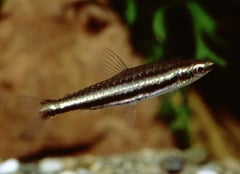
Nannostomus digrammusTwostripe Pencilfish
Lebiasinidae · (Fowler, 1913)
The twostripe pencilfish, Nannostomus digrammus, is a lebiasinid from the central Amazon basin in Brazil and the Rupununi basin in Guyana. Rare in the hobby, it usually arrives as bycatch among shipments of other fishes. It is most similar to N. bifasciatus but has an adipose-fin, and its small size and timid nature make it a poor community fish.
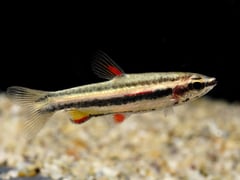
Nannostomus marginatusDwarf Pencilfish
Lebiasinidae · Eigenmann, 1909
The dwarf pencilfish, Nannostomus marginatus, is a lebiasinid of Guyana, Suriname and the middle-to-lower Amazon in Peru, Colombia and Brazil. Enduringly popular, it lacks the red body colour of males of the related N. mortenthaleri and N. rubrocaudatus, showing three dark lateral stripes with no red or purple between them. Colour varies between populations, and its small size and timid nature make it a poor community fish.

Satanoperca leucostictaWhitespot Eartheater
Cichlidae · (Müller & Troschel, 1849)
The whitespot eartheater, Satanoperca leucosticta, is a cichlid from the Guiana Shield in Guyana, Suriname, eastern Venezuela and northern Brazil. Farmed in several countries, it is frequently available in the ornamental trade. It is often confused with S. jurupari but is easily recognised by the prominent white spots or vermiform markings on the sides of the head. A larvophilous maternal mouthbrooder, it has been bred in aquaria.